The walls speak. But rarely with a single voice.
In the urban space, the poster is designed to be seen, consumed, then covered over. It lives quickly, disappears, and gives way to another. Yet, beneath this succession of images and messages, something persists: fragments, tears, layers. An involuntary memory of the city.
“Fragments / Posters: Skins of the City” explores these remnants. What remains after erasure. What escapes the control of communication and the perfect image.
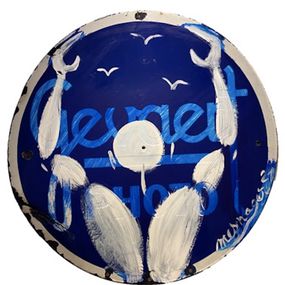
Through the practices of Mesnager, Lasveguix, and Wawapood, the poster is no longer merely a medium: it becomes matter. Torn, layered, altered, it reveals unexpected compositions where chance engages with artistic gesture.
Each work acts as an excavation. An digging of urban surfaces where broken typography, faded colors, and accidental forms intertwine. The wall becomes a living archive, a palimpsest where temporalities are layered without ever completely disappearing.
In this interplay of construction and destruction, the artists do not create ex nihilo: they extract, transform, and reinterpret. They reveal an aesthetic of the fragment, where the incomplete becomes language.
The exhibition thus invites us to look differently. To slow down. To pay attention to the details we pass by without noticing—and to recognize, in these remnants, a form of urban poetry.
Mesnager, a major figure in French street art, deploys his white silhouettes in the city like furtive and universal presences. His work evokes a discreet movement within urban space, between appearance and disappearance.
Lasveguix develops a raw and instinctive aesthetic, made of materials, layers, and visual tensions. His works reveal an urban energy where hybrid forms emerge, poised between chaos and construction.
Wawapood explores a free-flowing universe blending graffiti and illustration, populated by expressive and unconventional figures. His style plays on an ambiguity between apparent naivety and a darker depth.
This exhibition brings together practices rooted in the energy of reality, where the street becomes both a testing ground and raw material. Each work carries within it a story, a trace, a tension between appearance and disappearance.
Acquiring a piece is to grasp a fragment of this perpetually transforming urban memory—a singular work, both raw and sensitive, that permanently inscribes the intensity of gesture and time into a collection.
Read more