




France
•
1974
Nationality
Biography
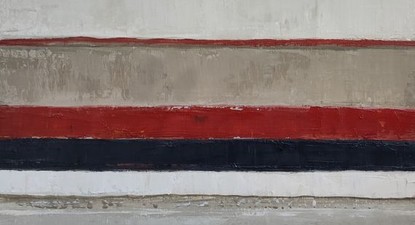
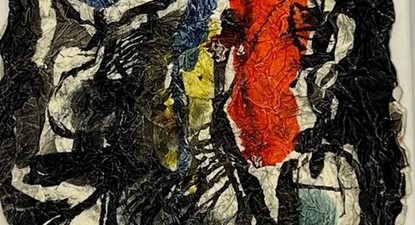
Fabien Gaillard, born in 1974 in Évreux, lives and works in Montpellier today. His pictorial practice is built around a research into matter, memory, and the relationship between the artist's intervention and the inherent qualities of the support.
Wood occupies a central place in his work. Noble essences or reclaimed wood marked by time are chosen for their singularities. Veins, roughness, nuances, and pre-existing traces are not concealed: they fully participate in the composition and sometimes guide the artist's gesture.
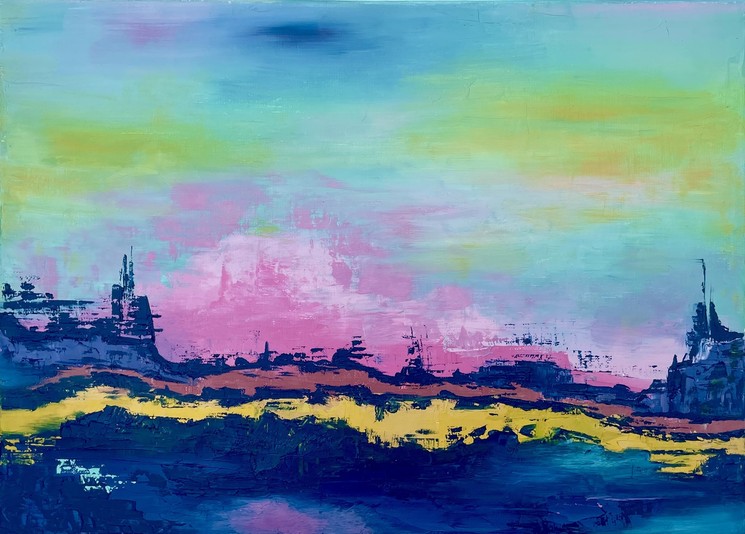
Fabien Gaillard favors fine acrylics and pigments that penetrate the fiber rather than cover it. Through plays of transparency, superposition, and impregnation, color reveals the structure of the wood as much as it transforms it. The paint thus seems to emerge from the support, creating a dialogue between pictorial matter and vegetal matter.
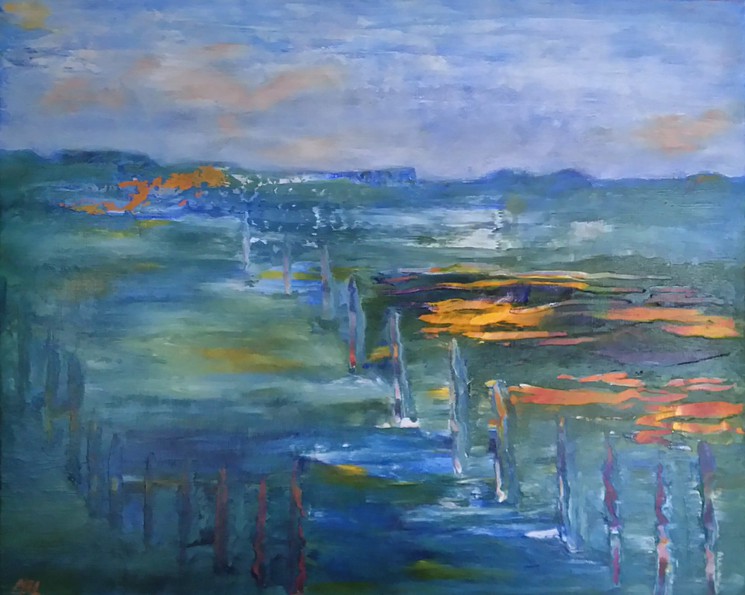
His universe finds particular origin in a poetics of the path, envisioned as a space of passage and memory. To this notion responds the silent presence of megaliths and standing stones, whose monumentality and permanence nourish his formal vocabulary.
Monolithic forms thus emerge from more fluid compositions, confronting the stability of stone with the movement of matter and pigment. More than a representation of reality, these mineral presences become essential forms, almost archaic, which contrast with the organic richness of wood.
This encounter constitutes one of the foundations of his work. Stone evokes permanence and a temporality that transcends the human scale; wood, in turn, retains the memory of the living, of its growth and its transformations.
Between these two temporalities, Fabien Gaillard seeks a balance: between mineral and vegetal, permanence and alteration, mastery of gesture and unpredictability of matter.
His works become territories of passage where each surface retains a part of its history.
Through this research, Fabien Gaillard develops a painting where the support is never simply the place of the work: it becomes one of the subjects. Wood, pigments, and mineral forms compose a sensitive plastic language, carried by a reflection on time, trace, and the deep relationship that unites the living to matter.
Explore all artworks (6)