Spain
•
1968
Enrique explored every artistic language before settling on figuration, painting and drawing the human figure, landscapes and overlooked everyday things as a constant reflection on the act of living.
Nationality
Themes
Biography
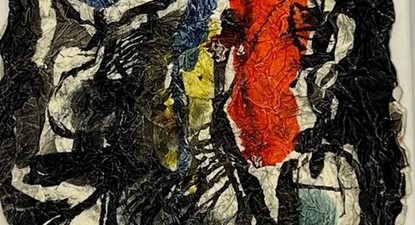
Enrique Gonzalez began in the world of art in childhood, self-taught and complemented by various art courses. In adolescence, through one of their painting teachers, the artist was introduced to printmaking, which became one of their main media for a long period. These were years of searching and deep experimentation, in which the work passed through abstraction, Expressionism, Cubism, figuration, Minimalism, Arte Povera, social realism, geometric art and Pop, driven by a vital need to explore every field of art. A voracious and unsystematic reader, the artist devoured books on aesthetics (Stravinsky, Tàpies, Kandinsky, Paul Klee, Tristan Tzara, Tanizaki and Rainer Maria Rilke, who became a major influence), philosophy (Valmiki, Tagore, Krishnamurti, Nietzsche, Taisen Deshimaru, Lao Tzu, Ibn Arabi and Rumi) and poetry (the Spanish Generation of '27, Walt Whitman, Goethe, Schiller, Hölderlin and Rimbaud). The same teacher also initiated them into a deep, perceptive understanding of music, from classical and jazz to rock and singer-songwriters, which has strongly influenced their life and work. After several decades of training and searching, the artist found a solid path within figuration, focusing on the human figure, landscape, small animals, birds and objects that go unnoticed in daily life, and returned to painting and drawing, the media they work in today. The essence of the work can be summed up as a constant reflection on the simple yet complicated fact of living. The artist has exhibited widely, in solo and group shows in Spain and abroad, takes part regularly in international art fairs and serves on the juries of prestigious art prizes. In 2006 they founded Grabado y Edición, the first and only magazine in Spain devoted to printmaking and art editions, and in 2013 created Enigma, the only publication in Spain produced by lithographic means. Their work is held in collections including the Museo Reina Sofía, the Calcografía Nacional and the Biblioteca Nacional de España in Madrid, the Congreso de los Diputados, the Fundación Fuendetodos Goya, the Fundación CIEC in Betanzos, the Museo de Arte del Tolima in Colombia and The Hispanic Society of America in New York.
Explore all artworks (2)