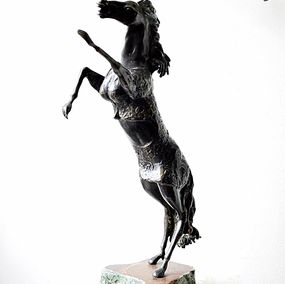
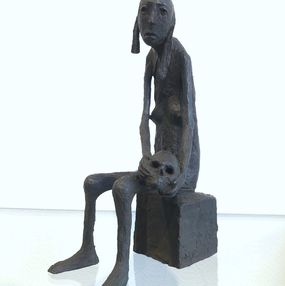
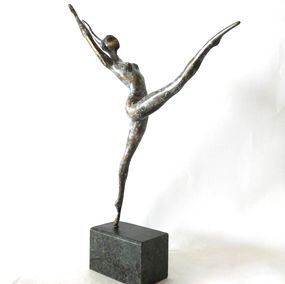
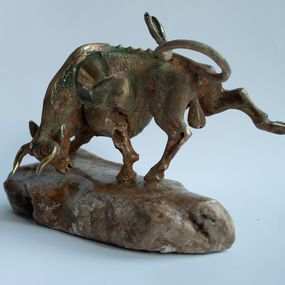
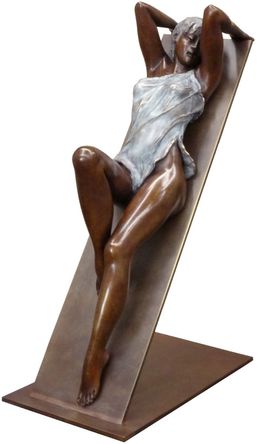
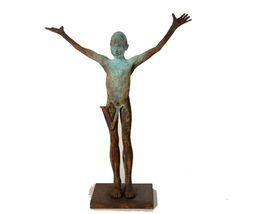
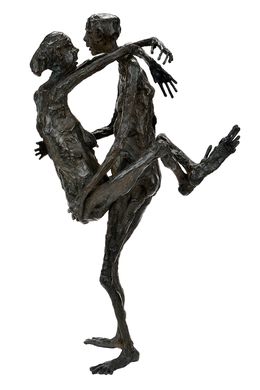
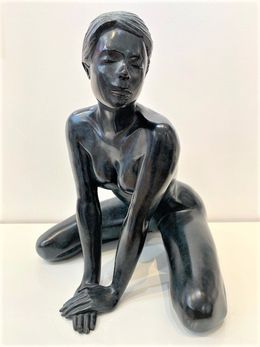
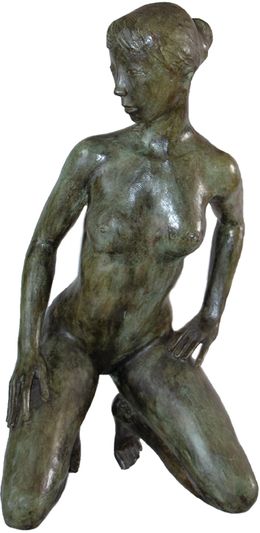
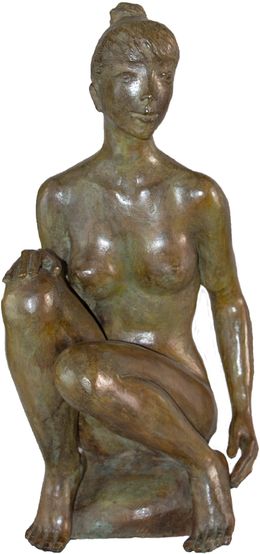
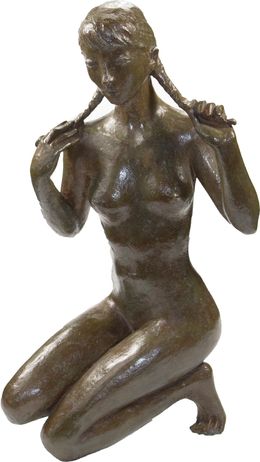
Bronze sculpture realized with double patina green and brown.
Stamp signed in the base, with stamp of foundry.
Very good condition.
Misha Frid (born 22 November 1938, Moscow, USSR) is a Russian-born sculptor whose practice is principally associated with figurative bronze sculpture. Trained in Moscow before emigrating from the Soviet Union in 1972, Frid developed an international career in North America, producing an extensive body of sculpture characterized by elongated figures, rhythmic movement, and recurring references to music, dance, theatre, and the natural world. He has worked in the United States and Canada and is associated in particular with Toronto and, more recently, the San Francisco Bay Area.
After settling in the United States, Frid became an American citizen in 1978. During this period he also developed a relationship with Erté (Romain de Tirtoff), the Russian-born French artist and designer whose elegant, elongated figures and theatrical aesthetic offered an evident point of affinity with Frid's developing sculptural language. In 1984 Frid and his family relocated to the Toronto area, where he established a substantial part of his subsequent career. His presence in the Canadian art world during the 1980s is independently documented by the Toronto Star photographic archive, which records him in his studio in November 1988 alongside the bronze Sheer Delight.
Frid's mature work concentrates overwhelmingly on the human figure. His bronzes frequently elongate and simplify the body rather than treating anatomy naturalistically. Figures stretch, balance, dance, perform, or interact with musical instruments, and the verticality of the compositions is often counterbalanced by sweeping curves and theatrical gestures. Music is among the most persistent themes in his oeuvre: violinists, harpists, cellists, flautists, and allegorical muses recur throughout his production. Other sculptures derive their imagery from ballet and performance, particularly Swan Lake. In these works the body functions less as portraiture than as a vehicle for rhythm and movement. The resulting aesthetic combines recognizable figuration with a decorative stylization that reflects Frid's sustained interest in music, ballet, and Art Deco.
During the late 1980s and 1990s Frid's work circulated extensively through international art fairs and commercial galleries. He exhibited at International ArtExpo in New York and Los Angeles and participated repeatedly in the Tokyo International Art Show during the early 1990s. His sculpture was consequently distributed well beyond Canada and the United States into private, corporate, and institutional collections.
An important public commission followed in 1991, when Frid won a Toronto public-art competition for Lady of the Lily, a monumental bronze approximately ten feet high. The work exemplifies the combination of elongated figuration, elegance, and upward movement characteristic of his sculpture. His international activity continued with participation in the SIART cultural-exchange program in Seoul in 1993.
Sport provided another significant theme during the following decade. In connection with the centennial 1996 Olympic Games in Atlanta, Frid produced the bronzes Equestrian, Gymnast, and Stadium Jumper. The three works translate athletic motion into the same vocabulary of balance and rhythmic extension that he applied to dancers and musicians. They were subsequently incorporated into the collection of the American Sport Art Museum and Archives in Alabama.
Frid's production was not confined exclusively to bronze. He has worked in drawing and graphic art and experimented with other sculptural materials, including crystal. Nevertheless, bronze remains the medium most closely identified with his oeuvre. Auction records continue to document examples of his characteristic figurative sculpture, including Odette, Woman with Bow (1996), Harp Player and His Muse, Pied Piper and His Muse, and Violin Player and His Muse. These works also demonstrate the use of limited editions and contrasting patinas that became characteristic features of his commercial bronze production.
Frid later returned to the United States, settling in the San Francisco Bay Area. His later activities have extended beyond sculpture into film and cultural projects. Particularly significant is his sustained engagement with the imagery of Swan Lake. He donated a sculpture on this theme to the Saint Petersburg Conservatory and subsequently collaborated on the documentary Swan Lake in Bronze (2013), which explored the relationship between sculpture, ballet, and music.
Viewed within the broader history of post-war émigré art, Frid's career occupies an unusual position. His work does not belong to the conceptual and unofficial-art tendencies most commonly associated with Soviet émigré artists of the 1970s. Instead, he maintained a fundamentally figurative and technically traditional sculptural practice while developing a highly recognizable language of stylized movement. His emigration allowed that practice to move into an international gallery, art-fair, public-commission, and editioned-bronze market largely unavailable to him in the Soviet Union.