Born in France in 1955, I have lived and worked in Jerusalem since 2015. I began painting with a friend in an evening class in high school. He loved to draw, I loved to paint. We both entered the Institut d'Arts Visuels in Orléans (1975/76), and then I was admitted to the Art Department at the Villa Arson – École Nationale Supérieure d'Arts in Nice – (1976/79). After graduating, I trained as a house painter and then studied to become a psychiatric nurse (1980/83). I already knew a little about hospitals and their patients, having worked there every summer as a ward attendant during my studies at the Beaux-Arts. Becoming a psychiatric nurse and then a nursing supervisor at the Georges Daumezon Mental Health Center in Loiret, I combined painting and psychiatry almost daily. Along with fatherhood and Judaism, they were my only true sustenance.
In Orléans and Nice I had discovered the beginnings of abstraction, Support Surface, American painting but also prehistoric painting - the birth of art according to Bataille - , the Quattrocento and Chinese painting.
We had to know "everything" about the works that preceded us, and particularly those of the 20th century.
We had to, in a way, answer for our own actions before them. All the avenues of contemporary art were open to us. Somewhat against the grain, I chose painting rather than Duchamp.
At the beginning of my nursing studies, I also met André Robillard. He lived at the hospital, where he drew, assembled, piled up, and collected in what served as both his home and studio.
I was discovering the raw art of "ordinary men at work," to use Dubuffet's phrase, but also the expressions of madness, as Oury and Maldiney described them. Whether in the often ephemeral works of patients: poems, drawings, confidences, words, coming from the depths of their being, or in the writings of Antonin Artaud.
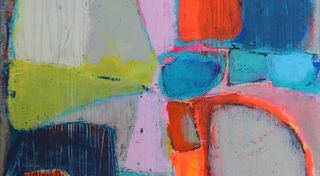
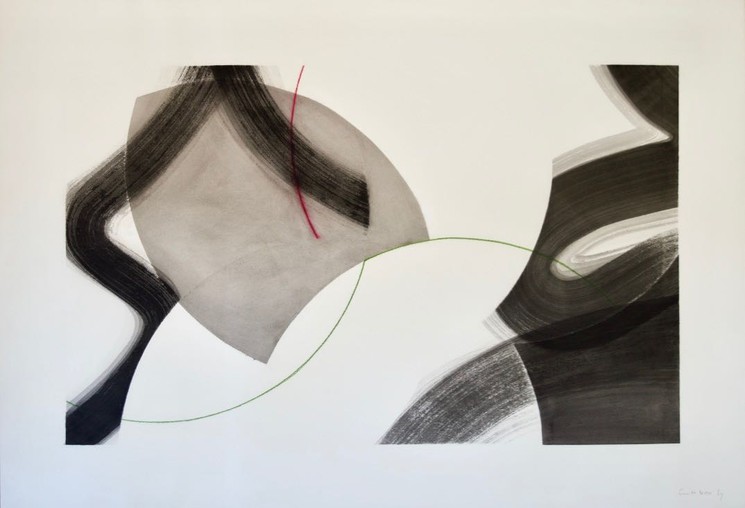
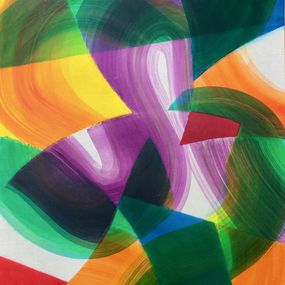
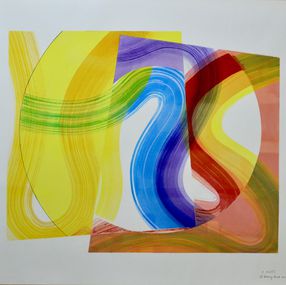
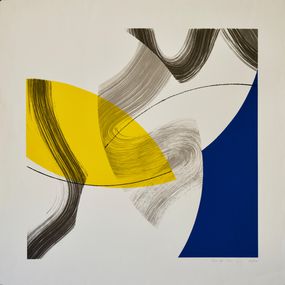
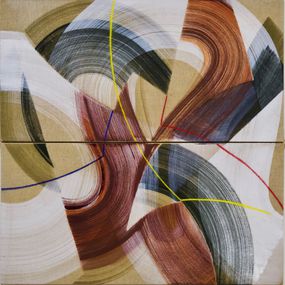
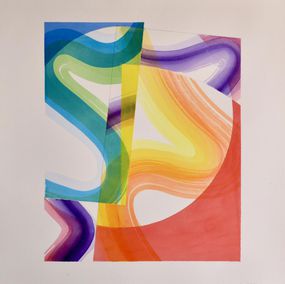
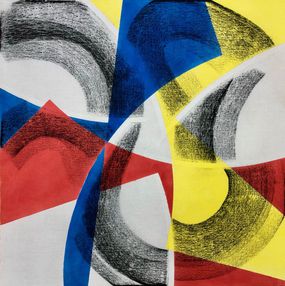
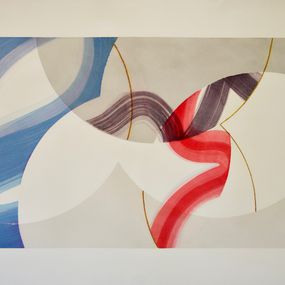
In 1984, after a detour through landscape, still life and self-portraiture, I returned to painting where I had "left" it. That is to say, at the heart of a geometric diamond composition created in Nice in 1977. I returned to my practice: working on a flat surface, compositional lines exceeding the format of the painting, while moving away from the expressionism and immediacy of the beginnings, with slow gestures, transparent and liquid colors.
I started working from compositional principles drawn from art history and geometry (circular symmetry, Borromean knots, harmonic progression of the square, geometric construction of the Golden Ratio and then, harmonic decomposition of the square, rectangle and spiral of harmonious growth by Matila Ghyka).
It all begins randomly, like a roll of the dice: the placement of geometric shapes on the canvas or stretched paper, based on the principle of composition. Each shape carries the design of the six or seven others that compose it: lines and forms emerge from this interweaving, itself the source of many more to come. Flat gestures and lines, white, black, or colored, will, in turn, anchor themselves to these creations in the unforeseen nature of a form of "free association."
Each element has its own life; it is first drawn or painted "in white" in order to imagine and anticipate when, where and how they might be placed in the painting.
I paint them by obscuring their surroundings and discover, in retrospect, the patterns resulting from their juxtaposition. The application of the layers itself decomposes over time, and the transparency allows the different strata of the painting's emergence to be perceived. Without sketches or preliminary work, I generally work on several paintings simultaneously, sometimes up to five or six. The more there are, the more easily I can forget them and rediscover them with surprise.
I intervene at least once in each session, without regret, on a part of each of them. It is only in this way that I manage to appropriate their appearance.
In 1989, in the paragraph entitled Epiphanies from the "Notes" compiled to present the exhibition of works from the "Compositions" series, I wrote: "The fascination exerted on me by the minute changes produced by the application of a layer on the canvas was undoubtedly the driving force behind this 'repetitive' practice. The abandonment of repetition occurred when, along the way, I discovered that its justification lay not in the purpose I had initially assigned it (to produce unique colors) but rather in the possibility of being able to paint with and on what fascinated me."
In essence, this is still true today.
I remain fascinated by the unfolding of the painting's appearance: the first moments of the painting, the unexpected advent of its drawings, the gradual rise of its intensity, and I try to paint in such a way that everyone can glimpse this path as much as the landscape onto which it opens.
P.S.: My works have been exhibited in France and Israel and are featured on several contemporary art websites and in galleries. Two catalogs published by the Centre d'Art Contemporain de la Scène Nationale d'Orléans have been dedicated to my work, featuring texts by the painter Christian Bonnefoi ("The Pose of Time") and the art historian Tristan Trémeau ("Painting with Restraint"). I have also written extensively about my work, as well as the artistic workshops and cultural projects I have led in hospitals.
Co-founder of the artists' collective "Le Pays Où le Ciel est Toujours Bleu" I was also from 2000 to 2015 responsible for cultural projects at EPSM Georges Daumezon, in particular the establishment of an "Art and Architecture" artist residency in partnership with the Frac Centre, but also the creation of a monumental rifle with André Robillard as part of the centenary of the establishment.