The imaginary country of Zahra Zeinali
"What can a true artistic temperament aspire to after a youth spent in Iran today? To flee worries, prejudices, restrictions, to open wide a window of freedom rich in potential that was long thought inaccessible. Zahra Zeinali became a visual arts teacher for fifteen years. Her students were aged 6 to 12. Drawing, sculpture, painting, model design, she taught them a wide variety of techniques, but above all to think and design freely for themselves, in an atmosphere of joyful creative disorder that, surprisingly, was tolerated by a scrupulous hierarchy. Then she spent four years at the University of Art and Architecture in Tehran.
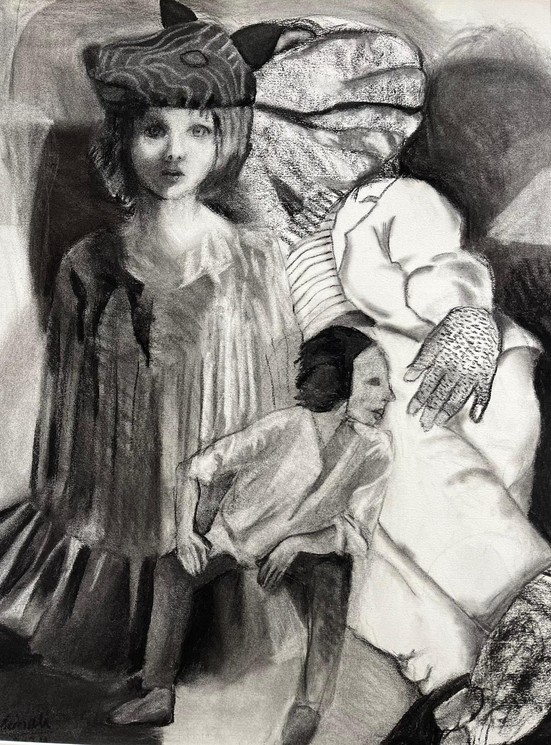
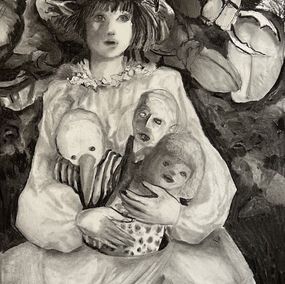
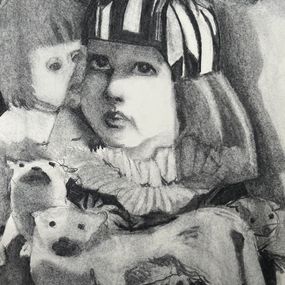
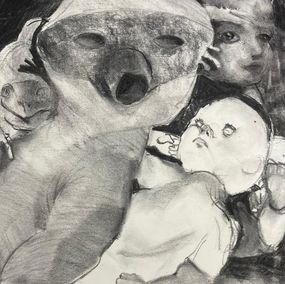
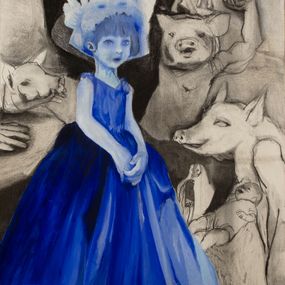
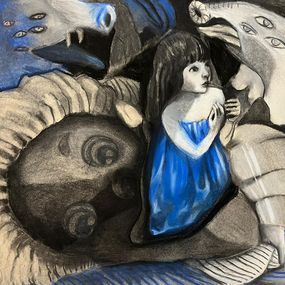
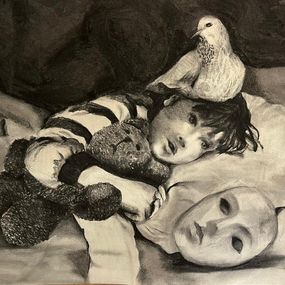
When she arrived in France, after a brief abstract period inspired by the rhythms of nature, it was at the time of the Charlie Hebdo and Bataclan attacks, which left a deep mark on her, to the point of lastingly darkening the ideal of emancipation and autonomy that she had projected onto her stay in Paris. "There is no paradise on earth," she concluded with a melancholy smile. An old doll, bought for 1 euro in a storeroom, triggered something in her. The bitter imprint left by Iranian confinement, the memory of her fifteen years of children's classes, the solitude of Parisian exile, all this sentimental nebula finds a plastic metaphor in the image of the doll. What these delicate earthenware faces evoke, often mistreated, abandoned, the childish innocence of their ingenuous looks, a sort of strange absence from the world of the living, as if their attenuated life took place behind the mystery of a theater curtain, in the hinterland of the wings, on the margins, at the confines of society and life. In each painting the same little girl returns, prey to a recurring dream, lost in an unknown, hostile environment…
The staging of the canvas or drawing is subject to a clever, slightly theatrical disorder, evoking the happy coincidences of bric-a-brac at flea markets. His unconditional admiration for Goya probably inspires his taste for chiaroscuro, for a vibrant and lively material. Painting that touches the human and the sensitive. Memory of life and pictorial passion inextricably mix in an almost organic synthesis.
Over time, Zahra Zeinali develops her universe, which slowly evolves according to the Unconscious, a vast underground life, stirring, agitated, that a hypersensitive artist such as Zahra does not seek to control. Autobiographical elements surface through the dreaminess of her painting. Naturally gifted for drawing, after nine years spent in France, her work speaks to us with a more detached tone of her experience as an Iranian emigrant, fleeing the restrictions of her country in the hope of tasting French freedom.
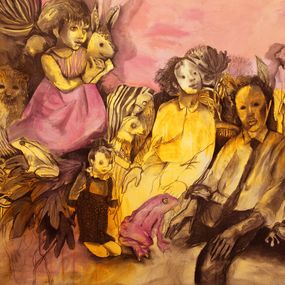
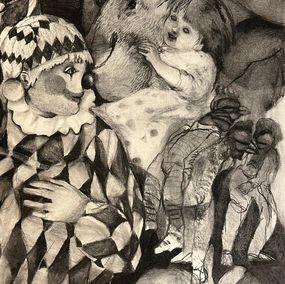
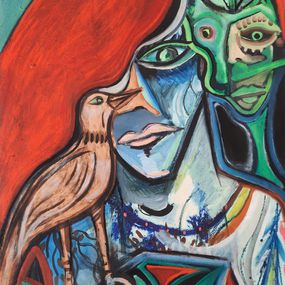
Innocence in the grip of a hostile environment, innocence symbolized by dolls with candid eyes, but mistreated, broken, such is apparently the major theme of her paintings, which, by progressive shifts, moves towards a less dark, more playful atmosphere, close to Alice in Wonderland, legendary heroine confronted with strangeness and the angel of the bizarre. Zahra follows in her footsteps, in a world in perpetual transformation. Masks, by nature, hide cruel truths, slightly disturbing clowns approach everyday life by roundabout ways, little girls whisper secrets to each other in dark corners. As in Alice, wolves, foxes, exotic birds, all sorts of animals emerge, adding a singular note to the enigma of existence.
Passionate about the art of photography, which she studied in Paris, Zahra sometimes takes photos in anticipation of the painting in progress. Hence the clever disorder of the bold, unusual, very free layouts of her compositions. It is not without profound reasons that the painter feels an affinity with the Portuguese Paula Rego, her bitterness, her own universe of broken dolls, her admirable neo-classical technique which does not forbid itself sneering and sarcasm.
Both express their feelings, sometimes painful, sometimes humorous, but served by the beauty of the drawing and the nobility of the material.
A real painter."
Xavier BUREAU, 2022