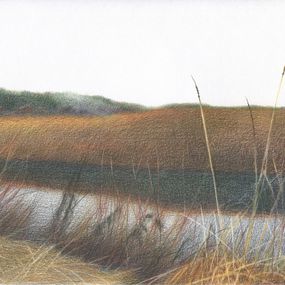
Taisiya Korotkova's work invites reflection on a disturbing duality: technological advancement versus humanity's instinctive regression.
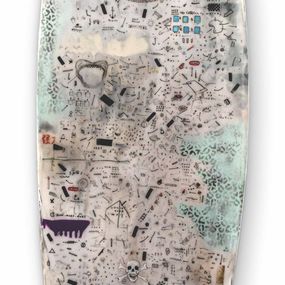
The "Dark Forest" series continues the artist's exploration of the relationship between humans and technology. It consists of numerous felt-tip drawings on the back of waxed kitchen canvases of various sizes, from 280 x 950 cm to miniatures.
In this project, Korotkova imagines the present and future in which humanity, guided by primitive instincts, has utilized destructive high technologies. There are no more men, only the ruins of military facilities and nature, slowly dissolving the remains of the so-called "civilization."
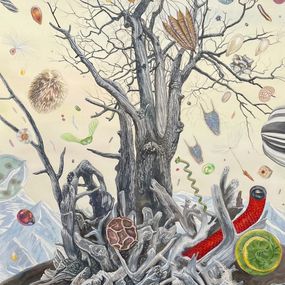
The drawings evoke fairy tale illustrations, reinforcing the impression of an almost mythological warning. The plants depicted have magical and medicinal properties, standing in front of the ruins, testifying to the resilience and ancient wisdom in the face of the rapid obsolescence of human "civilization."
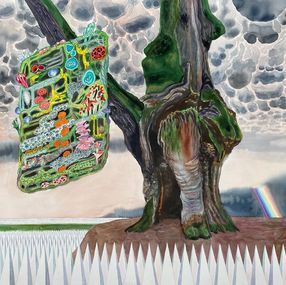
Notable elements in this drawing:
Dagdiesel
Dagdiesel Shop No. 8 is a test facility for underwater torpedoes at the Dagdiesel Machine Building Plant in the city of Kaspiysk, Republic of Dagestan.
Weeping willow (Salix)
A hybrid of Babylon willow (Salix babylonica), white willow (Salix alba), brittle willow (Salix fragilis) and charming willow (Salix blanda). Willow bark has antibiotic
properties. In folk medicine, bark infusions are used to treat colds. Salicylic acid was first discovered in willow, hence its name.
Cane (Phragmites)
A common genus of large perennial herbaceous plants. It grows in large thickets along
river bank sand deltas in countries with warm and temperate climates. Cane was traditionally used to make roofs, hedges, wicker walls, or insulation.
Submarine bunker
A submarine bunker is a specialised type of underground enclosure, first created in Germany to protect their submarine bases from air raids. The bunkers were also used sometimes to repair and assemble the submarines.
Sunk barrels with unidentified contents
According to the fragmented and faded recollections of merchant fleet sailors, who operated the vessels carrying chemical warfare agents, in the 1950s there were top secret journeys, where the captain would receive a sealed package with instructions:
to be opened in a certain location out in the White Sea and throw overboard the ship's cargo. These were strange containers and barrels, and the crew were unaware of the contents. All seafarers involved had to sign a non‑disclosure about these operations.
« The Dark Forest by Taisia Korotkova is the first total installation by the artist. [] It is not so much an impassable pristine thicket, but a slightly deserted world fair, where looming behind the laces of branches are outlines of grand and mysterious structures, there to showcase all sorts of wonders of progress: towers and domes, antennae and radars, missile silos and power generators. []
The new proiect by Taisia Korotkova continues on the themes that the artist began exploring in her past painting projects. In the series Technology, Museum of Cosmonautics, Closed Russia and others, she looked at the mythology of progress and achievement, the legacy and ruins of the sci-tech utopia.
Taisia's medium of choice, tempera, was deliberately anachronistic, which presented her narratives through a lens of an artificially distant perspective. The ruins of abandoned Soviet defense installations were reminiscent of the ruins as depicted in Romanticism, and the spacesuits in the museums seemed as ancient as Egyptian sarcophagi.
In the Dark Forest, Taisia Korotkova goes for a drastically different technique and scale. Painting is replaced in favor of black-and-white drawings, which, according to the artist, is a reference to old Art Nouveau illustrations in old fairy tales: a dark forest is first and foremost a fairy-tale setting. [] Images look even more refined than Taisia's past paintings, small and meticulously detailed - yet, they do not allow the audience to maintain any distance by surrounding the viewer with the dark forest, the one which leads astray. Their incorporeality is the incorporeality of the omnipermeating specter.
The Dark Forest invites a description as "hauntological." Coined by Jacques Derrida, the term "hauntology" was first introduced in 1993 in his Specters of Marx. By the late 2000s, through the works of British thinkers and music critics Mark Fisher and Simon Reynolds, hauntology came to denote a genre of electronic music-thus becoming a trend in contemporary culture, engrossed in a nostalgia for unrealized futures. In Fisher's eyes, the claustrophobia of the eternal present and the inevitability of capitalism were connected, to a large degree, with the collapse of the Soviet Union. []
Although most structures depicted in Taisia Korotkova's Dark Forest works are functional and come from the military-industrial complex, when surrounded by greenery in the monochrome "tapestries" they look like whimsical architecture utopias (utopias that could be produced by any people in any historical period).[]
Other structures depicted in the Dark Forest have also attracted "stalker" pilgrimages, visits by urban explorers, or mentions in conspiracy-themed folklore around formerly secret sites. The artist refers to the "stalker" subculture and, too, to the movie by Tarkovsky, which is part of the "hauntological canon." The multitude of social media communities have made these ruins almost a kitsch item (also noted by Brian Dillon) - joining the ranks of such clichés as romantic ruins in old paintings or postcards, becoming the familiar elements of "picturesqueness" and Taisia Korotkova makes a play on it by drawing her works with a marker on the backside of a tablecloth. It would not be too much of a stretch to imagine that similar landscapes with test sites and bunkers could soon adorn table covers or shower curtains, like the Eiffel Tower or old lighthouses do now.
We are not faced with a "dark forest" but with a full-blown "park of ruins." In place of nature prevailing over civilization, here is a botanical garden, where all plants are actually artifacts and not products of wild nature. The "herbarium" collected by Taisia Korotkova contains both grasses and monumental trees, but there is an additional rubric for flora that possesses magical, medicinal or intoxicating potency, or, in other words, a power to manipulate reality.
The Dark Forest brings to mind the renowned project by Pierre Hughe at dOCUMENTA (13). A lost world of bogs, marijuana bushes, a stature with living beehive in place of a head, and a white dog with a pink paw - a world which, by the artist's own admission, was a "composting pit" whereto all the various objects found on-site went to "rot," and, ultimately, for this "humus" not to return into nature but to produce new cultural apparitions. The "nature" itself in the Dark Forest seems a construct, a decoy, a mimicry act by the collective memory. In this case, it is the culture and the past, which poses as nature, that prevail over modernity and progress with its ambitions for the future, they get grounded and enveloped in roots. And this "nature" is by far not going to "heal". »
Irina Kulik