












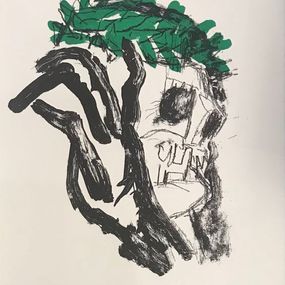
Skull, 1924
Print : · 27.5 x 19.5 x 0.3 cm 10.8 x 7.7 x 0.1 inch
Sold
Authenticity guaranteed
Sold with certificate of Authenticity from the gallery
Invoice from the gallery Learn more
Secure payment • Card, Amex, PayPal...
We accept several payment methods:
Paypal
American Express
Visa
Mastercard
Apple Pay
Google Pay
- Credit cards (Visa, MasterCard)
- American Express
- PayPal
- Bank transfer
- Gift card
- Apple Pay / Google Pay
All payments are secured with 3D Secure validation to protect your confidential information.
Verified Reviews : 9.6/10
Similar works


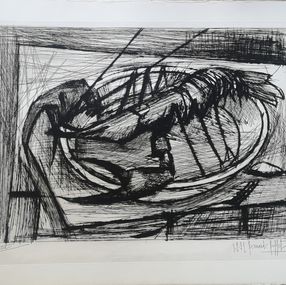
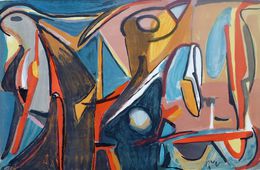
Bernard Buffet
Print . 56.5 x 75.5 x 0.1 cm Print . 22.2 x 29.7 x 0 inch
€3,500
Recommended by Artsper






About the artwork
Type
Print : numbered and limited to 70 copies
Condition
Artwork sold in perfect condition, not framed
Authenticity
Sold with certificate of Authenticity from the gallery
Invoice from the gallery
Signature
Hand-signed by artist
Technique & Support
on paper
Dimensions ( cm • inch )
27.5 x 19.5 x 0.3 cm 10.8 x 7.7 x 0.1 inch Height x Width x Depth
Sold by
Art gallery
Credentials
Vetted seller since 2019 • Top Seller
Description
Skull is an original etching and drypoint, realized by Otto Dix in 1924, Hand-signed and numbered 8/70, plate 31 from the “Der Krieg” portfolio - titled in German " Schädel". Printed by O. Felsing, Charlottenburg, published by Karl Nierendorf, Berlin.
The single sheet is removed from the larger portfolio of 50 works. References: - Quoted in Maria Tatar, Lustmord: Sexual Murder in Weimar Germany, Princeton University Press, 1995, p. 77. - Dix, cited in Eva Karcher, Otto Dix, New York: Crown Publishers, 1987, p. 16. Included a wooden frame. In excellent conditions. Here the artwork is representing a skull which is spoiling and rotting, with nake-shapes and vegetal forms in it mimicking decaying flesh. He is always inspired by these nightmarish scenes that are based on his memories of battle. Dix was interested in social satire and tried to develop a grotesque, exaggerated aesthetic.
Wilhelm Heinrich Otto Dix (1891–1969), is best known for paintings and prints with anguished, exploited human figures representing the terror and drama of his time. He lived during the most difficult and disasters period of modern German history, This fed his deep-rooted interest in dark social contexts and the human types that emerge from them. As he remarked, “You have to see man in an unbridled state in order to know something about him.” most of his artworks shows showing the devastating effect of war, he said “I had the feeling that there was a dimension of reality that had not been dealt with in art: the dimension of ugliness.”
Presentation
The painter Otto Dix left a mark on Germany with his piercing, sincere and believed gaze on society. It represents the vices, the fears, the violence, the ugliness, which are part of life, as well as beauty.
Born in 1891, he was introduced to the art early on by his mother. He joined the School of Applied Arts in Dresden in 1909. At 24, when he wanted to become an artist, he was mobilized for the war. On the front, he does not give up his artistic practices and continues to draw.
He is deeply marked by the violence of war, and represents the darkest moments he witnesses. Witness and actor of horror, he accepts the fact of seeing this to evolve. As he reads in Nietzsche, Man must be in an extreme situation to create. He was injured several times, but never gave up drawing.
At the end of the war, he returned to his parents and then joined the Academy of Fine Arts. He is interested in new trends such as Dadaism, but quickly becomes attached to reality to the detriment of abstraction. It then shows the reality of the human being, its darker sides. But the company is not ready to see what he shows, and his works are not selling well.
He settled in Düsseldorf and made many encounters, notably that of Johanna Ey, who ran a bakery frequented by artists. She opened a gallery and welcomed all these artists, including Otto Dix, whom she took under her wing and whose work she would strongly influence. She sells her first works, she who also defended art against war.
Otto Dix explores the themes of vices, old age, ugliness, which are part of life. He meets his future wife Martha Koch when he paints her husband's portrait. His career is booming. He makes many portraits, very realistic, where he strongly emphasizes his first impressions of the subjects. It doesn't embellish anything. In 1923, his wife gave birth to their first child, whom he represents many times and which will give a more joyful tone to his work, but this period will be short-lived.
His series “The War" is extremely striking. 50 etchings evoke his memories of the war. Horror, death, suffering, violence, as he himself saw them. In 1925, he was then very famous, he was a major artist in Germany.
He moved to Berlin, which came back to life after the war and embarked on a period of celebration and debauchery. His paintings represent extreme personalities, between bourgeoisie and vulgarity. It shows the prostitutes, the women we sometimes refuse to see.
Fascinated by women, he makes many portraits of Anita Berber, who is very liberated, very provocative. She dances the dance of vice, horror and ecstasy, and often extols the merits of cocaine. The scenes of sex and aggression inspire him, and, like Freud, he questions inner impulses.
In 1930, he painted his anxieties, but also, by extension, those which hover over Germany at the rise of National Socialism. He knows that his paintings are not in accordance with the principles of the regime. And his doubts were confirmed when in 1933 he was dismissed from the Academy of Fine Arts where he was teaching. Art comes under the control of the Nazi regime.
Its great triptychs, however, encourage people to reject war. He will then withdraw during the Second World War. In his landscape paintings, one feels the melancholy and loneliness, the gravity of the events that he cannot represent. Its landscapes echo the horrors of war. He represents himself worried and presages disorder and violence. However, he was mobilized at the end of the war. When he returns, the loss of hope is total, he shows his incomprehension through religious symbolism.
He died in 1969 of a stroke. He will have shown society what it has always repressed: violence, impulses, ugliness, in a unique and independent style ...
Discover similar artists



Reviews from our customers
All our reviews are extracted from Verified Reviews
You may also like


Salvador Dali
Print . 76 x 56 x 0.1 cm Print . 29.9 x 22 x 0 inch
€1,800
Salvador Dali
Print . 76 x 56 x 0.1 cm Print . 29.9 x 22 x 0 inch
€1,800
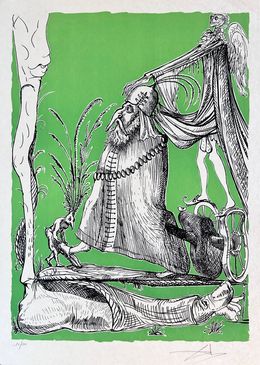
Salvador Dali
Print . 76 x 56 x 0.1 cm Print . 29.9 x 22 x 0 inch
€1,800

Salvador Dali
Print . 43 x 32 x 0.1 cm Print . 16.9 x 12.6 x 0 inch
€1,300
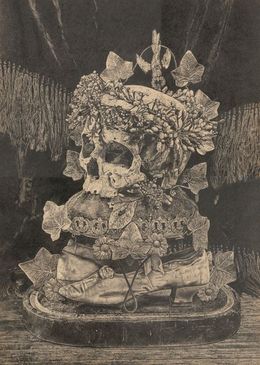
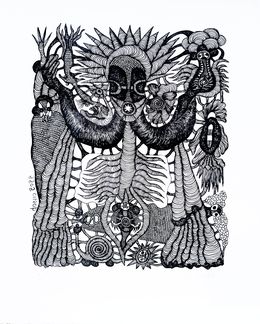
Odona Bones
Fine Art Drawings . 40 x 29 x 0.1 cm Fine Art Drawings . 15.7 x 11.4 x 0 inch
€3,000

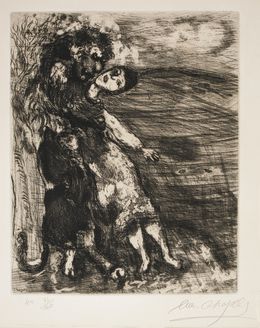
Marc Chagall
Print . 42 x 33.5 x 0.1 cm Print . 16.5 x 13.2 x 0 inch
€4,000
Recommended by Artsper

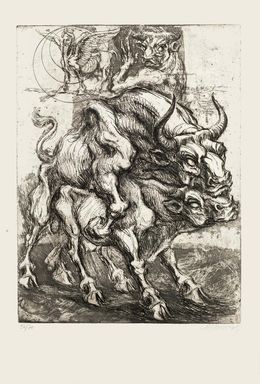



Ossip Zadkine
Print . 53 x 69 x 0.2 cm Print . 20.9 x 27.2 x 0.1 inch
€350

Leonardo Aliaga
Fine Art Drawings . 41 x 28 cm Fine Art Drawings . 16.1 x 11 inch
€380

Catherine Gran
Fine Art Drawings . 56 x 38 x 0.1 cm Fine Art Drawings . 22 x 15 x 0 inch
€3,900

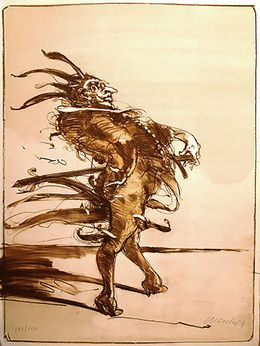

Egon Schiele
Print . 90 x 45 cm Print . 35.4 x 17.7 inch
€4,500
Recommended by Artsper