Bronze Sculpture for Sale

Upload an image to find similar artworks
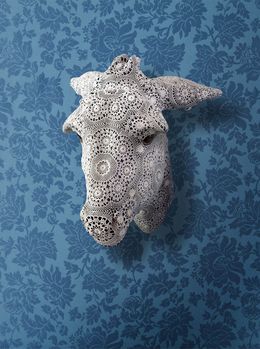
Joana Vasconcelos transforms everyday objects and artisanal traditions into monumental works that question power, gender, and culture. Between seduction and critique, her immersive installations create a dialogue between art, history, and space, offering unique and memorable experiences.

1. How did you first begin your journey as an artist? Was there a particular moment or influence that made you realize this was the path you wanted to pursue?
Joanna Vasconcelos: I did not experience a defining epiphany. Becoming an artist was not the result of a romantic vocation, but rather a progressive realisation that art constituted the most rigorous framework through which I could interrogate reality.
Growing up in Lisbon and born in Paris, I developed an acute awareness of cultural dislocation. That condition of in-betweenness revealed to me, at an early age, that identity is not innate but constructed, socially, politically and visually. Representation produces meaning; it also produces hierarchy. Art became the space where I could analyse and destabilise those structures.
From the outset, I rejected the separation between art and life. I was not interested in autonomous, self-referential formalism. Instead, I turned towards what is culturally marginalised: domestic objects, textile practices, everyday materials, popular iconography. These domains, often dismissed as artisanal, decorative, or feminine, are not peripheral. They are deeply embedded in systems of labour, gender and power. My intention was, and remains, to reposition these visual languages within the field of contemporary art, not as quotation, but as critical reconfiguration.


2. What inspires your work today, whether artists, movements, personal experiences, or cultural references?
Joanna Vasconcelos: My point of departure is often the visible surface of the everyday but what interests me is the system that produces it.
I am drawn to objects and forms that circulate silently within domestic and social space. They appear neutral, yet they are charged with ideology. Craft traditions in Portugal, such as embroidery, crochet, ceramics, textile ornamentation are particularly significant in this regard.
They are not merely aesthetic vocabularies; they are repositories of labour, gendered history and collective memory. I do not approach them nostalgically, but analytically. They allow me to question why certain forms are canonised while others are relegated to the periphery.
Inspiration, for me, does not operate as admiration. It functions as a critical encounter. I am interested in friction: between high and low culture, permanence and ephemerality, intimacy and monumentality. It is within these tensions that meaning emerges.
3. Can you tell us more about your creative process? How does a work typically come to life, from the initial idea to the finished piece?
Joanna Vasconcelos: A work often begins with an act of observation. I isolate an object and begin to question its symbolism: What social order does it serve? What histories does it conceal? What hierarchies does it reinforce? The conceptual framework precedes the physical expansion. Drawing, writing and dialogue within the studio are essential stages.
The realisation of many of my works requires engineering, technical experimentation and sustained collaboration. My studio operates as a structured ecosystem in which artisans, engineers, technicians and specialised makers contribute to the production of each piece.
4. If you had to describe your artistic approach, how would you define it? What do you feel is the distinctive element of your work?
Joanna Vasconcelos: My practice is grounded in the strategic displacement of the familiar. I appropriate objects that are socially coded, frequently associated with femininity, domesticity or consumption, and I subject them to processes of transformation: magnification, hybridisation, recontextualisation. Through this shift, the object is destabilised. It ceases to function passively and begins to operate critically.
The decorative, in my work, is not ornamental in the superficial sense. It is a political tool. Historically, ornament has been dismissed as excessive or secondary, often aligned with the feminine and therefore devalued. By amplifying decoration to monumental scale, I reposition it as a site of authority rather than embellishment.
Perhaps what defines my approach is the coexistence of seduction and disruption. The works invite the viewer through colour, scale and material richness, but beneath that attraction lies structural critique. I am interested in producing works that operate simultaneously as spectacle and as inquiry.

5. Looking back, was there a turning point, such as a project, exhibition, or period, that significantly shaped your career?
Joanna Vasconcelos: Certain institutional milestones, such as representing Portugal at the Venice Biennale, or exhibiting at Versailles were undeniably pivotal. They required me to engage directly with historically and politically charged contexts, where questions of power and representation become unavoidable.
However, the more decisive turning point was internal rather than external. It was the moment I fully embraced the parameters of my own language without concession. At a time when minimalism and dematerialisation dominated critical discourse, I chose excess, material density and scale. That insistence on autonomy on developing a coherent visual and conceptual system outside prevailing orthodoxies fundamentally shaped the trajectory of my career.


6. Could you tell us about your recent projects and what you are currently working on? Are there any upcoming exhibitions or directions you are particularly excited about?
Joanna Vasconcelos: In recent years, I have increasingly conceived works as immersive environments rather than autonomous objects. I am interested in installations that operate almost architecturally, spaces the viewer enters both physically and psychologically.
The body is no longer external to the work; it becomes embedded within it, activating a dynamic relationship between viewer, artwork and site. Meaning is not contemplated from a distance, but constructed through spatial experience.
This approach will be evident in several forthcoming presentations. The Absurd and the Dreamlike, a dialogue with Arne Quinze at La Citadelle in Villefranche-sur-Mer, opening in the summer of 2026, situates the work within a fortified historical structure overlooking the Mediterranean. The tension between monumentality, landscape and constructed fantasy becomes central to the encounter.
Similarly, Transfiguración, to be inaugurated at the Museo Picasso Málaga in 2026, unfolds within a museum deeply rooted in art history. There, my work engages in a silent yet deliberate conversation with modernism, exploring transformation not only as a formal strategy but as a conceptual condition.


Earlier this year, I inaugurated VENUS: Valentino Garavani through the Eyes of Joana Vasconcelos at PM23. This exhibition examined the intersection between art, fashion and myth, reinterpreting Valentino’s universe through my own sculptural and textile language. It was an opportunity to reflect on femininity, authorship and the construction of aesthetic identity across disciplines.
Each of these contexts presents a distinct architectural and historical framework, which I approach not as a neutral container but as an active interlocutor. The site shapes the work, just as the work redefines the site.
What continues to excite me is precisely this negotiation between structure and intervention, between heritage and contemporary gesture. My practice remains committed to producing environments that destabilise perception, inviting the viewer to inhabit a space where scale, material and symbolism are continuously reconfigured.

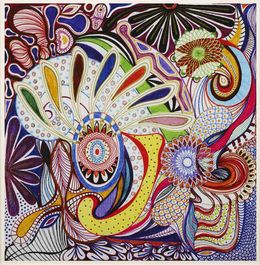
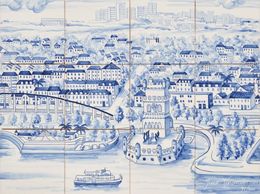
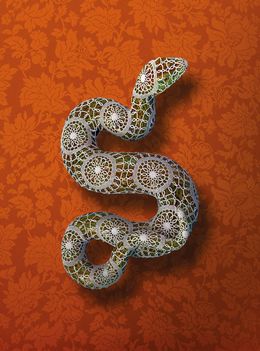
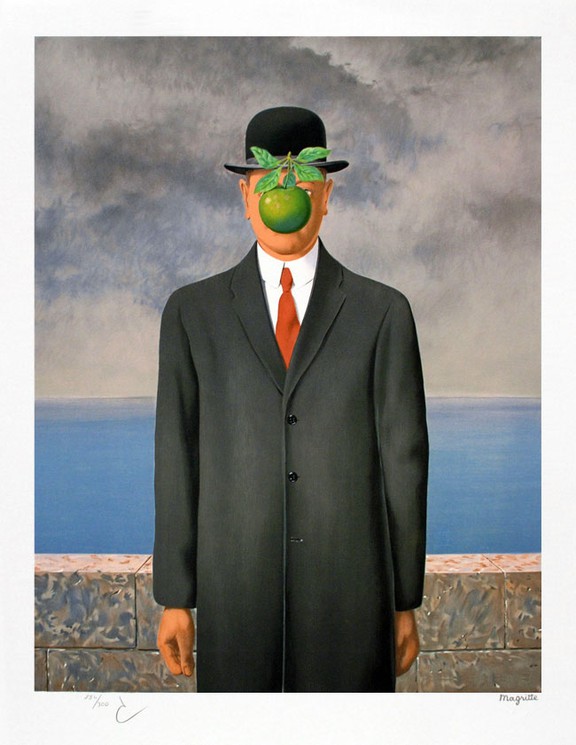
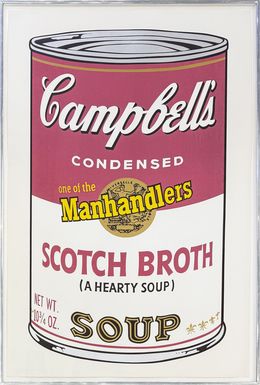
Print . 111.76 x 86.36 x 0.1 cm Print . 44 x 34 x 0 inch
$2,989
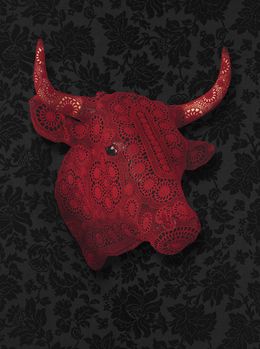

Choose your preferences
The best
of art, online
SIGN IN - REGISTER
Forgot your password?
No worries, enter you email address and we'll send you a link to reset your password.
ReturnUpload an image and discover similar artworks available on Artsper