












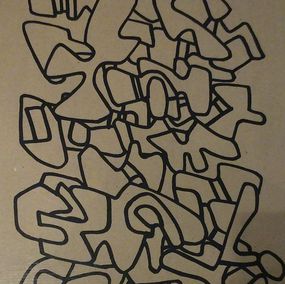
Bianchi e Neri II (Acetates) - Plate D, 1970
Print : lithography · 70 x 50 x 0.2 cm 27.6 x 19.7 x 0.1 inch
Sold
Authenticity guaranteed
Sold with certificate of Authenticity from the gallery
Invoice from the gallery Learn more
Secure payment • Card, Amex, PayPal...
We accept several payment methods:
Paypal
American Express
Visa
Mastercard
Apple Pay
Google Pay
- Credit cards (Visa, MasterCard)
- American Express
- PayPal
- Bank transfer
- Gift card
- Apple Pay / Google Pay
All payments are secured with 3D Secure validation to protect your confidential information.
Verified Reviews : 9.6/10
Similar works


About the artwork
Type
Print : numbered and limited to 90 copies
Condition
Artwork sold in perfect condition, not framed
Authenticity
Sold with certificate of Authenticity from the gallery
Invoice from the gallery
Signature
Hand-signed by artist
Technique & Support
lithography on paper
Dimensions ( cm • inch )
70 x 50 x 0.2 cm 27.6 x 19.7 x 0.1 inch Height x Width x Depth
Sold by
Art gallery
Credentials
Vetted seller since 2019 • Top Seller
Description
Bianchi e Neri II (Acetates) - Plate D is an original print, hand-signed in pencil on the lower right margin by Alberto Burri.
Hand-numbered in pencil on the lower left.
Edition of 90 prints plus 15 artist's proofs numbered in Roman numerals, out of commerce.
This beautiful plate is embossed on zinc plate and lithographed. After this process, Burri made a collage of acetates on Fabriano Rosaspina paper. With the embossing stamp of the publisher Stamperia 2RC (Rome) on the lower left corner.
Printed and published by Stamperia 2RC, Rome, in 1970.
This artwork is a sheet of the "Black and white II", a series that Alberto Burri realized in 1970, using an elaborate mix of techniques, such as lithography, chalcography, and acetate collage.
This six-etching portfolio, was printed by the Roman print shop 2RC, well-known for its graphic experimentations between the 1960s and the 1970s.
Valter and Eleonora Rossi, founders of the 2RC Art Editions, intensely believed that graphics had to be considered a proper artistic genre, just like painting and sculpture, and not a mere extension of them. Thanks to an inventive experimentation, 2RC was able to graphically reproduce processes and contents expressed by contemporary artists.
The partnership between Rossi and Alberto Burri is one of the most relevant examples that explain such an editorial choice. New media, such as acetate, indeed, allow a new series of artistic choices, and especially in these six "Black and White", they grant to the etching the same range of white as the one in paintings. Acetates are graphically independent from paintings.
In occasion of Burri's exhibition in 2RC Gallery in Milan, Cesare Brandi underlined an interesting point of view on the graphic works by the Umbrian artist and on the relationship between graphic technique and painting: "With him (Burri), it is possible to consider parallel series, in which the same plastic motif is reproduced in both painting and etching, so that we may think of the etching just as a smaller motif. But the difference is in the layout, the space on the sheet that focuses on the image. For this reason, the margins are no longer the link with the walls, like frames in a painting, but they become an inseparable part of the image, so we can say that the etching is taking along its invisible wall".

Presentation
Alberto Burri is an Italian artist, painter and sculptor (March 12, 1915, Citta di Castello, Italy - February 13, 1995, Nice, France). He is associated with the "matter painting" mouvement of the European Informal Art and considered his style to be "multimaterial".
He was also linked to the spatialism of Lucio Fontana and influenced, together with Antoni Tapies, the renewal of the assembling art of the post-war US (Robert Rauschenberg) and Europe.
Burri was a medic during World War II: he was captured by the Americans and held prisoner in Texas, where he started painting using makeshift materials. He returned to Italy in 1946 and settled in Rome, where he held his first personal exhibition the year after at La Margherita gallery. In 1948, he exhibited his first abstract work, Bianchi e Catrami, at the same gallery.
In 1949, Burri completed the piece entitled SZ1 using sacks; in 1950, he started the Muffe e i Gobbi series, using worn materials from previous sack works. Burri contributed to found the Gruppo Origine in 1949, together with Mario Ballocco, Giuseppe Capogrossi, and Ettore Colla. The group disbanded in 1951, yet it continued to operate until 1956 under the banner of Galleria Origine. In 1952, the Venice Biennial presented Burri's first exhibition, showing his piece titled Grande Sacco. International success came upon exhibiting in Chicago and New York in 1953. In 1954, Burri completed small flammable works on paper and continued using the theme of fire in the following years with Legni (1956), Plastiche (1957), and Ferri (1958 ca.).
Burri exhibited in 1955 at the VII National Quadrennial of Art in Rome, and in 1964 he won the Marzotto prize. In 1973, he started working on the Ciclo dei Cretti, encasing them in overlaid cement, creating an admirable exemplar of Land Art. Burri started working for Cellotex in 1976, and in 1979 he returned to the Cicli, dominating his latest works. The first, titled Il Viaggio, was exhibited at the Ex-Seccatoi del Tabacco di Città di Castello, and he presented his other Cycles in Florence in 1981, Palm Springs in 1982, Venice in 1983, Nice in 1985, Rome and Turin in 1989.
Discover similar artists



Reviews from our customers
All our reviews are extracted from Verified Reviews
You may also like


Alberto Burri
Painting . 48 x 64 x 0.1 cm Painting . 18.9 x 25.2 x 0 inch
€3,400


Alberto Burri
Print . 48 x 64 x 0.1 cm Print . 18.9 x 25.2 x 0 inch
€3,400


Olivier Messas
Sculpture . 57 x 6 x 3 cm Sculpture . 22.4 x 2.4 x 1.2 inch
€3,600

Alberto Burri
Print . 64 x 48 x 0.1 cm Print . 25.2 x 18.9 x 0 inch
€3,400

Alberto Burri
Print . 48 x 63 x 0.1 cm Print . 18.9 x 24.8 x 0 inch
€3,400


Veronika Obushikhina
Painting . 100 x 50 x 3.5 cm Painting . 39.4 x 19.7 x 1.4 inch
€1,488

Alberto Burri
Print . 48 x 63 x 0.1 cm Print . 18.9 x 24.8 x 0 inch
€3,400


Jean-Claude Coutaz
Fine Art Drawings . 78 x 57 x 0.1 cm Fine Art Drawings . 30.7 x 22.4 x 0 inch
€2,805

Kyong Lee
Painting . 65 x 50 x 0.1 cm Painting . 25.6 x 19.7 x 0 inch
€1,057


Kyung-Sup Byun
Fine Art Drawings . 200 x 100 x 5 cm Fine Art Drawings . 78.7 x 39.4 x 2 inch
€18,700
