Images, sequences, a book, installations…
Journeys, paths, stations, topography, geography, reconstruction…
Legend, chronology, duration… Franck Pourcel’s work, Ulysses or the Constellations, evokes a multitude of descriptive notions about the work in the commentator: formal characteristics, identification of the mode of production in space and time. Where to begin?
This is the particularity of a work of such magnitude. This magnitude is implicitly indicated by the difficulty in defining its aesthetic identity: starting from the Homeric narrative, Franck Pourcel traces a graph connecting the points of the stations of the hero’s journey. In this way, according to the tradition of constrained art, he orders a constellation, that is to say, he gives the spatialization of the path he undertakes “in the footsteps of Ulysses” a geometric form that constitutes in itself the matrix form of the work.
Before even seeing a single image, the viewer is captivated by the gigantic graph created by the relationships between points in the Mediterranean that form the route to be taken, but it appears less like a nautical chart than an astronomer's map.
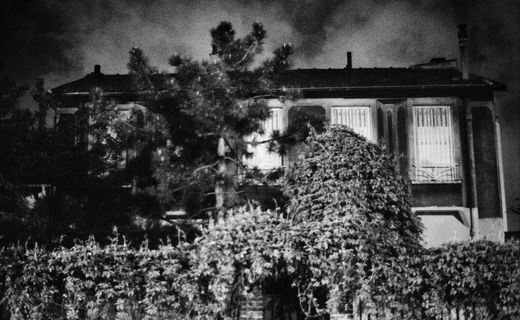
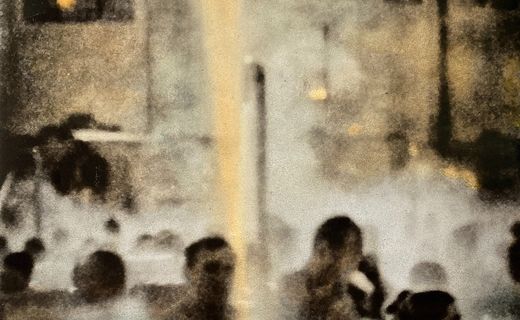
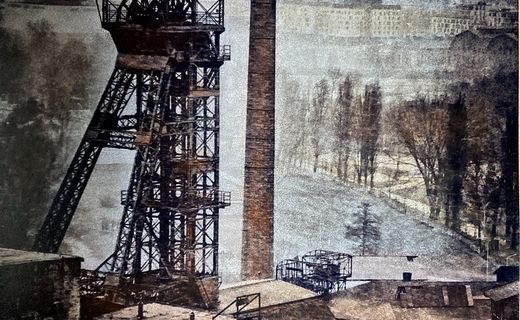
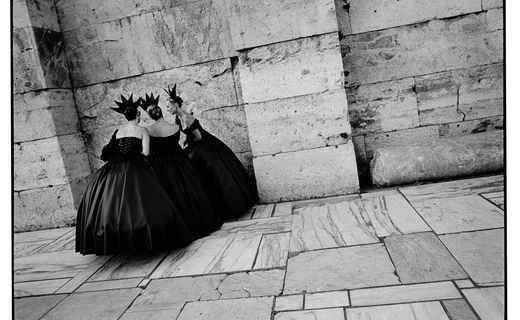
Each place, since they still exist, is thus the subject, over the years covered by the Ulysses or the Constellations project, of a journey, camera in hand. For the artist, it is a matter of rediscovering, through chance and intuition, traces of an equivalent to the legendary tale. Here a Cyclops, there the Sirens, but what would have been merely a scholarly treasure hunt is overlaid with the contemporary issues of today's world: Franck Pourcel brings Antiquity into the present, much like the contemporary philosopher still knows how to give voice to the Pre-Socratics.
Far from any pretense of allegory, the entirety of Ulysses or the Constellations is a confrontation between photography and the epic genre. The ambition to contain these episodes of work and exploration within a single, coherent project is a tour de force. A vast photographic poem, in my opinion virtually unparalleled in its generation. Indifferent to styles, poses, in short, to the trends that often govern contemporary photography, Ulysses or the Constellations encompasses its author even, transcending him—a clear sign, if ever there was one, of an authority acquired through the work itself.
Michel Poivert
Read more