Bronze Sculpture for Sale

Upload an image to find similar artworks
Nationality
Categories
Artistic movements
Themes
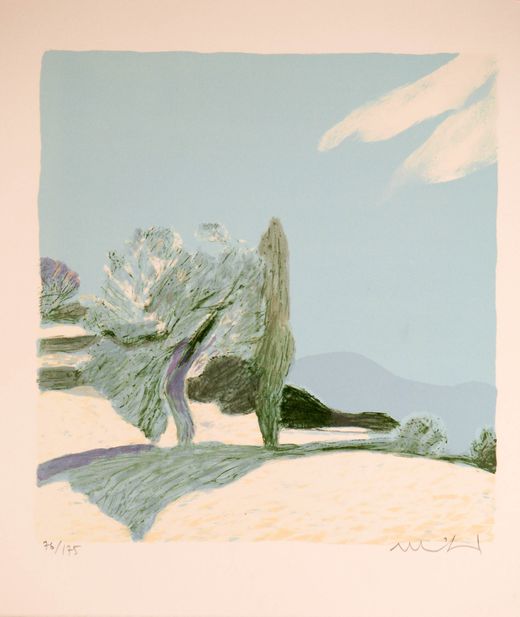
Roger Mühl (1929-2008) is a French painter, also a draftsman, lithographer, and sculptor, whose work is mainly associated with figurative landscape, light, and color.
Born in Geudertheim, in the Bas-Rhin, he entered the School of Decorative Arts in Strasbourg in 1939, before interrupting his studies during the Second World War and resuming them from 1945 to 1948. There he notably received the teaching of the painter Léon Lehmann, who introduced him to attentive observation of nature and drawing from motif. After his studies, Mühl worked as a decorator at Barabli, a satirical cabaret in Strasbourg founded by Germain Muller, then created mural paintings in schools, notably in Ittenheim, before intervening in Brittany, Normandy, and Paris at the request of the Ministry of National Education.
In 1953, the Alsatian House of Art in Strasbourg dedicated its first personal exhibition to him and the Museum of Modern and Contemporary Art in Strasbourg acquired two of his oil paintings. The following year, the artist settled in Montreux-Château, in the Territory of Belfort. His painting then built around nature, landscapes, portraits, and still lifes. He placed particular importance on the relationship between lines, masses, and color, preparing his paintings with numerous drawings and sketches. His travels in Holland, Germany, the Scandinavian countries, Spain, and especially Italy also nourished his artistic sensibility, particularly his interest in the art of the Quattrocento and Cinquecento.
Mühl simultaneously developed an important activity in the field of the 1% art, creating wall decorations, stained glass, and tapestries, notably in Aubusson in the Pinton workshop. He also worked in religious buildings, such as the Ostheim temple, where he notably created a Christ engraved in stone and a Christ in wrought iron. In 1960, his personal exhibition at the Galerie de Paris was a great success and marked the beginning of international recognition. He then exhibited in Paris and New York, notably at the David Findlay gallery. The same year, he was initiated into lithography in the workshop of Fernand Mourlot, where he indirectly encountered the graphic tradition of artists such as Picasso, Matisse, and Chagall.
His lithography practice also led him to illustrate books, including L'Aventure occidentale de l'homme by Denis de Rougemont, published in 1972. He subsequently created illustrations for texts by Marcel Pagnol and Albert Camus as well as for books dedicated to French gastronomy. In 1961, he received the Prestige Prize for the Arts after being selected for the Critics' Prize.
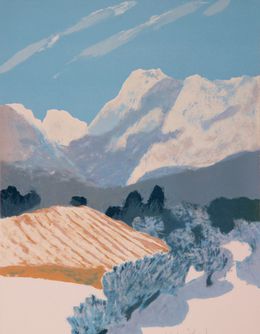
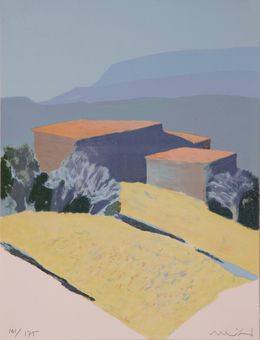
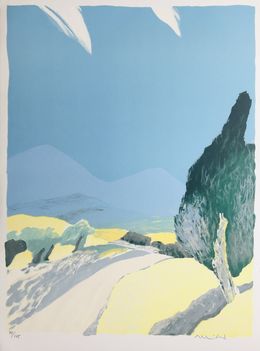
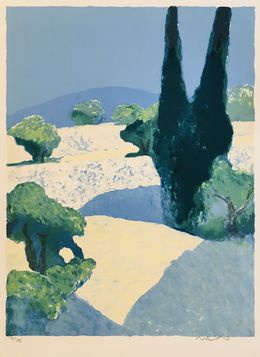
In 1965, Roger Mühl left Eastern France to settle in Grasse, then in Mougins in 1975. Provence, the Côte d'Azur, the olive trees, the calanques, gardens, and the sea became essential themes of his work. His painting remains figurative, but tends towards a growing simplification of forms and masses. The artist does not seek to literally reproduce the landscape: he recomposes it from his sensations and his perception of light. His work is thus distinguished by spare compositions, generous forms, and a palette where soft tones and color superimpositions produce an impression of luminosity and harmony.
Among the influences and references associated with his career are Delacroix, Van Gogh, Manet, Picasso, Braque, and Villon, while his approach to landscape maintains a critical rapprochement with certain compositions by Nicolas de Staël. His work is presented internationally, notably in Geneva, London, Milan, Dallas, Cologne, Stuttgart, Tokyo, Kyoto, and New York. In 1987, the Art Center Hall in Tokyo hosted an exhibition of his work, before a major retrospective was organized in Belfort in 1988. The Galerie Charpentier in Paris also associates him with several exhibitions dedicated to the School of Paris.
Through landscape painting, oil painting, watercolor, pastel, drawing, and lithography, Roger Mühl develops a work deeply attached to light and the observation of nature. From Alsace to the Mediterranean landscapes, his work transforms reality into sober and luminous compositions, where color becomes the main means of expressing atmosphere, depth, and sensations. This research makes Roger Mühl a singular figure in 20th-century French painting and post-war contemporary landscape.

Painting . 16 x 25 cm Painting . 6.3 x 9.8 inch
€990
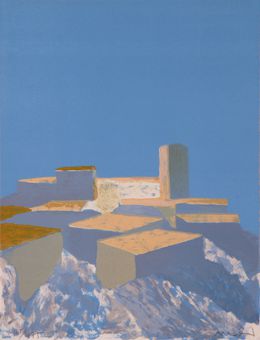
Print . 42 x 32 x 0.2 cm Print . 16.5 x 12.6 x 0.1 inch
€600
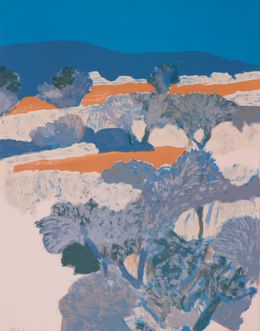

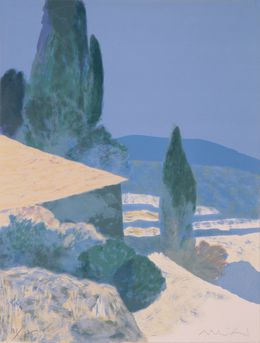
Print . 42 x 32 x 0.2 cm Print . 16.5 x 12.6 x 0.1 inch
Sold







Discover other selections of artworks
Choose your preferences
The best
of art, online
SIGN IN - REGISTER
Forgot your password?
No worries, enter you email address and we'll send you a link to reset your password.
ReturnUpload an image and discover similar artworks available on Artsper