Thinking of giving art for Christmas?

Explore our gift guide

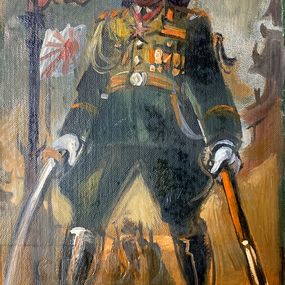
Napoleon III Review-Militaria Napoleonic, Circa 1900
Edouard Detaille  

Painting : gouache · 75 x 57 x 5 cm 29.5 x 22.4 x 2 inch · Ready to hang

€20,500 20 500 €
Delivered in time for Christmas

One of the last works available by this artist

Are you a company? Leasing from /month
Shipping & delivery

Shipped from: France

Delivery to: France , € 54

Estimated delivery: Less than one week

Free returns within 14 days, full refund

Authenticity guaranteed

Sold with certificate of Authenticity from the gallery

Invoice from the gallery Learn more

Secure payment • Card, Amex, PayPal...
We accept several payment methods:
Paypal American Express Visa Mastercard Apple Pay Google Pay

  • Credit cards (Visa, MasterCard)
  • American Express
  • PayPal
  • Bank transfer
  • Gift card
  • Apple Pay / Google Pay

All payments are secured with 3D Secure validation to protect your confidential information.

Verified Reviews : 9.6/10
Discover similar artworks
About the artwork

Type

Painting : Unique artwork

Condition

Artwork sold in perfect condition, framed, ready to hang

Authenticity

Sold with certificate of Authenticity from the gallery

Invoice from the gallery

Signature

Hand-signed by artist

Technique & Support

Dimensions ( cm • inch )

75 x 57 x 5 cm 29.5 x 22.4 x 2 inch Height x Width x Depth

Artwork dimensions including frame

106 x 87 x 8 cm 41.7 x 34.3 x 3.1 inch

Sold by

Art gallery

Professional art gallery • France

Credentials

Vetted seller since 2025

Discount

This seller offers discount when you purchase multiple artworks.

Description

Original glass and frame. Another version, less accomplished is in the Invalide. Réf Jean Humbert Book on EDOUARD DETAILLE

The emperor is accompanied by his aide-de-camp, Colonel Castelnau, and Marshal Canrobert. In a gilded wooden frame, under a Marie Louise blue background.

Life and time  
Born in 1848 into a close-knit bourgeois family, Édouard Detaille, the eldest of eight children, displayed early talent in drawing. “He was a prodigy," notes François Robichon. By the age of thirteen, he exhibited an astonishing surety of hand and a phenomenal sense of composition. His father, connected to Horace Vernet, encouraged him. At seventeen, after passing his baccalaureate, he entered Meissonier's studio. This relationship, which developed into mutual affection, spared Detaille the academic detour through the École des Beaux-Arts. Rather than dictating an official art style, Meissonier, at the peak of his fame, traveled with his students, introducing them to the nuances of Titian, Rembrandt, and Rubens in Brussels and Lille.

In 1867, the Paris of “free trade" dominated the world through the technological revolutions of the Universal Exhibition, and the amiable young man, striking in appearance, discovered the salon of Princess Mathilde and the theater of Dumas fils. He even approached the Empress, noting in his journals, “Not bad, the Empress." This observation encapsulated Detaille: he had no doubts about his talent, cultivated panache, enjoyed the company of beautiful women, and aimed to conquer the circles of power without sacrificing his freedom.

From childhood, he listened to his calling: “Before I could read, I could guess the subjects of battles, the names of famous generals, the weapons of officers and soldiers from the images I admired in the books of Norvins and Laurent de l'Ardèche." He mingled with collectors and regularly attended military reviews on the Champs-Élysées. His first painting exhibited at the Salon in 1868, “La Halte de tambours," was praised by critics who immediately recognized “a remarkable truth of observation and simplicity of effect." The purchase of this work by Princess Mathilde, cousin of Emperor Louis-Napoleon, made Detaille, at twenty, an envied celebrity known to Sainte-Beuve, Théophile Gautier, the Goncourt brothers, and Flaubert. The young artist's humanistic vision contrasted with the compositions of his predecessors, depicting soldiers in maneuvers, contemplative and resigned as war loomed.

**The Combatant's Vision**  
The Siege of Paris, where he nearly lost his life in 1870, and the deaths of two brothers in that defeat darkened his outlook. From 1871 onward, Detaille no longer concealed the cruelties of war: German riflemen mowed down by machine gun fire, cavalrymen and panicked horses caught in ambushes, fields plowed by shells strewn with dead animals. The unvarnished tragedy: “It is an absolute fact that no painter has ever rendered a battlefield covered with corpses as it is," commented Jules Claretie. The fallen bodies still bear the appearance of life in their frozen rigidity. Detaille's testimony of the devastating defeat and the catastrophic effects of the first total war in history was not a celebration of heroism but a lament, a “lesson in darkness." “From war, once considered the supreme effort of human genius, we now see only melancholy and horrors," judged one writer in response to his canvases.

“Detaille experienced the reality of combat at a young age during a war that foreshadowed the two world conflicts of the 20th century," explains François Robichon. With great realism, Detaille painted war from the perspective of the combatant. He introduced a humanity and a critical lucidity regarding the evolution of warfare. His works intensely captured the violence and firepower of new weapons like machine guns. Before he turned thirty, Detaille had become a chronicler of these painful years. He exhibited, as a critic noted, a “striking portrait of modern war" that both French civilians and soldiers had experienced firsthand. He embodied a youth humiliated and eager for revenge. Yet this scrupulous artist also remembered, in his expansive landscapes—from the chalky plateaus of Île-de-France to the Russian plains—the lessons of Corot and Courbet. Manet was not far off. “I wouldn't want my art to be reduced to mere patriotic art," he asserted. “A system I often employ and love is to first execute the landscape, very effective, very tight, based on nature…" Echoing Meissonier's advice: “Always nature, always nature!" Detaille remained close to this father figure, constructing a grand townhouse next to his mentor's studio at 129 boulevard Malesherbes at the age of 26, having purchased 425 m² of land from the Pereire brothers. He even chose the same architect as Meissonier: Paul Boesvilwald. A bachelor and incorrigible seducer, the painter welcomed his conquests, including Valtesse de la Bigne, amidst his collections, having built his studio in the courtyard.

Diplomatic Actor
As Detaille's fame grew, his Malesherbes townhouse quickly became a gathering place for foreign princes, politicians, and heads of state, where Juliette Adam, Léon Gambetta's muse, offered him valuable advice. The Prince of Wales, the future Edward VII, developed a genuine friendship with the painter. “This fervent patriot, friend of Déroulède, was extraordinarily open to the world," recounts François Robichon. In just a few years, he gained considerable social, cultural, and international stature. Received at Windsor, at the English court, he was close to Tsar Alexander III and a great friend of Félix Faure.

In this capacity, Detaille played a decisive role in the Entente Cordiale, signed in 1904 between England and France, and in the Franco-Russian alliance of 1894, thereby contributing to the Triple Entente among the three powers. An engaged witness of his time—associated with the birth of the “Ligue des Patriotes" alongside Alphonse de Neuville and Déroulède, founder of the “Sabretache," and initiator of the Army Museum—Detaille was not blinded by his convictions. He was not indifferent to the honors discreetly paid to him by Wilhelm II and the Crown Prince through diplomatic channels. Like Barrès, he placed his hopes in the restoration of a symbol tarnished by Sedan: the French army.

Beyond this choice, he was a man turned towards modernity. “Well-informed from the best sources, he was at the center of European life," observes François Robichon. Knowledgeable of photography's potential, he was among the first in the 17th arrondissement to install electricity and telephone, to drive a car, and to attend the Lumière brothers' cinematograph sessions in 1896. He even contemplated making a historical film. In this sense, he was a precursor. His astonishing war panoramas—Champigny and Rezonville—long sequence shots created with Alphonse de Neuville on rue de Saussure, near the Asnières gate, anticipated the historical cinema of Abel Gance, the naturalism of John Ford, the frescoes of Andrei Tarkovsky, and the emotional power of Apocalypse Now. Did Abel Gance not draw his Napoleonic epic vein from Detaille's paintings? Detaille imagined a painting beyond the frame, capturing both the entirety and detail of the cathartic upheaval of war. He pushed the traditional boundaries of his profession, paving the way for the major art of the 20th century: cinema.

Detaille passed away on December 24, 1912, at his home on boulevard Malesherbes, and his funeral was nearly a national event, held at Saint-Charles-de-Monceau church on December 27. A company from the 28th infantry regiment, for whom he had designed the new uniform, presented arms. The Prime Minister, Raymond Poincaré, bareheaded, walked behind the family. Today, François Robichon, who has sensitively and passionately revived the painter's fate, is fighting to save his grave at Père Lachaise.

Edouard Detaille, Napoleon III Review-Militaria Napoleonic
France  • 1848  - 1912

Presentation

The Army Museum houses in its collections the studio collection of the military painter Jean-Baptiste Edouard Detaille (1848-1912), bequeathed to the State upon his death. From his early sketchbooks to monumental compositions, this collection offers a comprehensive view of the painter's art, as well as insight into the conception, technique, and aesthetics of the works of this artist, one of the most celebrated representatives of the French school of his time.

Édouard Detaille entered the studio of the painter Ernest Meissonier (1815-1891) in 1865; he then turned to historical painting, depicting the events he witnessed. The Franco-Prussian War of 1870-1871 provided him with numerous subjects for his compositions and the opportunity to create two panoramas on the battles of Rezonville and Champigny, in collaboration with Alphonse de Neuville (1836-1885) [1]. For these monumental works, the two artists sketched on location and worked from photographs. During the 1890s, the painter focused on subjects related to the Napoleonic era and the contemporary French army, for which he designed a new uniform project in 1912. His last commissions were monumental works, including one for the Budget Room in the Paris City Hall. He chose to represent a subject related to the armies of the Revolution and the Empire, of which [2]. Edouard Detaille had a distinguished official career: medalist at the Salons of 1869, 1870, 1872, 1888; Grand Prix at the Universal Exhibitions of 1889 and 1900; member of the Institute since 1892 and Grand Officer of the Legion of Honour.

An active member of the Costume History Society, he amassed a collection of uniforms, equipment, and harnesses, which inspired his paintings. In his will dated March 24, 1912, he bequeathed his townhouse and all its contents to this society, on the condition that it be used as an exhibition space. However, after some difficulties, the collection finally entered the Army Museum in 1915. It includes, in addition to the artist's masterpieces, sketches and drawings, weapons and uniforms, as well as photographs reproducing the painter's works, which he commissioned almost systematically.

It should be noted that Édouard Detaille maintained close ties with the Army Museum since the creation of the Army Historical Museum in 1896 by La Sabretache, a society of which he was president [3]. The entire collection is displayed in a room entirely dedicated to him, on the ground floor of the East Wing, inaugurated on April 15, 1916, and renamed the "Detaille Room." This room "is one of the most important in the Army Museum. It preserves with reverence and gratitude the memory of the great artist in whose personality the modern history of the French Army was, in a way, synthesized" [4].

The work of Edouard Detaille reveals a meticulous technique, a sense of drawing, and a concern for documentary accuracy. This precision of the brush and this desire to remain faithful to reality constituted the great quality of Detaille's art, but also the main source of criticism of his art, at a time when pictorial research was moving towards new paths, breaking with academicism.

Laëtitia Desserrières, Iconography Department

Reviews from our customers

All our reviews are extracted from Verified Reviews

You may also like

Print, Gillets Jaune, Luke ELK Cornish

Luke ELK Cornish

Print . 60 x 84 x 0.1 cm Print . 23.6 x 33.1 x 0 inch

€1,300 €1,040

Print, Les mousquetaires, Claude Weisbuch

Claude Weisbuch

Print . 37 x 50 x 0.02 cm Print . 14.6 x 19.7 x 0 inch

€300

Painting, Napoleon and the Sphinx, Daniil Litvinov

Daniil Litvinov

Painting . 93 x 145 x 2 cm Painting . 36.6 x 57.1 x 0.8 inch

€2,850

Painting, Taras Bulba, Oleg Litvinov

Oleg Litvinov

Painting . 32 x 70 x 2 cm Painting . 12.6 x 27.6 x 0.8 inch

€1,150

Painting, Profil d'un Toréro, Catherine Clare

Catherine Clare

Painting . 92 x 65 x 2 cm Painting . 36.2 x 25.6 x 0.8 inch

€1,500

Painting, Napoleon, Oleg Litvinov

Oleg Litvinov

Painting . 41 x 104 x 2 cm Painting . 16.1 x 40.9 x 0.8 inch

€1,650

Painting, Mazepa and Karl, Oleg Litvinov

Oleg Litvinov

Painting . 42 x 134 x 2 cm Painting . 16.5 x 52.8 x 0.8 inch

€2,450

Painting, Glorious Fight, Oleg Litvinov

Oleg Litvinov

Painting . 70 x 160 x 2 cm Painting . 27.6 x 63 x 0.8 inch

€3,680

Painting, Ivan Bohun, Oleg Litvinov

Oleg Litvinov

Painting . 34 x 22 x 2 cm Painting . 13.4 x 8.7 x 0.8 inch

€600

Painting, Napoleon in Egypt, Daniil Litvinov

Daniil Litvinov

Painting . 33 x 26 x 2 cm Painting . 13 x 10.2 x 0.8 inch

€470

Painting, Napoleon on Horseback, Daniil Litvinov

Daniil Litvinov

Painting . 32 x 26 x 2 cm Painting . 12.6 x 10.2 x 0.8 inch

€470

Print, Napoleon said..., Zoltan Salamon

Zoltan Salamon

Print . 45 x 30 cm Print . 17.7 x 11.8 inch

€440

Painting, Napoleon in Egypt, Daniil Litvinov

Daniil Litvinov

Painting . 91 x 147 x 2 cm Painting . 35.8 x 57.9 x 0.8 inch

€3,000

Painting, Portrait of a noble man, Alexander Litvinov

Alexander Litvinov

Painting . 18 x 13 x 2 cm Painting . 7.1 x 5.1 x 0.8 inch

€265

Need help?
How do I showcase my work?

Have you purchased a painting, sculpture or work on paper?
Find our expert advice for the conservation and promotion of your works in the articles below:

Protect your purchase with Artsper: Buy with confidence

At Artsper, our mission is to allow you to collect works of art with complete peace of mind. Discover the protections we offer at every stage of your shopping experience.

Buy works from top galleries

We work in close collaboration with carefully selected art galleries. Each seller on Artsper is carefully examined and approved by our team, thus ensuring compliance with our code of ethics. You therefore have the assurance of purchasing authentic, high-quality works.

Total transparency: you know what you are buying

Before being posted online, all artwork on Artsper is reviewed and validated by our moderation team. You can browse with complete peace of mind, knowing that each piece meets our criteria of excellence.

Personalized support: our experts at your service

Our team of contemporary art experts is available by phone or email to answer all your questions. Whether you want advice on a work or a tailor-made selection to enrich your collection, we are here to support you.

Resell your works with ease

If you have purchased a work on Artsper and wish to resell it, we offer you a dedicated platform to relist it. To find out more, click here.


Make offers with Artsper: negotiate like in a gallery

You have the possibility to propose a price for certain works, just like in a gallery. This feature allows you to initiate discussions and potentially acquire your coins at advantageous prices.

Get help with your negotiations

Our team will negotiate for you and inform you as soon as the best offer is obtained. Do not hesitate to call on our expertise to ensure a transaction at the best price.


Order securely

Artsper satisfaction assurance

We want you to be completely satisfied with your purchase. If the work you receive is not to your liking, you have 14 days to return it free of charge, and you will be refunded in full, whatever the reason.

Secure payment with Artsper partners

All credit card payments are processed by Paybox, the world leader in payment solutions. Thanks to their strict security standards, you can transact with confidence.
Problem Support

In the rare event that an artwork arrives damaged or not as described, we are here to help. Whether for a return, refund, restoration or exchange, our team will support you throughout the process and will ensure that we find the solution best suited to your situation.
Conditions to benefit from Artsper protections:

  • Use one of the payment methods available on Artsper for your order.

  • Report any problems within one week of receiving the work.

  • Provide required photographic evidence (including original artwork and packaging).

Artsper guarantees cover the following cases:

  • The received work lacks a described characteristic (for example, a signature or frame).

  • The artwork has significant differences from its description (e.g. color variation).

  • The work is damaged upon receipt.

  • The work is lost or damaged by the carrier.

  • Delivery is significantly delayed.

With Artsper, you collect with complete peace of mind.

Why choose Artsper for your art purchases

Artsper offers you access to more than 200,000 works of contemporary art from 2,000 partner galleries. Our team of experts carefully selects galleries to guarantee the quality and originality of the works.

You benefit from:

  • Works at gallery price

  • Return within 14 days, regardless of your location

  • Easy resale of the work purchased on Artsper

  • Personalized research tools (selection and tailor-made universe)

Our customer service is available for any assistance.

Where can I be delivered?

Artsper delivers internationally. The list of countries is available in the first step of your cart.

If your country is not listed contact us at [email protected] and we will see what we can do.

Note that Customs fees may apply for works shipped internationally. This is indicated in the first step of the shopping cart.

You can choose a delivery address different from the billing address. Make sure that a trusted person is present to receive the work if you cannot be there.