HOMES
“Home!” Might this not be one of the first words spoken by a very young child?
The home is a familiar and universal place. Built and inhabited, it is within our sight, our reach, and all our senses. Its existence leaves an imprint on our memory and nurtures our imagination and creativity.
The house is a hollow body made of walls, which can be compared to a shell, a womb, or a cocoon. Businesses use the term “mother house.” The home, the place of our childhood, is the mother of our memories, our happiness, our suffering, and our hopes.
Memory, Erasure
The home, used in the singular, carries an intimate quality and represents the place where we live. Ma maison, the title of Isabelle Cavallieri’s series of drawings, evokes a dreamlike atmosphere connected to memories, dreams, and nightmares. Childhood is never far away. Absence, abandonment, aggression, invasion, and confinement emerge through the work. The ornamental quality and graphic virtuosity create a distance from the violence it contains.
With Niki Neuts, the memory of a building is deliberately blurred, veiled in uncertainty, while remaining precise in what it reveals of its darker character. Ink, wax, charcoal, and various imprinting and printing techniques cause forms to fade or emerge on the paper. Architecture is no longer a stable mass, separate from the landscape surrounding it. Instead, it becomes caught in a process of emergence, transformation, and erasure, within an environment that gradually absorbs it.
Representation, Interpretation
As a home ages, it bears the marks of time. Asya Marakulina is interested in the demolition of buildings, which exposes the interior walls of homes. Traces of domestic life are revealed to the viewer: wallpaper, kitchen wall tiles, chimney flues, electrical switches… What is destined for destruction, she chooses to preserve through the medium of ceramics. She transforms what no longer exists into an archive.
Geoffroy Didier is also interested in ruins. He materially collects their traces, paying particular attention to fragments of plasterboard, patterned wallpaper remnants, and pieces of tile. These remnants are sorted, reworked, cut down, and arranged into wall compositions. New materials have a market value; once destroyed, they seem to have none. Reincarnated through the artist’s hand and presented anew, they acquire a new status and an artistic value.
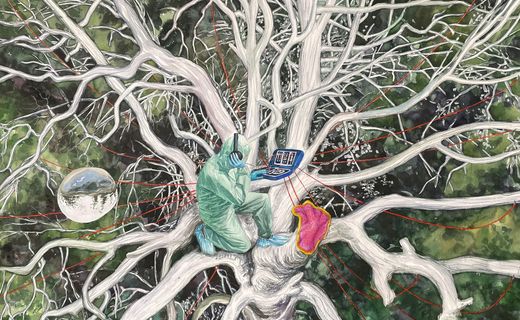
Béatrice Meunier-Déry’s cabins are the result of an architectural and environmental reflection. Using reclaimed materials, she constructs elevated shelters and cabins perched above the ground. Vegetation sometimes encloses the small structures or, elsewhere, takes over their interiors. These unusual and unconventional homes reflect our desire to escape everyday life and domestic routines, and our longing for peace and relaxation in a wooded natural setting, far from the city.
Cinema and literature nourish Jérôme Progin’s artistic research. He experiments with unusual materials such as soot, dishwashing liquid, and candle flame. The action upon the surface takes place immediately, and the result becomes a snapshot. His staged scenes bring the familiar into collision with the unsettling. If there is a house, it seems destined to disappear. Even when he unfolds and refolds the faces of a construction, what emerges are views. His work is cinematic.
Transposition, Transmutation
Egor Plotnikov’s work revolves around memory and escape. On fragments of old wooden beams, he draws the oak forest of Compiègne using Renaissance techniques. His gaze embraces the landscape through a 180-degree view, as if looking through a window. Looking outward creates a sense of freedom. Conversely, in his Refuge series, a small figure finds himself confronted with tiny, almost carceral spaces. He escapes from them.
Deeply connected to her roots in Uzbekistan, Zulfiya Spowart reinterprets her past and her education in textile craftsmanship through her work. She draws, for example, on a fragment of mosaic from a kindergarten in her homeland. This detail becomes the starting point for a playful contemporary sculpture. The motif is reinterpreted and translated into a soft textile form designed for a children’s play area. The artist thus reflects on geographical distance and the feeling of belonging.
Places subjected to destructive human actions are of particular interest to Sarah Feuillas. The notions of wall, opacity, transparency, and the boundary between interior and exterior, fragility and resistance, guide her research. She formally connects past, present, and future, focusing on lines and structures. She photographs architectures in distress within the landscape and, in the studio, draws on these images to create installations using materials such as wood, steel, and glass.
The works brought together in HOMES do not offer a single representation of home. Each presents its own vision, shaped by a story, a memory, a material, or a gesture.
Home can be a place of childhood, a refuge, or a space of confinement. It can leave traces behind, become a ruin, disappear, be transformed, or extend into the landscape. It can also become a fragment of memory, a transmitted motif, or an imagined construction.
Thus, the nine artists brought together here do not tell a single story about home. Rather, they invite us to consider what it preserves, what it reveals, what it transforms, and what we project onto it.
HOMES is a journey through these singular stories, these real and imagined spaces where the intimate and the collective, memory and oblivion, construction and disappearance meet.
Clotilde Boitel, curator of the exhibition
Read more