Bronze Sculpture for Sale

Upload an image to find similar artworks

Appointed official painter of the navy in 1849
Landscape painter, draftsman, watercolorist
He primarily depicted the lives of fishermen on the coasts of the English Channel.
Born Eugène Modeste Edmond Poidevin, he was admitted to the École des Beaux-Arts in Paris in the workshops of Louis Hersent and Xavier Leprince, from whom he borrowed his taste for anecdotal scenes.
He failed to win the Grand Prix de Rome, but obtained a second prize in 1829.
He exhibited successfully at the Salons from 1831 until his death in 1870.
He provided illustrations for Charles Philipon's newspaper. Eugène
Lepoittevin launched the trend of caricature collections, such as [title missing] or [title missing] (collection of 12 plates),
His work was doubly inspired by that of Eugène Isabey, who introduced him to Étretat, and by Dutch painting, which he studied during a stay in the Netherlands. His taste for realism connects him to the young school of 1830, while remaining faithful to the Romantic style of his early work. Lepoittevin owned a villa in Étretat, where he hosted Gustave Courbet in 1869.
Eugène Modeste Edmond Poidevin was born in Paris, in the 1st arrondissement, at 8 rue de Ventadour, in his parents' home. His father, Nicolas Jean Baptiste Modeste Poidevin, originally from Rouen, was a cabinetmaker and assistant furniture storekeeper/upholsterer, then head cabinetmaker at the Palace of Versailles, where the family settled. A mediocre student but an artist at heart, Eugène Le Poittevin became a pupil of a local painter, Ledoux. At 15, to prove his vocation to his father, who opposed it, he made a copy at the Palace of Versailles of a painting by Nicolas Antoine Taunay. The copy caused a sensation in the city of Versailles, and the Duchess of Berry granted the young man a pension of 500 francs from the treasury of King Louis XVIII. He briefly attended the workshop of Xavier Leprince; The latter had a short career, as the public only saw about twenty of the artist's paintings, which he exhibited at the Salons of 1819, 1822, and 1824. Le Poittevin is nevertheless said to have borrowed from him a taste for anecdotal and picturesque scenes. Under Leprince's influence, Eugène Le Poittevin traveled to Normandy, Brittany, the Landes region, Italy, Belgium, the Netherlands, Germany, and England.
In 1826, following Xavier Leprince's death, Le Poittevin managed to gain admission to the École des Beaux-Arts in Paris, in the studio of Louis Hersent, where Karl Girardet and Augustin Pajou also trained. He twice unsuccessfully attempted the Grand Prix de Rome competition. After Leprince's death, he moved into his master Leprince's studio and exhibited three works at the Salon under the name Potdevin, achieving success. His father changed his name to Le Poittevin and was appointed to the Rohan castle near Strasbourg. In 1829, Eugène Le Poittevin won second prize in the Grand Prix de Rome competition, deemed too young for first prize. His master Hersent recommended that he work from life. He exhibited successfully at the Salons from 1831 until his death in 1870.
Following Leprince's untimely death in December 1826, Le Poittevin is said to have completed one of the large compositions he planned to exhibit at the 1827 Salon: a view of his studio begun the previous year. Le Poittevin is believed to have finished this painting by creating 11 of the 36 portraits included in the composition. While the canvas was presented at the 1827 Salon under the title [title missing], the Salon catalogue reveals the involvement of the young painter Le Poittevin, identified as Eugène Potdevin. This was Le Poittevin's first participation in the Salon. At the same Salon, he presented three of his works: (which was acquired by the Duchess of Berry for display in her gallery), and [the painting]. This last painting was acquired by the collector Du Sommerard, who also purchased the [work] completed by Le Poittevin. Catalogue of the exhibition presented from July 14th.
In 1834, the government of Louis-Philippe commissioned him to create a work for the historical museum of Versailles, followed in 1835 by another. His work was purchased by the State and displayed at the Luxembourg Museum. In 1840, he traveled to Algeria and returned ill. He exhibited upon his return, and at the Rouen Salon. He received commissions for the historical museum of Versailles for [works to be inserted here]. His wife died in 1851. Around this time, he had a villa built for himself in Étretat, as well as a studio on the seafront where he stayed regularly. The theme of the sea, fishermen, and their families, with whom he maintained cordial relations, became central to his work (e.g., [work to be inserted here], 1860, Fécamp, Musée des Pêcheries). These themes, which he exhibited at the Salon, were lithographed by Jean-Pierre-Marie Jazet for Goupil et Cie [publisher name missing]. He painted scenes of sea bathing (Musée des Beaux-Arts de Troyes). At the 1867 Universal Exhibition in Paris, he sent his painting, which was acquired by Napoleon III for the Élysée Palace. His work was exhibited at the Maritime Exhibition in Le Havre in 1869. That same year, he lent his studio in Étretat to Gustave Courbet, who came to paint his famous painting and series there. In parallel, Le Poittevin, who had a keen sense of humor, painted Cinderellas, Little Red Riding Hood, and a painting (Saint Petersburg, Hermitage Museum) caricaturing two of the artist's friends watching a Norman woman bathing. In 1870, despite being seriously ill, he exhibited his last painting at the Salon. He died at his daughter Eugénie's home on August 6, 1870. His second wife, Adèle Pironin, whom he married in 1861, died in 1872. Le Poittevin's studio, including 144 paintings, thousands of drawings and his collections, was sold in Paris at the Hôtel Drouot from April 9 to 12, 1872.


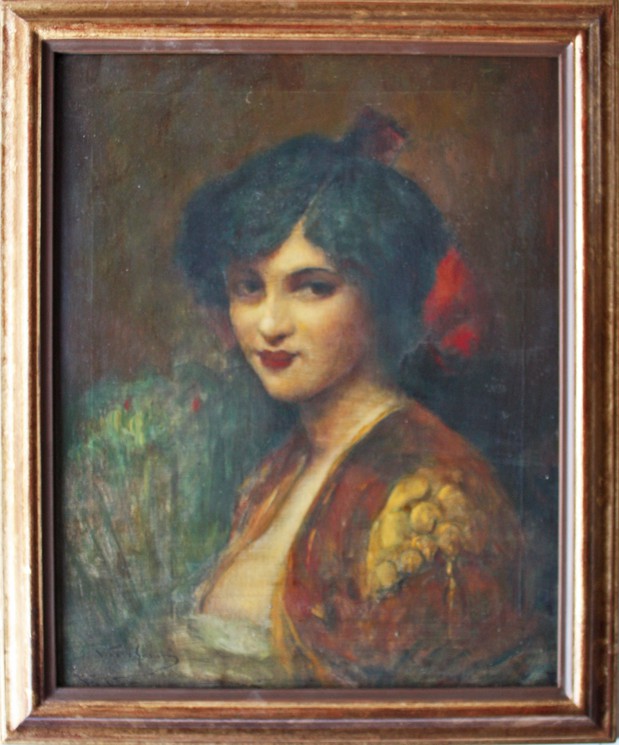
Painting . 48 x 63 x 7 cm Painting . 18.9 x 24.8 x 2.8 inch
€5,400
171 followers


Choose your preferences
The best
of art, online
SIGN IN - REGISTER
Forgot your password?
No worries, enter you email address and we'll send you a link to reset your password.
ReturnUpload an image and discover similar artworks available on Artsper