Bronze Sculpture for Sale

Upload an image to find similar artworks

Art must be accessible to everyone. If it is not, then it misses its purpose.
Nationality
Categories
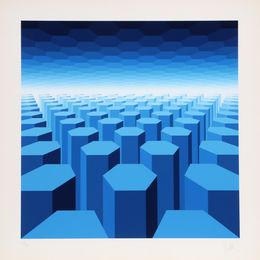
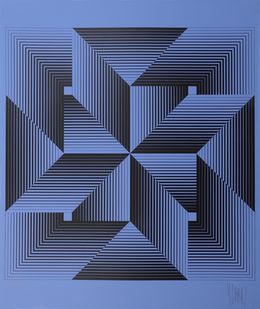
Jean-Pierre Vasarely, also known as Yvaral, is a French artist born in Paris in 1934 and died in the same city in 2002. Son of Victor Vasarely, a major figure in Op Art, he developed a personal research in geometric abstraction, perception, and movement starting in the 1950s. He studied graphic arts and advertising at the École des Arts appliqués de Paris between 1950 and 1953, a training that plays an important role in his approach to composition, color, and visual structure.
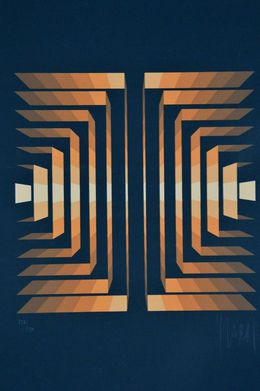
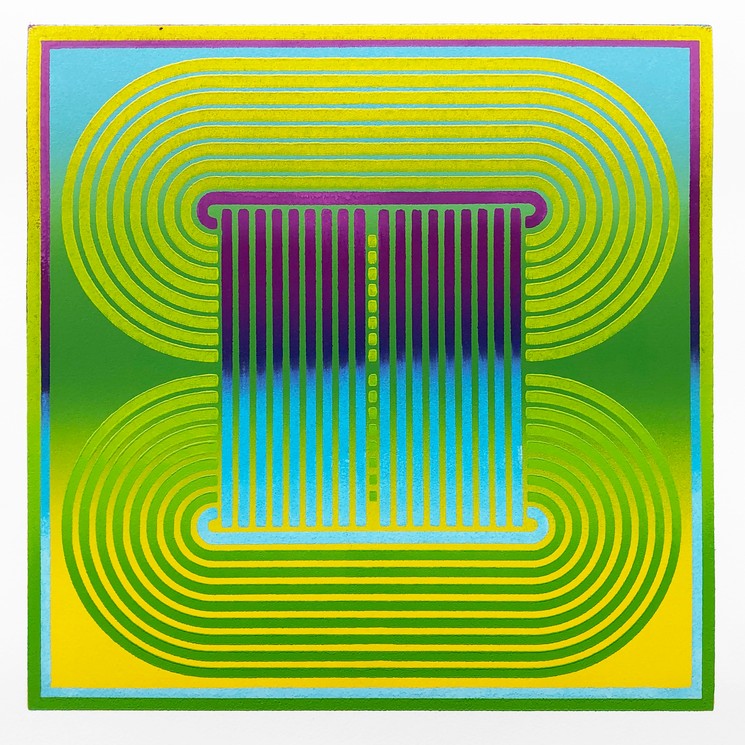
Starting in 1954, Yvaral worked in the field of optical art and kinetic art. His early research explores the possibilities offered by geometric forms, repetitions, contrasts, and color interactions to produce effects of vibration and apparent movement. His work does not only seek to represent movement: it invites the viewer to experience it through a constantly solicited perception. His works thus play on the notions of illusion, rhythm, depth, and visual displacement.
In 1960, Yvaral participated in the founding of the Group of Visual Research (GRAV) with Julio Le Parc, François Morellet, Francisco Sobrino, Horacio Garcia Rossi, and Joël Stein. The group seeks to develop an abstract visual language based on simple geometric elements and an experimental approach to perception. This approach places Yvaral in one of the most important researches in kinetic art and optical art in France during the 1960s. His research also extends to kinetic sculpture and installations, as evidenced by Structure optique en fils vinyliques transparents, created in 1963-1964 and kept at the Centre Pompidou. The work associates serigraph printed wood and nylon threads in a structure designed around optical and kinetic principles.
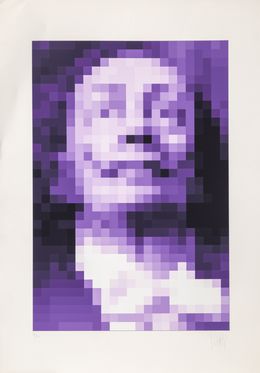
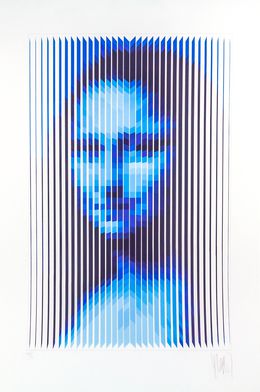
Starting in the 1970s, Yvaral deepened his research into the relationships between art, mathematics, and technology. In 1975, he used the term "Digital Art" to designate a practice based on digital or algorithmic rules. This conception of the digital does not yet refer to the common use of computing: Yvaral is primarily interested in the possibility of constructing an image from systems, numbers, and programmed transformations. Subsequently, he actually uses the computer to process and transform images, while the final works remain made by hand.
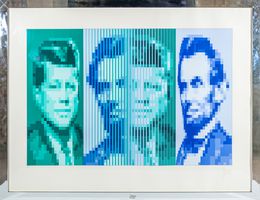
This new approach allows him, in particular, to develop series of portraits from immediately recognizable images. Faces of personalities like Marilyn Monroe are subjected to geometric and digital transformations until they become abstract compositions, while retaining enough elements so that the original model remains identifiable. Yvaral thus creates a dialogue between figuration and abstraction, between familiar image and geometric construction. This research extends his concerns about perception while opening his work towards the beginnings of digital art and the image generated according to mathematical systems.
Throughout his career, Yvaral has participated in many international exhibitions and his work has joined important public collections. His works are particularly preserved at the Tate, the Centre Pompidou, the Hirshhorn Museum and Sculpture Garden, the Louisiana Museum of Modern Art, and the Musée d'Art moderne de Paris. His work continues to be shown in exhibitions dedicated to Op Art, kinetic art, and the visual research of the 20th century. In 2016, his works notably participated in the exhibition The Illusive Eye at the Museo del Barrio in New York.
Through his use of geometry, mathematical systems, color, and progressively the computer tool, Yvaral occupies a singular place in the history of optical art, kinetic art, and digital art. His work establishes a link between the visual experiments of the 1950s and 1960s and the new possibilities offered by digital technologies. By progressively transforming painting into a space governed by rules, structures, and algorithms, Yvaral contributes to renewing the relationship between the artist, the image, and perception.










Discover other selections of artworks
Choose your preferences
The best
of art, online
SIGN IN - REGISTER
Forgot your password?
No worries, enter you email address and we'll send you a link to reset your password.
ReturnUpload an image and discover similar artworks available on Artsper