Bronze Sculpture for Sale

Upload an image to find similar artworks

Painting : oil · 48 x 63 x 7 cm 18.9 x 24.8 x 2.8 inch · Ready to hang
One of the last works available by this artist
How does it work?
1
Choose an artwork you like and the desired duration of the lease-purchase agreement
2
Fill out your profile to be contacted by a member of our team
3
Once the contract is signed, you will be debited every month for the duration of the agreement
Shipped from: France
Delivery to: France , € 53
Estimated delivery: Less than one week
Free returns within 14 days, full refund
Sold with certificate of Authenticity from the gallery
Invoice from the gallery Learn more
All payments are secured with 3D Secure validation to protect your confidential information.




Type
Painting : Unique artwork
Condition
Artwork sold in perfect condition, framed, ready to hang
Authenticity
Sold with certificate of Authenticity from the gallery
Invoice from the gallery
Signature
Hand-signed by artist
Dimensions ( cm • inch )
48 x 63 x 7 cm 18.9 x 24.8 x 2.8 inch Height x Width x Depth
Artwork dimensions including frame
64 x 75 x 8 cm 25.2 x 29.5 x 3.1 inch
Art gallery
Credentials
Vetted seller since 2025
Discount
This seller offers discount when you purchase multiple artworks.
Minor retouching under UV light (as seen on pictures). Slight invisible crack in the canvas (could be restored). Original Victorian frame.
Eugène Modeste Edmond Poittevin was born in Paris in 1806, at 8 rue de Ventadour in his family home. His father, Nicolas Jean Baptiste Modeste Poidevin, originally from Rouen, was a cabinetmaker and later the chief cabinetmaker at the Château de Versailles, where the family moved. An average student but an artist at heart, Eugène became a pupil of a local painter named Ledoux. At 15, to prove his artistic vocation against his father's wishes, he made a copy of the painting "Le Sac de la Ville" by Nicolas Antoine Taunay at the Château de Versailles. This copy caused a sensation in Versailles, leading the Duchess of Berry to grant him a pension of 500 francs from King Louis XVIII's funds. He briefly attended the studio of Xavier Leprince, whose career was short, with only around twenty paintings exhibited in the Salons of 1819, 1822, and 1824. Nevertheless, Poittevin borrowed Leprince's taste for anecdotal and picturesque scenes. Under Leprince's influence, Eugène traveled to Normandy, Brittany, the Landes, Italy, Belgium, the Netherlands, Germany, and England (London).
In 1826, after Leprince's death, Poittevin was admitted to the École des Beaux-Arts in Paris, in the studio of Louis Hersent, who also trained Karl Girardet and Augustin Pajou. He unsuccessfully attempted the Grand Prix de Rome twice.
After Leprince's death, he took over his studio and exhibited three works at the Salon under the name Potdevin, achieving success.
His father changed his name to Le Poittevin and was appointed to the Château des Rohan near Strasbourg. In 1829, Eugène Le Poittevin won second prize in the Grand Prix de Rome competition, deemed too young for the first prize. His teacher Hersent encouraged him to work from nature. He exhibited successfully at the Salons from 1831 until his death in 1870.
Early Salon Exhibitions
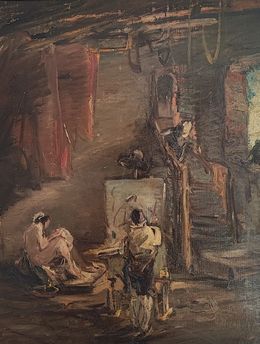
Following Leprince's premature death in December 1826, Poittevin completed one of the major compositions he had planned for the 1827 Salon: a view of his studio that he had begun the previous year. He finished this painting by executing 11 of the 36 portraits included in the composition. The painting was presented at the 1827 Salon under the title "Intérieur de l'atelier de feu Leprince", with Poittevin identified as Eugène Potdevin. This marked Poittevin's first participation at the Salon. He also presented three works: "Des Moissonneurs" (acquired by the Duchess of Berry for her gallery), "Une porte de ferme", and "Vue prise entre Saint-Germain et Versailles". The latter was purchased by collector Du Sommerard, who also acquired "Intérieur de l'atelier de feu Leprince" finished by Poittevin.
His second exhibition at the 1831 Salon marked a significant breakthrough. He presented nine paintings, this time under the name Lepoittevin, featuring picturesque landscapes populated with figures, climatic views, rural motifs, and marine scenes. Many titles revealed the precise locations depicted, such as "Moulin anglais situé sur le bord de la mer", "Intérieur de cour, pris en Normandie", and "Un sloop échoué, vue prise sur les côtes d'Angleterre, à la marée basse". His marine painting "Vue prise aux Bords de la Tamise" earned him a second-class medal. He continued to shine in subsequent Salons, receiving honorable mentions in 1833 and 1834, and a first-class medal in 1836 for another marine, "Pêcheurs normands".
From 1836, he began exhibiting at the Salon of Brussels; that year, he presented three works: "Sauvetage de débris", "Scène de pêcheurs normands, à marée basse", and "Défense d'une cote". He was awarded a silver medal at this Salon. This recognition led him to focus more on Belgium, as noted in the 1837 Salon of Bruges, where he was listed as residing in Brussels. Interestingly, he also appeared in the French press as a member of the Academy of Fine Arts in Brussels.
In France, official recognition came swiftly; it peaked at the Salon of 1843 when he received the Legion of Honor at the age of 37.
Caricatures of 1830
He provided lithographic plates for Charles Philipon's journal "La Caricature" and initiated the trend of lithographic caricatures, like "Le Diable fecit" and "Diabolico Foutromanie" (a collection of 12 plates), which featured humorous and often risqué scenes. These works were quickly censored and condemned to destruction in 1845 for moral offenses.
Commissions for Versailles
In 1834, the Louis-Philippe government commissioned him to create "Combat de Wertingen du 8 octobre 1805" for the historic museum at Versailles, followed by "Bataille navale remportée devant l'île d'Embro, 1346" in 1835. His work "L'Attaque des ours blancs" was purchased by the state and displayed at the Musée du Luxembourg. After traveling to Algeria in 1840, he returned ill but exhibited works such as "Gueux de mer" and "Soleil couchant" at the Rouen Salon. He received further commissions for the historic museum at Versailles, including "La Prise de Baruth le 17 mai 1109" and "Déjeuner offert à la reine Victoria sous la tente au mont d'Orléans".
Success in Prussia and Belgium
He traveled and exhibited regularly in Berlin starting in 1839, then in Belgium. By 1841, he was exhibiting in Leipzig and Dresden. He was promoted by Prussian art dealer Louis Sachse, a pioneer in the art market. His classes attracted many German students in Paris, and he became a member of the academies of Antwerp and Berlin.
He was appointed Knight of the Legion of Honor in Paris in 1843 and Knight of the Order of Leopold in Brussels in 1845. He married Stéphanie Maillard in 1846, with whom he had a daughter, Eugènie. The name change to Le Poittevin was formalized then. His second daughter, Marie, was born in 1847. In 1848, he was part of a committee to organize and safeguard the interests of art and artists.
In 1849, he was named official painter of the Marine.
Genre Scenes
His wife died in 1851, and he built a villa, La Chaufferette, in Étretat, along with a studio by the seaside where he frequently stayed. The themes of the sea, fishermen, and their families, with whom he developed friendly relationships, became central in his work. He painted scenes of seaside bathing and exhibited works such as "Les Bains de Mer à Étretat". At the 1867 Exposition Universelle in Paris, he showcased "Bains de Mer, plage d'Étretat", which was acquired by Napoleon III for the Élysée Palace. His "Naufrage dans les mers polaires" was presented at the 1869 maritime exhibition in Le Havre.
That same year, he lent his Étretat studio to Gustave Courbet, who painted his famous "Falaise d'aval après la pluie" and the series "La Vague" there.
Simultaneously, Poittevin, known for his humor, created whimsical pieces like "Cendrillons" and "Petit Chaperon rouge", which caricatured friends of the artist watching a Norman woman bathe.
In 1870, despite being gravely ill, he presented his final painting at the Salon, "Vue des environs d'Étretat pendant la saison des bains". He died at his daughter Eugénie's home on August 6, 1870. His second wife, Adèle Pironin, whom he married in 1861, passed away in 1872.
The collection from Poittevin's studio, which included 144 paintings and thousands of drawings, was sold at the Drouot auction house in Paris from April 9 to 12, 1872.
Style
His genre scenes were inspired by Eugène Isabey, who introduced him to Étretat, and by Dutch painting, which he studied during a stay in the Netherlands. He regularly collaborated with friends like Hippolyte Bellangé and Émile-Henri Brunner-Lacoste.
His preference for realism connected him to the young school of the 1830s while he remained true to the romantic style of his early years as a historical painter for Versailles, close to Léon Cogniet.
Critic Charles-Paul Landon described Poittevin as an uneven painter of great talent whose Salon works varied significantly in quality, advising him to be cautious. In 1839, "Journal des artistes" noted Poittevin's facility with talent, which he often overused, presenting 12 to 15 paintings at the Salon each year. At the 1848 Salon, his work "David Teniers conduisant Don Juan D'Autriche" was met with severe criticism from Louis Van Roy for its drawing and perceived false colors, despite noting its elegance and distinction.
The Hôtel Blanquet in Étretat
A precursor, alongside Eugène Isabey, to the many landscape painters who frequented Étretat in the 19th century, Eugène Lepoittevin was also the creator of the famous sign painted in 1842 that adorned the façade of the Hôtel Blanquet, where artists, including Claude Monet, stayed. This sign is preserved at the
Musée des Pêcheries in Fécamp.
A Rediscovered Painting
"Les Bains de Mer, Plage d'Étretat", painted in 1864 and acquired by Napoleon III for his personal collection, was considered lost since the emperor's fall in 1870. It reappeared 150 years later at Sotheby's Paris on December 3, 2020, where it fetched a record price of €226,800 for the artist.

Appointed official painter of the navy in 1849
Landscape painter, draftsman, watercolorist
He primarily depicted the lives of fishermen on the coasts of the English Channel.
Born Eugène Modeste Edmond Poidevin, he was admitted to the École des Beaux-Arts in Paris in the workshops of Louis Hersent and Xavier Leprince, from whom he borrowed his taste for anecdotal scenes.
He failed to win the Grand Prix de Rome, but obtained a second prize in 1829.
He exhibited successfully at the Salons from 1831 until his death in 1870.
He provided illustrations for Charles Philipon's newspaper. Eugène
Lepoittevin launched the trend of caricature collections, such as [title missing] or [title missing] (collection of 12 plates),
His work was doubly inspired by that of Eugène Isabey, who introduced him to Étretat, and by Dutch painting, which he studied during a stay in the Netherlands. His taste for realism connects him to the young school of 1830, while remaining faithful to the Romantic style of his early work. Lepoittevin owned a villa in Étretat, where he hosted Gustave Courbet in 1869.
Eugène Modeste Edmond Poidevin was born in Paris, in the 1st arrondissement, at 8 rue de Ventadour, in his parents' home. His father, Nicolas Jean Baptiste Modeste Poidevin, originally from Rouen, was a cabinetmaker and assistant furniture storekeeper/upholsterer, then head cabinetmaker at the Palace of Versailles, where the family settled. A mediocre student but an artist at heart, Eugène Le Poittevin became a pupil of a local painter, Ledoux. At 15, to prove his vocation to his father, who opposed it, he made a copy at the Palace of Versailles of a painting by Nicolas Antoine Taunay. The copy caused a sensation in the city of Versailles, and the Duchess of Berry granted the young man a pension of 500 francs from the treasury of King Louis XVIII. He briefly attended the workshop of Xavier Leprince; The latter had a short career, as the public only saw about twenty of the artist's paintings, which he exhibited at the Salons of 1819, 1822, and 1824. Le Poittevin is nevertheless said to have borrowed from him a taste for anecdotal and picturesque scenes. Under Leprince's influence, Eugène Le Poittevin traveled to Normandy, Brittany, the Landes region, Italy, Belgium, the Netherlands, Germany, and England.
In 1826, following Xavier Leprince's death, Le Poittevin managed to gain admission to the École des Beaux-Arts in Paris, in the studio of Louis Hersent, where Karl Girardet and Augustin Pajou also trained. He twice unsuccessfully attempted the Grand Prix de Rome competition. After Leprince's death, he moved into his master Leprince's studio and exhibited three works at the Salon under the name Potdevin, achieving success. His father changed his name to Le Poittevin and was appointed to the Rohan castle near Strasbourg. In 1829, Eugène Le Poittevin won second prize in the Grand Prix de Rome competition, deemed too young for first prize. His master Hersent recommended that he work from life. He exhibited successfully at the Salons from 1831 until his death in 1870.
Following Leprince's untimely death in December 1826, Le Poittevin is said to have completed one of the large compositions he planned to exhibit at the 1827 Salon: a view of his studio begun the previous year. Le Poittevin is believed to have finished this painting by creating 11 of the 36 portraits included in the composition. While the canvas was presented at the 1827 Salon under the title [title missing], the Salon catalogue reveals the involvement of the young painter Le Poittevin, identified as Eugène Potdevin. This was Le Poittevin's first participation in the Salon. At the same Salon, he presented three of his works: (which was acquired by the Duchess of Berry for display in her gallery), and [the painting]. This last painting was acquired by the collector Du Sommerard, who also purchased the [work] completed by Le Poittevin. Catalogue of the exhibition presented from July 14th.
In 1834, the government of Louis-Philippe commissioned him to create a work for the historical museum of Versailles, followed in 1835 by another. His work was purchased by the State and displayed at the Luxembourg Museum. In 1840, he traveled to Algeria and returned ill. He exhibited upon his return, and at the Rouen Salon. He received commissions for the historical museum of Versailles for [works to be inserted here]. His wife died in 1851. Around this time, he had a villa built for himself in Étretat, as well as a studio on the seafront where he stayed regularly. The theme of the sea, fishermen, and their families, with whom he maintained cordial relations, became central to his work (e.g., [work to be inserted here], 1860, Fécamp, Musée des Pêcheries). These themes, which he exhibited at the Salon, were lithographed by Jean-Pierre-Marie Jazet for Goupil et Cie [publisher name missing]. He painted scenes of sea bathing (Musée des Beaux-Arts de Troyes). At the 1867 Universal Exhibition in Paris, he sent his painting, which was acquired by Napoleon III for the Élysée Palace. His work was exhibited at the Maritime Exhibition in Le Havre in 1869. That same year, he lent his studio in Étretat to Gustave Courbet, who came to paint his famous painting and series there. In parallel, Le Poittevin, who had a keen sense of humor, painted Cinderellas, Little Red Riding Hood, and a painting (Saint Petersburg, Hermitage Museum) caricaturing two of the artist's friends watching a Norman woman bathing. In 1870, despite being seriously ill, he exhibited his last painting at the Salon. He died at his daughter Eugénie's home on August 6, 1870. His second wife, Adèle Pironin, whom he married in 1861, died in 1872. Le Poittevin's studio, including 144 paintings, thousands of drawings and his collections, was sold in Paris at the Hôtel Drouot from April 9 to 12, 1872.
Netherlands
Ukraine

United Kingdom
France

France
Italy

Italy
Spain
All our reviews are extracted from Verified Reviews

Painting . 53 x 74 x 5.5 cm Painting . 20.9 x 29.1 x 2.2 inch
€1,650

Painting . 65 x 90 x 10 cm Painting . 25.6 x 35.4 x 3.9 inch
€2,940


Print . 48 x 36 x 0.5 cm Print . 18.9 x 14.2 x 0.2 inch
€800
Painting . 73 x 58 x 1 cm Painting . 28.7 x 22.8 x 0.4 inch
€1,429
Painting . 50 x 70 x 2 cm Painting . 19.7 x 27.6 x 0.8 inch
€1,108

Painting . 16 x 23 x 7 cm Painting . 6.3 x 9.1 x 2.8 inch
€3,500
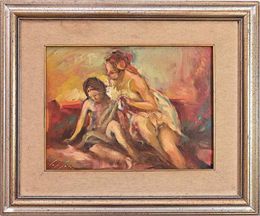

Painting . 76 x 90 x 3 cm Painting . 29.9 x 35.4 x 1.2 inch
€900
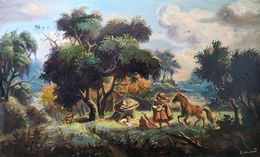

Fine Art Drawings . 34 x 56 x 0.3 cm Fine Art Drawings . 13.4 x 22 x 0.1 inch
€7,600
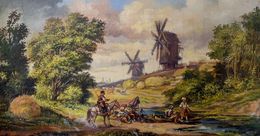
Painting . 31 x 55 x 2 cm Painting . 12.2 x 21.7 x 0.8 inch
€630

Photography . 100 x 70 x 0.2 cm Photography . 39.4 x 27.6 x 0.1 inch
€685
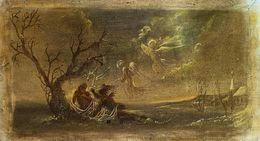
Print . 56 x 76 x 0.1 cm Print . 22 x 29.9 x 0 inch
€1,980
At Artsper, our mission is to allow you to collect works of art with complete peace of mind. Discover the protections we offer at every stage of your shopping experience.
We work in close collaboration with carefully selected art galleries. Each seller on Artsper is carefully examined and approved by our team, thus ensuring compliance with our code of ethics. You therefore have the assurance of purchasing authentic, high-quality works.
Before being posted online, all artwork on Artsper is reviewed and validated by our moderation team. You can browse with complete peace of mind, knowing that each piece meets our criteria of excellence.
Our team of contemporary art experts is available by phone or email to answer all your questions. Whether you want advice on a work or a tailor-made selection to enrich your collection, we are here to support you.
If you have purchased a work on Artsper and wish to resell it, we offer you a dedicated platform to relist it. To find out more, click here.
You have the possibility to propose a price for certain works, just like in a gallery. This feature allows you to initiate discussions and potentially acquire your coins at advantageous prices.
Our team will negotiate for you and inform you as soon as the best offer is obtained. Do not hesitate to call on our expertise to ensure a transaction at the best price.
We want you to be completely satisfied with your purchase. If the work you receive is not to your liking, you have 14 days to return it free of charge, and you will be refunded in full, whatever the reason.
All credit card payments are processed by Paybox, the world leader in payment solutions. Thanks to their strict security standards, you can transact with confidence.
In the rare event that an artwork arrives damaged or not as described, we are here to help. Whether for a return, refund, restoration or exchange, our team will support you throughout the process and will ensure that we find the solution best suited to your situation.
Use one of the payment methods available on Artsper for your order.
Report any problems within one week of receiving the work.
Provide required photographic evidence (including original artwork and packaging).
The received work lacks a described characteristic (for example, a signature or frame).
The artwork has significant differences from its description (e.g. color variation).
The work is damaged upon receipt.
The work is lost or damaged by the carrier.
Delivery is significantly delayed.
With Artsper, you collect with complete peace of mind.
Have you purchased a painting, sculpture or work on paper?
Find our expert advice for the conservation and promotion of your works in the articles below:
Artsper delivers internationally. The list of countries is available in the first step of your cart.
If your country is not listed contact us at [email protected] and we will see what we can do.
Note that Customs fees may apply for works shipped internationally. This is indicated in the first step of the shopping cart.
You can choose a delivery address different from the billing address. Make sure that a trusted person is present to receive the work if you cannot be there.
Artsper offers you access to more than 200,000 works of contemporary art from 2,000 partner galleries. Our team of experts carefully selects galleries to guarantee the quality and originality of the works.
You benefit from:
Works at gallery price
Return within 14 days, regardless of your location
Easy resale of the work purchased on Artsper
Personalized research tools (selection and tailor-made universe)
Our customer service is available for any assistance.
Choose your preferences
The best
of art, online
SIGN IN - REGISTER
Forgot your password?
No worries, enter you email address and we'll send you a link to reset your password.
ReturnUpload an image and discover similar artworks available on Artsper