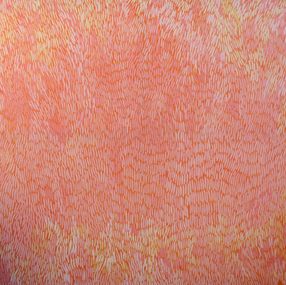
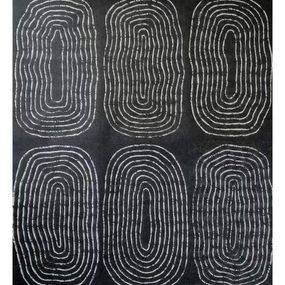
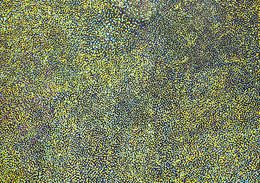
Christine Nakamarra Curtis painted a symbolic representation of Mina Mina's Dreaming, a significant creation story associated with the ceremonial site of the same name, located near the ephemeral salt lake Mackay. The story follows a group of ancestral women who, during their journey, created landscape features as well as several laws and objects, such as the digging stick, the bush truffle, and the snake vine.
In the painting, we can see the paths taken by the women, the sand dunes, the vines and the bush food collected, notably bush truffles.
Mina Mina is an extremely important ceremonial site for women, located approximately 600 km west of Yuendumu, just east of Lake Mackay and the border with Western Australia. The area has a salt lake that is generally dry. There are also several seepage ponds, sand hills, and a large stand of desert oak.
The Dreaming of Mina Mina is an important source of ritual knowledge and social organization for the Warlpiri Aboriginal people, particularly regarding the different roles played by men and women. There are several elements associated with Mina Mina. In addition to the snake vine, these may include women, digging sticks, ceremonial skirts, desert oak, and desert truffle.
The Dreaming of Mina Mina tells the story of a group of ancestral women who traveled from west to east. During the Dreamtime, these ancestral women danced at Mina Mina and digging sticks emerged from the ground. They picked up these sticks and began traveling east. They carried these sticks on their shoulders and were adorned with skirts of braided rope, white feathers, and necklaces made of seeds. They continually anointed themselves with "shining grease" to increase their ritual powers as they went. During their journey, the women were followed by a bird of the Jakamarra subsection. The bird called and then hid in the bushes behind them.
When the women dance at Mina Mina, they create a large cloud of dust that sweeps away the snake ancestors. They had already transformed from grubs into snakes at Kunajarrayi (Mount Nicker, 200 km southwest of Yuendumu) and had stopped at Mina Mina to watch the women dance. This dust cloud pushes them further north, to Yaturluyaturlu (near the Granites gold mine). In this way, the Dreaming of the Women and the Dreaming of the Grubs intersect. This allowed the ancestral women to observe the grubs and learn how best to locate and cook them—skills that Warlpiri women still use today.
The women set out from Mina Mina towards the east, dancing, digging for medicinal plants, collecting snake vine and creating many places along the way. The rope-like vine grows along the trunks and branches of trees, including the desert oak. It is used as a ceremonial decoration and as a strap for carrying parraja or coolamons (food dishes) and water containers. Snake vines can be tied around the forehead to treat headaches, and the Warlpiri sometimes chew the leaves to treat severe colds.
As the women traveled east, they passed through Kimayi, a stand of desert oak trees. They crossed sand hills where the Bush Potato ancestors and the Yam or 'little yam' ancestors of Yumurrpa fought a great battle over women. This battle is also a very important story for the Warlpiri. The women traveled to Janyinki and stopped at Wakakurrku (Mala Bore), where they drove their digging sticks into the ground. These sticks grew into mulga trees, which still grow at Wakakurrku today. The women then traveled to Lungkardajarra (Rich Bore), where they looked back to their country to the west and began to feel nostalgic for what they had left behind.
The women split up at Lungkardajarra. Some of them headed east to Yarungkanyi (Mount Doreen) and continued east. They passed through Coniston into Anmatyerre country, then continued to Alcoota and Aileron and beyond. The other group of women traveled north from Lungkardajarra to Karntakurlangu. These women stopped at Karntakurlangu (an area that literally means "women's") to dig for sand monitor lizards (goannas) and desert truffles before continuing north. However, both groups of women eventually grew so homesick for the desert oaks to the west that they returned to Mina Mina, where they stayed for good.
Provenance: Artists from Warlukurlangu (official Aboriginal Artists Cooperative), Yuendumu, Northern Territory, Australia.
Ref. No: 246/24ny
The work is accompanied by the official certificate of authenticity from the artist's cooperative. The name of the Aboriginal artists' cooperative and the unique registration number assigned to the work are indicated on the back of the canvas, allowing the ethical and authentic provenance of the work to be traced.