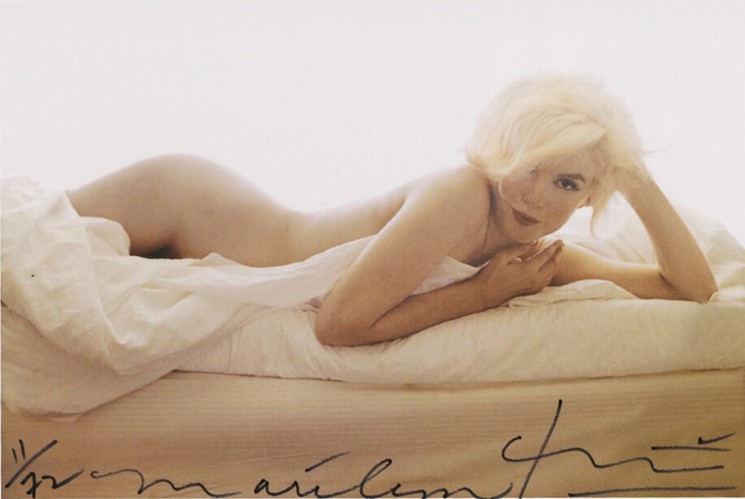

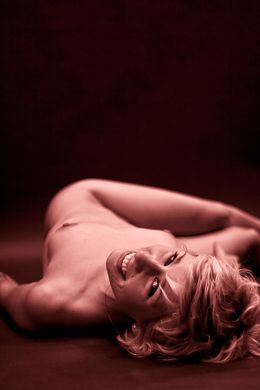
Marilyn new baby on the bed, 2009
Photography : ink · 20 x 30.5 x 1 cm 7.9 x 12 x 0.4 inch
$3,384
3 384 $US
One of the last works available by this artist
Shipping & delivery
Shipped from: France
Delivery to: United States , $ 91
Estimated delivery: One to two weeks
Free returns within 14 days, full refund
Authenticity guaranteed
Sold with certificate of Authenticity from the gallery
Invoice from the gallery Learn more
Secure payment • Card, Amex, PayPal...
We accept several payment methods:
Paypal
American Express
Visa
Mastercard
Apple Pay
Google Pay
- Credit cards (Visa, MasterCard)
- American Express
- PayPal
- Bank transfer
- Gift card
- Apple Pay / Google Pay
All payments are secured with 3D Secure validation to protect your confidential information.
Verified Reviews : 9.6/10
Similar works


About the artwork
Type
Photography : numbered and limited to 72 copies
1 copy available
Condition
Artwork sold in perfect condition, not framed
Authenticity
Sold with certificate of Authenticity from the gallery
Invoice from the gallery
Signature
Signed artwork
Technique & Support
Dimensions ( cm • inch )
20 x 30.5 x 1 cm 7.9 x 12 x 0.4 inch Height x Width x Depth
Sold by
Art gallery
Credentials
Vetted seller since 2015 • Top Seller
Description
Bert Stern (1929 – 2013)
Photograph in inkjet print on baryta paper.
Photo signed and numbered by the artist with stamp on the back.
Numbered edition of 72 copies.
Likewise, the certificate was completed, signed, numbered and titled by Bert Stern during his lifetime.
Paper dimensions: 33 x 48 cm
Photo dimensions: 20 x 30.5 cm
The photos of Marilyn were taken during the famous last sitting, which took place between Bert Stern and Marilyn Monroe. It was his last posing session before his death in August 1962.
Presentation
Born in 1958 in Cyprus, lives and works in Saint-Étienne.
Represented by Galerie Schumm Braunstein, Paris.
Mechanics of perception
From the articulation of two elements, two notions, two complementary processes, which operate simultaneously, I create mechanisms of perception. For many years, my research based on this same phenomenon, deployed in the field of painting, continues today in the field of paper structure.
Draw a geometric element inside a rectangle.
Its internal / external delimitation produces the simultaneous appearance of a second element, inscribed in the surface of the rectangle and nested with the other. From the observation of this data, I create and define the Geogram: unit formed in a rectangle by the interweaving of two geometric elements, articulated in full / empty.
5 complementary units are retained, “primary forms” the geograms. These same geograms, materializing in the painting space, are transferred to the paper surface and form planograms, plane structures articulated by the fold / unfold.
What links the two fields of research is the problem of the surface. The actions carried out and the procedures used are different, yet having the same function: to transform the surface by introducing an articulation and to produce a mechanism of perception.
What we observe in these works is always a formation and the “how” of this leads us to the process that produces it. The planogram since its inception, 2002, is presented in its paper structure, "naked", in direct contact with the environment, wall, floor, space.
In 2015, it unfolds in a predefined space, a square white frame, thus establishing a new tension between its own training limits (height, width, depth) and those of the frame.
In the first part, the line planogram, centered in the continuity of the paper, engages the square in its verticality. The two complementary elements, which are at the edge of a line, give their extension a different formation. According to these extensions, the lines combine together in a space made up of verticality and horizontal interruption, play and thwart the limits between frame and planogram, continuing to reveal its mechanism by going back to its origin.
In 2016, the repeated planogram disappeared, giving way entirely to its extensions: strip articulated at 90 °, line folded at 180 ° and line at 270 ° silent folding.
Thus the planogram becomes pligram. The fold is the mechanism that transforms the surface of the paper, while the incision establishes perception.
Its flattening is done directly by a line with the cutter. The vertical, thus memorized in the fiber of the paper, meets the horizontal incision and causes an interruption, the articulated band is replaced by the folded or silent line.
Thus in this new distribution of the surface, the redistribution of perception of two complementary elements takes place between the lines and the intervals.
I think that the formation of memory, language, thought cannot be done without articulation of at least two relationships, processes, notions ... The articulations presence / absence, fold / unfold, are specific to this mental mechanism.
- A. Stella
Discover similar artists


Reviews from our customers
All our reviews are extracted from Verified Reviews
You may also like

Alberto Ricardo
Print . 80 x 60 x 5 cm Print . 31.5 x 23.6 x 2 inch
$117


Bert Stern
Photography . 48 x 33 cm Photography . 18.9 x 13 inch
$3,384
Recommended by Artsper

Simone Simon
Photography . 40 x 30 x 0.12 cm Photography . 15.7 x 11.8 x 0 inch
$1,050




Guy Sargent
Photography . 88 x 68 x 0.2 cm Photography . 34.6 x 26.8 x 0.1 inch
$1,079

Guy Sargent
Photography . 88 x 68 x 0.2 cm Photography . 34.6 x 26.8 x 0.1 inch
$1,079


Guy Sargent
Photography . 88 x 68 x 0.2 cm Photography . 34.6 x 26.8 x 0.1 inch
$1,079

Bert Stern
Photography . 33 x 48 x 1 cm Photography . 13 x 18.9 x 0.4 inch
$5,718
Idan Wizen
Photography . 60 x 40 x 1 cm Photography . 23.6 x 15.7 x 0.4 inch
$875

Dasha & Mari
Photography . 101 x 101 x 1 cm Photography . 39.8 x 39.8 x 0.4 inch
$2,917

Larry Clark
Photography . 13 x 18 x 0.1 cm Photography . 5.1 x 7.1 x 0 inch
$350