







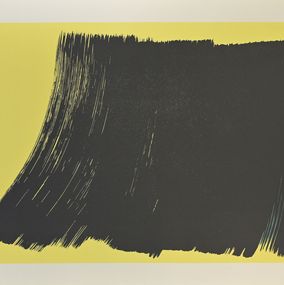
L-05-1976, 1976
Print : lithography · 75 x 102 cm 29.5 x 40.2 inch
€2,500
2 500 €
Shipping & delivery
Shipped from: Spain
Delivery to: Germany Free delivery
Estimated delivery: Two to three weeks
Free returns within 14 days, full refund
Authenticity guaranteed
Sold with certificate of Authenticity from the gallery
Invoice from the gallery Learn more
Secure payment • Card, Amex, PayPal...
We accept several payment methods:
Paypal
American Express
Visa
Mastercard
Apple Pay
Google Pay
- Credit cards (Visa, MasterCard)
- American Express
- PayPal
- Bank transfer
- Gift card
- Apple Pay / Google Pay
All payments are secured with 3D Secure validation to protect your confidential information.
Verified Reviews : 9.6/10
Similar works


About the artwork
Type
Print : numbered and limited to 108 copies
1 copy available
Condition
Artwork sold in perfect condition, not framed
Authenticity
Sold with certificate of Authenticity from the gallery
Invoice from the gallery
Signature
Hand-signed by artist
Technique & Support
lithography on paper
Dimensions ( cm • inch )
75 x 102 cm 29.5 x 40.2 inch Height x Width x Depth
Sold by
Art gallery
Credentials
Vetted seller since 2026
Description
Original lithograph printed and published by the Erker-Presse, St. Gallen. The sheet bears the press's blindstamp and carries the publisher's annotations on the verso. Edition of 108.
Hartung catalogued his own work by a private alphanumeric system in which the letter records the technique and the figures the sequence and the year; L denotes a lithograph.
The Erker-Presse was founded in 1963 by Franz Larese (1927-2000) and Jürg Janett (1927-2016), who had opened their gallery and publishing house at St. Gallen in 1958 and moved to the Gallusplatz in 1962. The press gave Hartung a workshop in which he drew directly on the stone, working with the master printer Urban Stoob; the house used neither zinc plates nor transfer paper, so that every sheet issued from it is an original lithograph in the strict sense. The large formats of the 1970s show Hartung deploying the roller, the spatula and the scraper across the full sheet: broad fields of ink opened by bundles of scratched lines, the gesture registered as a subtraction from the surface rather than as a stroke laid upon it.
Hartung's graphic work is catalogued by Rainer Michael Mason and, for the years to 1965, by Rolf Schmücking. The Erker production is documented in the press's own publications and in the Erker archive, now divided between the Kunstmuseum St. Gallen - which holds over a thousand sheets - and the Kantonsbibliothek Vadiana.
Presentation
Hans Hartung (21 September 1904 – 7 December 1989) was a pioneering German-French painter renowned for his dynamic gestural abstract style. In 2019 and 2020, the Musée d'Art Moderne de Paris hosted a major retrospective celebrating Hartung's innovative contributions to abstract art. This landmark exhibition revitalized interest in his work, highlighting his influence on contemporary art movements.
In 2024, the Hartung-Bergman Foundation in Antibes continues to promote his legacy through exhibitions and educational programs. Recent showcases have explored his experimental techniques, including his late-career works characterized by bold, dynamic brushstrokes and innovative use of materials. His art remains highly relevant, inspiring new generations of artists and collectors worldwide.
Born in Leipzig, Hartung developed an early interest in painting and, by 1922, had created a series of abstract tachiste watercolors. He pursued studies in philosophy and art history at Leipzig University before refining his artistic skills at the Academies of Leipzig (1924-1925), Dresden (1925-1926), and Munich (1928).
Hartung lived primarily in Paris from 1926 to 1931, with travels to Holland and Belgium, where he was influenced by artists such as Georges Rouault, Paul Cézanne, Vincent van Gogh, and later, by Cubism. His first solo exhibition took place at Galerie Heinrich Kühl in Dresden in 1931. Between 1932 and 1934, he resided on Minorca, returning to a calligraphic abstract style. After a brief stay in Berlin in 1935, Hartung fled Nazi Germany and settled in Paris, where he connected with influential abstract artists like Jean Hélion, Wassily Kandinsky, and Piet Mondrian.
In 1938, encouraged by his friendship with sculptor Julio González, Hartung explored sculpture. During World War II, he fought in the French Foreign Legion, sustaining severe injuries in 1944. After a six-year hiatus, he resumed painting in 1945 and later became a French citizen. Hartung's post-war works featured expressive graphic signs and bold gestural marks, created with brushes or, from 1961 onwards, scratched into wet paint. From 1962, he experimented with compositions featuring large, shadowy dark patches.
Hartung achieved international acclaim, winning one of the top painting prizes at the 1960 Venice Biennale. He was married to Norwegian painter Anna-Eva Bergman, with whom he shared his life and artistic journey in Paris.
In 2025, Hartung's legacy continues to be celebrated through significant exhibitions and institutional initiatives. The Musée de l'Orangerie in Paris is featuring his work in the exhibition Out of Focus: Another Vision of Art from 1945 to the Present Day, which explores the motif of blurriness in modern and contemporary art.
Discover similar artists

Reviews from our customers
All our reviews are extracted from Verified Reviews
You may also like


Hans Hartung
Print . 59.5 x 86.5 x 0.2 cm Print . 23.4 x 34.1 x 0.1 inch
€1,200
Recommended by Artsper

L'Outsider
Painting . 92 x 65 x 3 cm Painting . 36.2 x 25.6 x 1.2 inch
€3,000


Despa Hondros
Fine Art Drawings . 55 x 77 x 0.1 cm Fine Art Drawings . 21.7 x 30.3 x 0 inch
€1,200


Regis Duvignau
Photography . 38 x 48 x 1 cm Photography . 15 x 18.9 x 0.4 inch
€1,200


Alessandra Bisi
Painting . 30 x 20 x 0.1 cm Painting . 11.8 x 7.9 x 0 inch
€170


