





Charlotte Abramow: photographer and film director
Photographer and director, Charlotte Abramow imagines colorful, clean, and quirky images, where metaphor and the absurd open the way to deeper subjects. From Miró to Magritte, she revisits her inspirations, her creative process, and the engaged dimension of her work, while also mentioning her upcoming projects.

1. Tell us about your very first memory related to art.
Charlotte Abramow: It was an exhibition at the Centre Pompidou. I must have been 4 or 5 years old, and I fell in love with Miró's blues. My mum told me that afterwards I ran over to her to bring her into the room and tell her that I loved those three paintings.
I still love them just as much, especially because of the colours: the blue, the red, and those little touches of black.


2. Can you tell us more about your creative process? How does a work come to life, from the initial idea to the finished piece?
Charlotte Abramow: My process involves a lot of thinking upfront. I like to conceptualise what I'm going to do, because I generally like to convey messages through my photos, and to do that I rely heavily on metaphor.
When it comes to staging, I aim for an image that is pared-back enough to be readable and striking, with something a little unexpected or absurd.
Then there is a more experimental side to my work, especially when I deal with the body: there, I lean more towards play and improvisation, experimenting with body painting and transforming the body into a landscape.
So I would say that my work combines conceptualisation and careful staging, as in my project Maurice, which also has a documentary dimension, with more playful experimentation, where having fun creates surprising images.

3. How would you describe your work? What makes your universe recognisable at first glance?
Charlotte Abramow: What characterises my work, I would say, is the readability of the image, the use of colour, and a slightly absurd or offbeat element, because I like to use metaphor or laughter to talk about certain subjects, and to see how a fairly clear image can lead us towards a deeper subject.
4. What inspires you? Where do you look for ideas?
Charlotte Abramow: In truth, everything in life inspires me. Life is inspiring: people, faces, their stories, the stages and experiences of existence.
I've noticed that photography is truly therapeutic for me, that it helps me get through different stages of my life. Colours also inspire me enormously, as do nature, flowers and animals. Quite honestly, everything inspires me.
5. You talk a lot about commitment: do you think art has to be political?
Charlotte Abramow: It's hard to know where I stand on the question of commitment. I think of photographers, sometimes war or documentary photographers… From the comfort of my studio, my commitment remains relatively comfortable by comparison.
But the power of the image is intense, and all power is a way of telling a story about power: the way we photograph people, who we choose to photograph, and what we decide to shine a light on, is already political.
I think we've reached a time when we almost have to be political, because the survival of humanity is, to some extent, at stake. My work is also committed because I care deeply about social justice, feminism, anti-racism and ecology; for me, these are intrinsically linked struggles.
It's about raising awareness, to try to move political leaders who remain somewhat deaf.

6. Which artists do you love? Who moves you, and why?
Charlotte Abramow: Many artists inspire me, but the ones who come up most often, in painting, are of course Miró and Magritte.
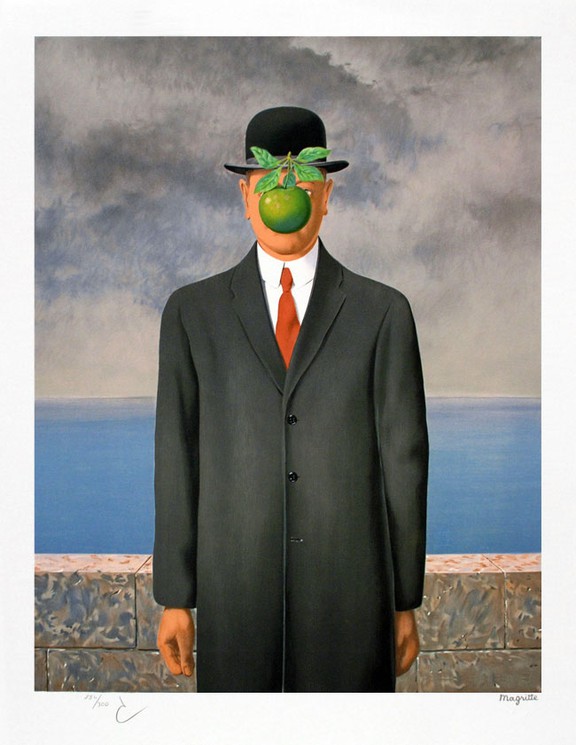
I really like Magritte because his images are so strongly readable. That's probably where my inspiration comes from. He brings together things that have something in common but were not, a priori, meant to meet (what he called “elective affinities”).
I love that feeling of being thrown off balance: in front of a Magritte canvas, you find yourself questioning your perception of reality. I also love the play of scale in his paintings, the sky that keeps recurring, and that whole vocabulary that sticks in your mind: the sleigh bells, the clouds, the women, the birds, the cage, the bowler hat, the apple. He also worked in advertising, and you can feel it in his very readable visual codes, inherited from advertising, while he raised, with the Surrealist movement, fairly political questions that challenged the established order. It's very powerful to combine carefully crafted imagery using advertising codes with a substance that questions society.
In photography, I adore Sophie Calle, for the way she approaches her projects and integrates writing into her images. I really like Harley Weir and Tim Walker. In more documentary photography, I was deeply moved by Mathieu Asselin's Monsanto project. I found the way he tackles a social and political issue, the damage caused by Monsanto, both powerful and aesthetically very beautiful.
7. Finally, what's your latest news? What are your upcoming projects?
Charlotte Abramow: I'm working on a new project that will take the form of an exhibition, which I hope to present in 2027.
At the same time, I'd like to take the exhibition “Maurice, Tristesse et Rigolade”, held in Brussels last winter, on tour in France. There is also the new edition of the book Maurice, Tristesse et Rigolade, published a few months ago, to which I added a chapter on grief, on how we transform absence into presence in order to tame grief, since we never really get over it: we tame it and try to make it less painful. Here again, art helped me a lot.
Selection of artworks


