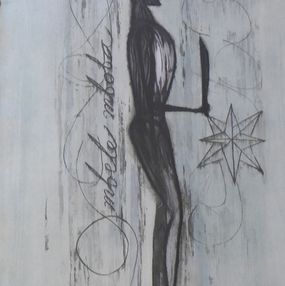
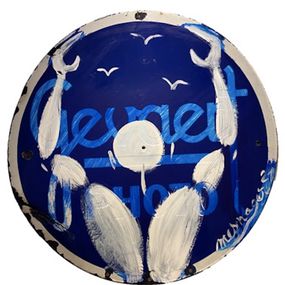
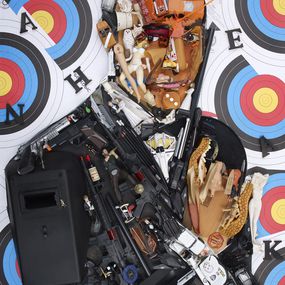
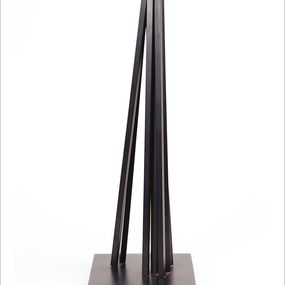
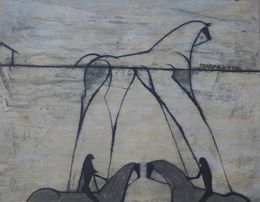
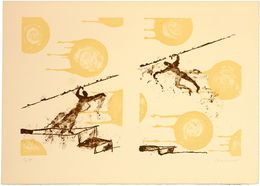
José Bedia is one of the most important and emblematic artists in contemporary Latin American art. His works are part of countless museum collections, including the Museum of Modern Art in New York (MoMA), the Whitney Museum of American Art in New York, the Hirshorn Museum in Washington, the Philadelphia Museum of Art in Philadelphia, and the Tate Gallery in London. From a very young age, José Bedia felt a great interest in drawing images from so-called primitive cultures, influenced and encouraged by his teacher Antonio Alejo, who provided him with information about indigenous art, particularly that of the Americas. For more than thirty years, Bedia has worked as both an artist and an anthropologist, a medium between two worlds: indigenous and Western culture. Each year, he integrates and lives alongside ancestral tribes from the United States, Mexico, Peru, and several African countries, to recount, through his ritual art-composed of drawings, paintings, installations, and sculptures, and featuring a kind of alter ego with a silhouette and profile similar to his own, constituting an archetype of Western man the presence and essence of dissimilar and opposing worlds: Western and non-Western, civilized and savage, modern and primitive, urban and rural. Bedia fuses and expresses, from his Palo Monte worldview (he was initiated into the Palo Monte tradition in 1984, and his work stems from the myths and practices of this religion), the wisdom of the world's cultures and religions, the sacred character of human nature. He develops an analytical and conceptual approach to address an ethical-philosophical-religious reflection on the relationship between humankind and the universe. His work is a cosmogony, an anthropology, an energy, a vast poetic interpretation of the world in order to reconcile men with the Cosmos and compose together the universal harmony. Acrylic paint on canvas 178 x 290 cm Provenance Fernando Quintana gallery. Signed front by the artist