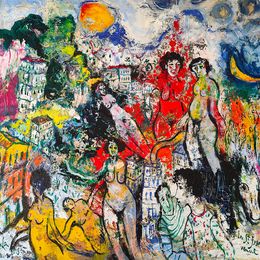
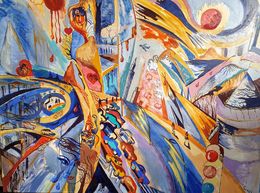
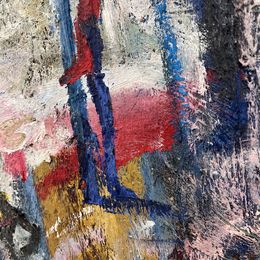
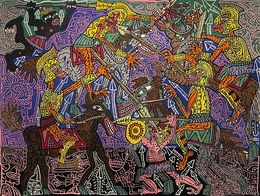
Morte e risurrezione, 1965
Painting : oil · 89.5 x 146.5 x 2 cm 35.2 x 57.7 x 0.8 inch · Ready to hang
$9,562
9 562 $US
One of the last works available by this artist
Shipping & delivery
Shipped from: France
Delivery to: United States , $ 391
Estimated delivery: Less than one week
Free returns within 14 days, full refund
Authenticity guaranteed
Sold with certificate of Authenticity from the gallery
Invoice from the gallery Learn more
Secure payment • Card, Amex, PayPal...
We accept several payment methods:
Paypal
American Express
Visa
Mastercard
Apple Pay
Google Pay
- Credit cards (Visa, MasterCard)
- American Express
- PayPal
- Bank transfer
- Gift card
- Apple Pay / Google Pay
All payments are secured with 3D Secure validation to protect your confidential information.
Verified Reviews : 9.6/10
Similar works




About the artwork
Type
Painting : Unique artwork
Condition
Artwork sold in perfect condition, framed, ready to hang
Unstretched (shipped rolled)
Authenticity
Sold with certificate of Authenticity from the gallery
Invoice from the gallery
Signature
Hand-signed by artist
Dimensions ( cm • inch )
89.5 x 146.5 x 2 cm 35.2 x 57.7 x 0.8 inch Height x Width x Depth
Artwork dimensions including frame
96 x 153 x 5 cm 37.8 x 60.2 x 2 inch
Sold by
Art gallery
Credentials
Vetted seller since 2015
Description
Oil on canvas impastoed on medium.
Signature and date in the bottom right – Signature, monogram and title on the back.
Provenance: artist's studio.
"Morte e risurrezione" is a very particular work in the career of Sergio Birga. It is overloaded with symbols as if its author wanted to create an inventory painting significant to him of the issues of the artistic world of the time. This painting also marks our regret for not having been able to question its author about the meaning he gave to the different figures. His wife confided to us that the subject was so dense that even with her husband's explanations, she could never grasp everything. We are therefore reduced today to interpreting what seems most obvious to us. For those who are somewhat familiar with the artist's later work, this painting sets up many signs and attitudes that will manifest episodically throughout his work. Thus, man and woman finally freed are found nude, embracing, turned, backs to the viewer, towards a future that is "at the bottom" of the image. Thus this yellow character at the top center, a kind of Moloch that one will find in Statue of Liberty in "The Great Society" and several drawings from the series "Literary Design". Archetypes of the bourgeois collector, the dealer, the model, and many other, characters, places or objects, that the viewer can discover and interpret as they wish, are also present. Among the latter, on the right, this dangling fish which could be the symbol of time devouring everything like the crocodile having swallowed a clock in "Peter Pan". We have no explanations for ourselves regarding the presence of eyes everywhere, nor for the "royal" skeleton in its coffin which may legitimize the title of the work.
Presentation
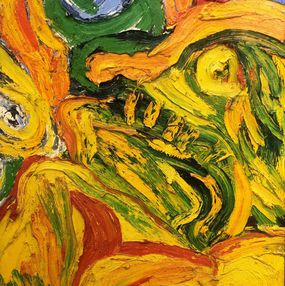
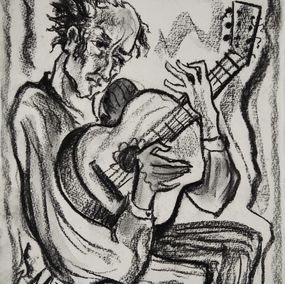
Sergio Birga was born in Florence in 1940. After graduating from the "Scuola d’Arte" in this city, he goes to Paris in 1965 to follow Lucien Coutaud’s engraving courses at the Fine Arts. He joins the Young Painting forum where he plays an important role in the late 60s and early 70s.
It is especially during three trips to Germany and his contact with the two generations of German expressionists that he will affirm his style and will adopt a work on the colour that will remain through his whole work, from every period. Oskar Kokoschka, Ludwig Meidner, Erich Heckel, Conrad Felixmüller, Otto Dix will give him advice and influence, and he will exchange portraits with the last two.
Sergio Birga is very engaged politically and stands against the Vietnam War and more generally against all “imperialisms.” He bluntly denounces the customs and the structural organisation of the bourgeoisie, fights against the privileged status of art, artists and intellectuals who, for him, are mere servants to the hegemony of the bourgeoisie.
In the 70s his work bears witness to the destruction of the heart of the cities by real estate big business, of historical and popular neighbourhoods for the benefit of “luxury residences” for newly promoted managers. From the 80’s onward his painting moves away from the political argumentation towards a “poetic realism” which draws its references in classical Italian painting, from the Renaissance to De Chirico.
Sergio Birga gives a preference to urban landscapes, gardens, colonnades in a very assertive “magical realism”. Today, without giving up his lifelong themes, he is turning towards illustrations of literary or religious inspiration in which the line owes a lot to his training as an engraver. The Expressionist inspiration is present in every artistic period of Sergio Birga. Indeed it is more obvious in the aggressive speech of the 60s and 70s but nevertheless always present thereafter.
First through the use of often “raw”, "saturated" colours, which establish a climate of violence or unreality immediately felt by the viewer. Sergio Birga also excels at introducing a threat in the image by creating a gap between a seemingly insignificant scene and an abnormal detail or unusual colours.
Discover similar artists

Reviews from our customers
All our reviews are extracted from Verified Reviews
You may also like


Sergio Birga
Painting . 61 x 41 x 0.5 cm Painting . 24 x 16.1 x 0.2 inch
$3,883

Bengt Lindström
Painting . 161 x 114 x 3 cm Painting . 63.4 x 44.9 x 1.2 inch
$52,154

George Areshidze (Reshka)
Painting . 90 x 60 x 3 cm Painting . 35.4 x 23.6 x 1.2 inch
$2,272
Alexandre Garbell
Painting . 29 x 40 x 0.5 cm Painting . 11.4 x 15.7 x 0.2 inch
$1,275
Jacques Audiberti
Painting . 46 x 61 x 0.5 cm Painting . 18.1 x 24 x 0.2 inch
$869

Alexandre Garbell
Painting . 29 x 40 x 0.5 cm Painting . 11.4 x 15.7 x 0.2 inch
$1,275

Laurence Lejay
Painting . 42 x 34 x 3 cm Painting . 16.5 x 13.4 x 1.2 inch
$1,970

Catherine Clare
Painting . 54 x 65 x 2.5 cm Painting . 21.3 x 25.6 x 1 inch
$2,133


Dalila Hachelaf
Painting . 30 x 20 x 0.2 cm Painting . 11.8 x 7.9 x 0.1 inch
$191

Karl-Karol Chrobok
Painting . 100 x 80 x 2.2 cm Painting . 39.4 x 31.5 x 0.9 inch
$5,215

Robert Combas
Print . 230 x 300 x 3 cm Print . 90.6 x 118.1 x 1.2 inch
$46,359