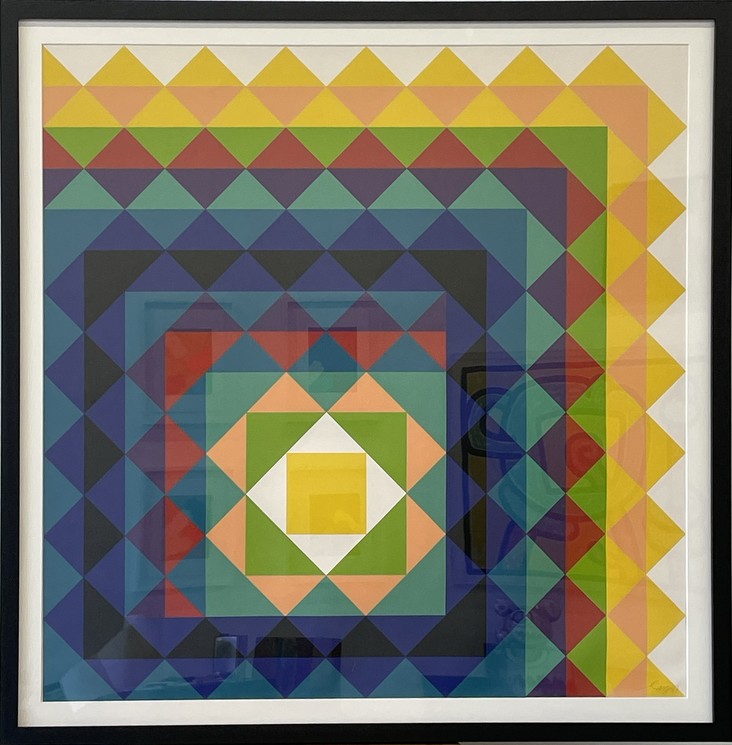

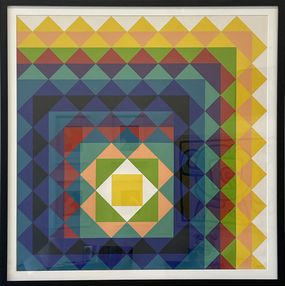
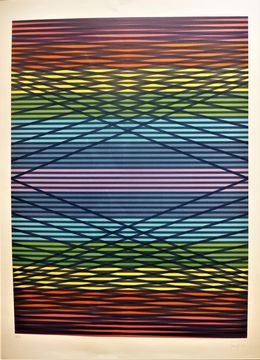
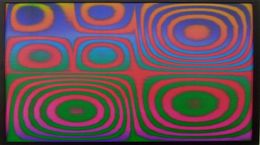
Chromatic Triangulation II, 1965
Print : Screen Print · 79.375 x 79.375 x 2.54 cm 31.2 x 31.2 x 1 inch · Ready to hang
Sold
Authenticity guaranteed
Sold with certificate of Authenticity from the gallery
Invoice from the gallery Learn more
Secure payment • Card, Amex, PayPal...
We accept several payment methods:
Paypal
American Express
Visa
Mastercard
Apple Pay
Google Pay
- Credit cards (Visa, MasterCard)
- American Express
- PayPal
- Bank transfer
- Gift card
- Apple Pay / Google Pay
All payments are secured with 3D Secure validation to protect your confidential information.
Verified Reviews : 9.6/10
Similar works



About the artwork
Type
Print : numbered and limited to 75 copies
Condition
Artwork sold in perfect condition, framed, ready to hang
Authenticity
Sold with certificate of Authenticity from the gallery
Invoice from the gallery
Signature
Hand-signed by artist
Technique & Support
Dimensions ( cm • inch )
79.375 x 79.375 x 2.54 cm 31.2 x 31.2 x 1 inch Height x Width x Depth
Artwork dimensions including frame
84.45 x 84.45 x 3 cm 33.2 x 33.2 x 1.2 inch
Sold by
Art gallery
Credentials
Vetted seller since 2020 • Top Seller
Description
"Chromatic Triangulation II" from "A Series of Eight Screenprints" Newly custom framed and matted using acid free materials. Presents well.
Provenance: Tupperware Brands Corporate Collection, Orlando, Florida, acquired 1971.
Toning and some fading, moisture staining near bottom.
Provenance: Tupperware Brands Corporate Collection, Orlando, Florida, acquired 1971.
Toning and some fading, moisture staining near bottom.
Presentation
Artistic polymath Herbert Bayer was one of the Bauhaus's most influential students, teachers, and proponents, advocating the integration of all arts throughout his career. Bayer began his studies as an architect in 1919 in Darmstadt. From 1921 to 1923 he attended the Bauhaus in Weimar, studying mural painting with Vasily Kandinsky and typography, creating the Universal alphabet, a typeface consisting of only lowercase letters that would become the signature font of the Bauhaus. Bayer returned to the Bauhaus from 1925 to 1928 (moving in 1926 to Dessau, its second location), working as a teacher of advertising, design, and typography, integrating photographs into graphic compositions.
He began making his own photographs in 1928, after leaving the Bauhaus; however, in his years as a teacher the school was a fertile ground for the New Vision photography passionately promoted by his close colleague László Moholy-Nagy, Moholy-Nagy's students, and his Bauhaus publication Malerei, Photographie, Film (Painting, photography, film). Most of Bayer's photographs come from the decade 1928–38, when he was based in Berlin working as a commercial artist. They represent his broad approach to art, including graphic views of architecture and carefully crafted montages.
In 1938 Bayer emigrated to the United States with an invitation from Alfred H. Barr, Jr., founding director of The Museum of Modern Art, to apply his theories of display to the installation of the exhibition Bauhaus: 1919–28 (1938) at MoMA. Bayer developed this role through close collaboration with Edward Steichen, head of the young Department of Photography, designing the show Road to Victory (1942), which would set the course for Steichen's influential approach to photography exhibition. Bayer remained in America working as a graphic designer for the remainder of his career.
Discover similar artists




Reviews from our customers
All our reviews are extracted from Verified Reviews
You may also like

Gary Lang
Painting . 11 x 11 x 2 cm Painting . 4.3 x 4.3 x 0.8 inch
€4,580

Bruno Munari
Print . 70 x 70 cm Print . 27.6 x 27.6 inch
€850




Victor Vasarely
Print . 70 x 62 x 0.1 cm Print . 27.6 x 24.4 x 0 inch
€1,980

Ronald Hunter
Painting . 80 x 80 x 2 cm Painting . 31.5 x 31.5 x 0.8 inch
€1,499


Peta Jacobs
Photography . 32 x 32 x 2 cm Photography . 12.6 x 12.6 x 0.8 inch
€650