












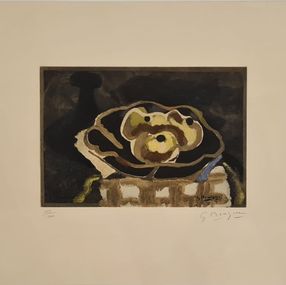
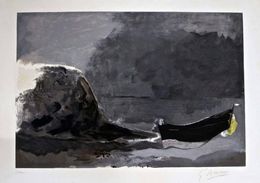
Si je mourais là-bas (If I Died There) (Vallier 181), 1962
Print : etching, engraving · 45.7 x 71.8 x 0.1 cm 18 x 28.3 x 0 inch
Sold
Authenticity guaranteed
Sold with certificate of Authenticity from the gallery
Invoice from the gallery Learn more
Secure payment • Card, Amex, PayPal...
We accept several payment methods:
Paypal
American Express
Visa
Mastercard
Apple Pay
Google Pay
- Credit cards (Visa, MasterCard)
- American Express
- PayPal
- Bank transfer
- Gift card
- Apple Pay / Google Pay
All payments are secured with 3D Secure validation to protect your confidential information.
Verified Reviews : 9.6/10
Similar works


About the artwork
Type
Print : numbered and limited to 10 copies
Condition
Artwork sold in perfect condition, not framed
Authenticity
Sold with certificate of Authenticity from the gallery
Invoice from the gallery
Signature
Hand-signed by artist
Dimensions ( cm • inch )
45.7 x 71.8 x 0.1 cm 18 x 28.3 x 0 inch Height x Width x Depth
Sold by
Art gallery
Credentials
Vetted seller since 2023 • Top Seller
Description
Georges Braque.
Si je mourais là-bas (If I Died There) (Vallier 181), 1962.
Wood engraving printed in blue, on Japon paper.
Hand signed lower right.
Edition IV / X lower left.
Printed by Féquet and Baudier, Paris.
Published by Louis Broder, Paris.
It is from the same titled portfolio. Vallier 181.
Backed on Japon paper.
Presentation
If there is a painter who best represents the “honor of France," as Malraux said, it must be Georges Braque. A friend and colleague to Picasso, Derain, Apollinaire, Gris, Laurens, Léger, Satie, Reverdy, de Staël and other well-known artists of that era, he remained close to the many cultural revolutions that shook the century. Born to a family of decorative painters, Georges Braque's destiny was to follow in their footsteps as an artisan. However, in 1905, he suddenly gave up his studies and took up a new path.
In 2024 and 2025, the legacy of Georges Braque, a master of Cubism, is celebrated through several key events. From October 8 to December 2, 2024, the Bernard Jacobson Gallery in London presents Braque, Picasso, Matisse: Prints, showcasing his prints. On October 16, 2025, the Centre Pompidou-Metz hosts a conference on Le Grand Nu (1907–1908) and the birth of Cubism. Lastly, the Guggenheim Bilbao highlights his late landscape series with Les derniers paysages. These events emphasize Braque's lasting influence on modern art and abstraction.
Braque discovered fauvism in 1905 with the works of Matisse and Derain. Though the fauvist period only lasted a year and half, Braque would find in this movement a way of escaping academic ideas and exploring new possibilities with color. At the 1907 Salon des Indépendants in the South, Braque presented six fauvist paintings. It was at this exhibition that Braque would meet Daniel Henry Kahnweiler and Wilhelm Uhde, both of whom combined to purchase all the painting Braque had on show. The first would become his first dealer, acquiring six paintings, while the second would become his first collector, purchasing five paintings.
The following year, at the Salon d'Automne, only one of his seven paintings was accepted. That same 1907 exhibition featured a retrospective on Cézanne. Deeply inspired by the late works of the Master of D'Aix, Braque made another pilgrimage to l'Estaque in order to better study his theories and ideas. Before this trip, Braque was working as a fauvist. After it, he moved on to what would become his great work of cubism.
The origins of Cubism, a movement that would revolutionize the visual rhythm of painting and take it on an unexpected trajectory, remain unclear. It is not easy to define the paternity and the inspiration for the first cubist works, but history remembers it as a combination of efforts from these two diametric opposites, two artistic geniuses. On one side was Pablo Picasso: an artist gifted with extraordinary virtuosity, a visionary whose life was eventful and whose personality was lively and exuberant. On the other hand was Georges Braque: an artist whose brilliance was in innovation and ideas. He was an intellectual, a modest man, and someone who preferred to live quietly rather than seek celebrity.
Braque referred to their working relationship, at this time, as akin to climbing partners. It would go on to define a period in art history that was only to end in 1914 when Braque was called up to fight in the First World War. He returned in 1915, with a severe head injury, and was convalescent till 1917. From that point onwards, even if he continued to work on Cubism till 1922, Georges Braque was similarly developing a new approach to painting, one which would function thematically.
The thematic period became the third period in his work. Georges Braque devoted himself to the analysis of different subjects, working to explore all possibilities in their composition in order to finally lay bare the object. With these recurrent themes, Braque was looking to perfect his pictorial ideas and explore the extreme limit of an object's depiction. Some of the great works of his career emerged during this period: billiards, for which he would be awarded a prize at the Venice Biennale; the birds; and the Norman fishing boats, a landscape he knew intimately after establishing a studio at Varengeville-sur-Mer.
At the twilight of his life, Georges Braque set to work on his series Metamorphoses. He first made gouache sketches of roughly a hundred of his major works. Then, taking these two-dimensional works, he transformed them three-dimensionally, not virtually as he had done with analytic cubism, but directly and physically into sculpture. All of the works have names derived from Greek mythology, which Georges Braque dearly loved. His golden sculptures do seem like they have been made in an ancient goldsmith's workshop. He had already devoted a series of works to Hesiod's Theogony and now he chose the name Metamorphoses in direct reference to Ovid's work.
Braque collaborated with a sculptor who worked mainly with precious stones, Heger de Loewenfeld. Together, at the request of André Malraux, they presented this new work at the Palais du Louvre. Braque had already been the first living painter to show work at the Louvre; he painted the ceiling of the Salle Henri II in 1953. The exhibition took place from March to May 1963. Three months later, Georges Braque died. Malraux led a national mourning and himself delivered the eulogy standing before the Louvre in front of the Saint-Germain-l'Auxerrois church.
Discover similar artists



Reviews from our customers
All our reviews are extracted from Verified Reviews
You may also like

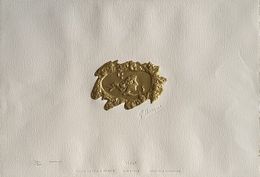


Georges Braque
Sculpture . 42.8 x 33 x 10.5 cm Sculpture . 16.87 x 13 x 4.12 inch
$24,000
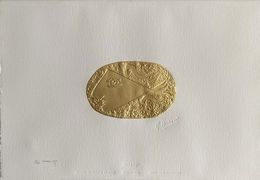



Georges Braque
Print . 34 x 27.5 x 0.1 cm Print . 13.4 x 10.8 x 0 inch
$5,601
Recommended by Artsper


Toni Caldentey
Painting . 92 x 120 x 2 cm Painting . 36.2 x 47.2 x 0.8 inch
$2,100


Georges Braque
Print . 56 x 37 x 0.1 cm Print . 22 x 14.6 x 0 inch
$19,254


LN Le Cheviller
Painting . 80 x 80 x 1.5 cm Painting . 31.5 x 31.5 x 0.6 inch
$1,144