












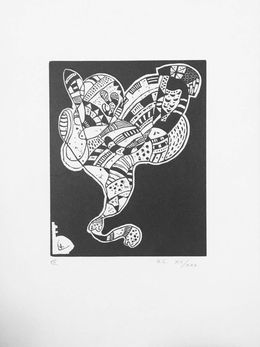
Gravure pour 10, 1942
Print : etching · 38.5 x 28 x 0.1 cm 15.2 x 11 x 0 inch
$1,289
1 289 $US
One of the last works available by this artist
Shipping & delivery
Shipped from: Italy
Delivery to: United States , $ 129
Estimated delivery: Two to three weeks
Free returns within 14 days, full refund
Authenticity guaranteed
Sold with certificate of Authenticity from the gallery
Invoice from the gallery Learn more
Secure payment • Card, Amex, PayPal...
We accept several payment methods:
Paypal
American Express
Visa
Mastercard
Apple Pay
Google Pay
- Credit cards (Visa, MasterCard)
- American Express
- PayPal
- Bank transfer
- Gift card
- Apple Pay / Google Pay
All payments are secured with 3D Secure validation to protect your confidential information.
Verified Reviews : 9.6/10
Similar works


About the artwork
Type
Print : numbered and limited to 75 copies
1 copy available
Condition
Artwork sold in perfect condition, not framed
Authenticity
Sold with certificate of Authenticity from the gallery
Invoice from the gallery
Signature
Stamped
Dimensions ( cm • inch )
38.5 x 28 x 0.1 cm 15.2 x 11 x 0 inch Height x Width x Depth
Sold by
Art gallery
Credentials
Vetted seller since 2019 • Top Seller
Description
Gravure 10 pour Origine is a modern artwork by Wassily Kandinsky. Black and white woodcut. Numbered on the lower margin. Edition of 9/75. This is the second edition, unsigned and monogrammed on the plate with a "K" at the bottom left of the print. It belongs to the "Origine" series. Good condition, except for some signs of foxing. Ref. C. Derouet, J. Boissel, "Kandinsky. Oeuvre de Vassily Kandinsky (1866-1944)", Centre Georges Pompidou.
Exhibition catalogue at the Musèe National d'arte moderne - Centre Georges Pompidou, Paris (30 October 1984 - 28 January 1985). pp.430 -431. "Kandinsky in Paris 1934-1944". Exhibition catalogue at Palazzo Reale, Milan (September-October 1985). p.274; Catalog Roethel, The Graphic Work of Kandinsky, Dumont, no. 203. Vasily Vasil'evic Kandinskij (1866 - 1944) was a Russian painter naturalized French, also anglicized as Vassily Kandinsky, precursor and founder of abstract painting. In this essay Kandinsky dedicates himself to the graphic part that can exist even without color. The point is the first nucleus of the meaning of a composition, it is born when the painter touches the canvas; it is static. The line is the trace left by the moving point, therefore it is dynamic. It can be horizontal, vertical and diagonal. It can be broken, curved, mixed. The individual sounds can be mixed together; the more the line is varied, the more the spiritual tensions it arouses change: dramatic if it is broken, more lyrical if it is curved. The thickness also changes: it can be thin, marked, thick, variable. The surface is the material support intended to receive the content of the work, usually a canvas (but Kandinsky also painted ceramics and plates). This second edition from the original woodcuts was authorized by the artist's widow Nina Kandinsky.

Presentation
Wassily Kandinsky was born in Moscow in 1866 in a wealthy and educated family. He learned German from his grand-mother and took piano, cello and drawing lessons.
In 1885, he went to Moscow to study Law. At the age of 30, he decided to abandon a promising teaching career to dedicate himself to art. He went to Munich to study painting, and very quickly he started to teach art, and created, with other artists from Munich, the Phalanx Association. He met Gabriele Münter, a German-American artist, who became his partner until 1914. Together they traveled in Europe and North Africa and, in 1906, they moved to Paris for a year. During this period, he created small format paintings, impressionist landscapes, that made him look like a dilettante to the artists of the Paris scene.
In 1908, Kandinsky moved back in Murnau, Germany with Gabriele Münter, and this is when his actual artistic career began. His favorite themes - landscapes, popular culture - remained unchanged, but his treatment of them was increasingly abstract through and the colors more and more autonomous. In 1914, when the war broke out, he left Munich to take refuge in Switzerland and then back to Moscow where he stayed until 1921. During this period he started writing "Point and line to plane", published only in 1926. Those years he didn't paint much, focusing, for material questions, on drawing and works on paper. During the first years of the communist regime, he dedicated himself to the creation of new artistic institutions in the country, such as a state organization managing for fine arts.
However, his situation become precarious. In 1921, while on an official mission, he stayed in Germany with his wife Nina. Walter Gropius, Director of the Bauhaus, offered him a teaching position: he was a teacher at the school until its closure in 1933, when he moved to France. Stripped of his German nationality Wassily Kandinsky moved to Paris, as a stateless person. It was only in 1939 that he became a French citizen, in extremis before the beginning of the Second World War. During the last years of his life he lived with his wife and continued his artistic research in Neuilly-sur-Seine. He died in 1944.
Discover similar artists


Reviews from our customers
All our reviews are extracted from Verified Reviews
You may also like



Antonio Segui
Print . 40 x 37.5 cm Print . 15.7 x 14.8 inch
$2,929


Hugo Rosell Barbie
Painting . 73 x 60 x 1 cm Painting . 28.7 x 23.6 x 0.4 inch
$3,316

Joanne Freeman
Print . 71 x 66 cm Print . 28 x 26 inch
$2,107
Recommended by Artsper


Amedeo Modigliani
Print . 46 x 30 x 0.5 cm Print . 18.1 x 11.8 x 0.2 inch
$2,343


Marcel Gromaire
Print . 45 x 31 x 0.05 cm Print . 17.7 x 12.2 x 0 inch
$351


Kjeld Ulrich
Print . 76 x 56 x 0.5 cm Print . 29.9 x 22 x 0.2 inch
$539


Egon Schiele
Print . 80 x 58 cm Print . 31.5 x 22.8 inch
$2,929
Recommended by Artsper
