





Guy Savoy: chef and member of the Académie des beaux-arts
In 2024, Guy Savoy became the first chef in history to be elected to the Académie des Beaux-Arts, marking the official recognition of gastronomy within the institution. In his eponymous restaurant, repeatedly named the world's best restaurant, works from his personal collection are presented alongside loans from the Pinault Collection.

1. You are surrounded by very different works of art. What brings them together? What do they have in common?
Guy Savoy: Love at first sight, quite simply. I've never been comfortable with the word collector. It suggests something methodical, as though you're trying to assemble a complete period or the work of a single artist.
That's not me at all. My collection is incredibly eclectic. The Tang dynasty Fat Lady has nothing in common with Fabrice Hyber's totem, and that's exactly what I love about it.

2. You were elected to the Académie des beaux-arts. In your inaugural address, you quoted the collector Michel David-Weill, whose seat you succeeded to. Someone once asked him why he started collecting art, and he replied, "For nothing." What about you?
Guy Savoy: For my own pleasure, but also because these works give me landmarks. At home, you naturally have your bearings. In a restaurant, it's different.
Every service, the dining room is filled with different guests, even though I've had the privilege of knowing many of them for years.
Having these works of art around me reminds me that I'm on my own ground, that I'm at home. In fact, I find it difficult to take a piece down to hang a new one. I can always add, but I can't bring myself to remove one because they've become part of the family.
3. Do these works of art also contribute to your creativity in the kitchen?
Guy Savoy: If you're sensitive to art, then that sensitivity is already within you, and it inevitably finds its way into whatever you do.
Cooking is my means of expression. The difference is that it's also something you can taste.
Apart from looking at them, you'll never experience the artworks in my restaurant with your senses, whereas food gives you that extra pleasure.
For a chef, flavor is the highest expression of sensation
4. There are also works of art in the kitchen itself. Why was it important for you not to limit art to the dining room?
Guy Savoy: From the kitchen, we share exactly the same view as our guests because there are windows everywhere.
There was no reason why we shouldn't share the artworks as well. Here, Fabrice Hyber's murals extend all the way to the delivery area and even the staff changing rooms because I think it's important to be immersed in that atmosphere from the very beginning.
One day, a journalist asked an 18 year old commis waiter what it felt like to see works of art as soon as he arrived at work. His answer was wonderful: "When art enters a house, violence leaves it."


5. The artichoke appears in several works of art. Could you tell us why it holds such an important place?
Guy Savoy: The artichoke is the house's signature vegetable because our artichoke soup is the restaurant's iconic dish.
So yes, you'll find it in many different places. When people ask me, "Why the artichoke?" I usually answer, "Because it's the only vegetable with a heart."


6. One of the works by Robert Combas displayed in the offices has a particularly meaningful story behind it. Could you tell us about it?
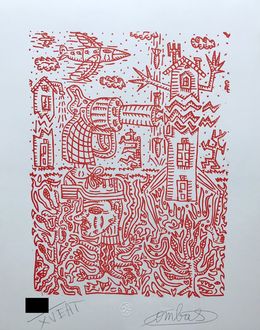
Guy Savoy: I bought that Combas painting the day after the Bataclan attacks because the gallery owner told me it depicted a shoe crushing evil.
I don't imagine many works of art were sold the day after the Bataclan but, for me, buying it was my own way of standing up to barbarism.

7. Do certain iconic dishes evoke works of art for you?
Guy Savoy: The Troisgros brothers' salmon with sorrel, where I trained as an apprentice, has often reminded me of Picasso's Les Demoiselles d'Avignon because it marked the beginning of a new era.
Before salmon with sorrel, no one had ever served fish cut like an escalope, and the sauce was always poured over the fish rather than underneath it.
Here, our gardeners' vegetable stew reminds me of Fabrice Hyber's work because of its colors and its joyfulness.
People often say that cooking is the art of bringing joy. The same is true of Fabrice Hyber. Even when he tackles serious subjects, such as rising sea levels, his paintings remain full of joy.
8. If you could invite artists, living or deceased, to your table, who would you choose?
Guy Savoy: I'd choose artists who defined major turning points in art history. Kandinsky, who was the first to truly embrace abstraction. Picasso, who took it even further. And Jean-Michel Basquiat.
But I certainly wouldn't say no to Monet, Van Gogh or Giacometti. People always talk about Walking Man, but Giacometti's Dog has an extraordinary poetry. It's the same with Van Gogh.
I find the Irises far more powerful than the Sunflowers. And Leonardo da Vinci's Head of a Woman is so much more joyful than the Mona Lisa, which is, after all, a little gloomy.
I once caused quite a stir at the Louvre when I was asked to comment on Chardin's brioche painting and I said, "It's burnt." I'm not sure they'll invite me back to talk about art again.
Their favorite artworks






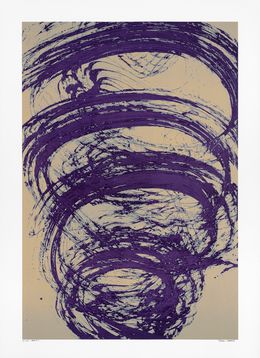
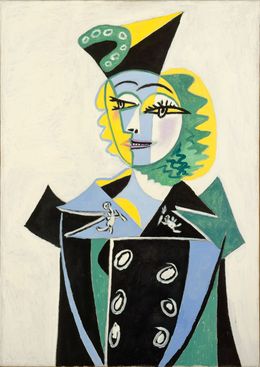
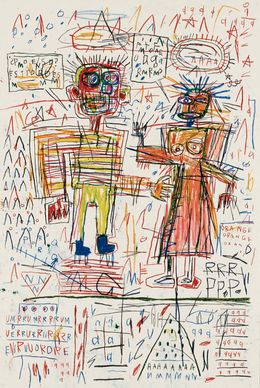
Jean-Michel Basquiat
Print . 122 x 81 x 2.54 cm Print . 48 x 31.9 x 1 inch
€55,742
Recommended by Artsper


