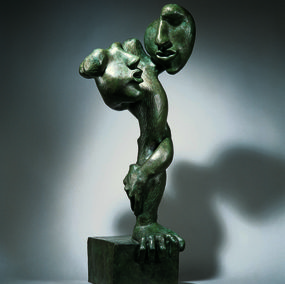
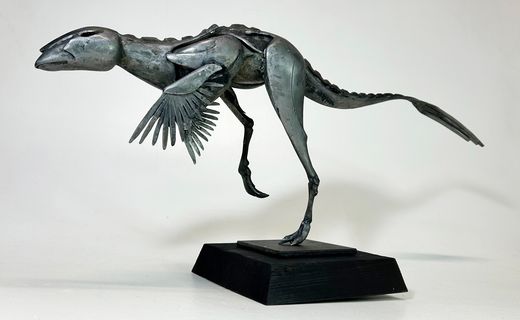
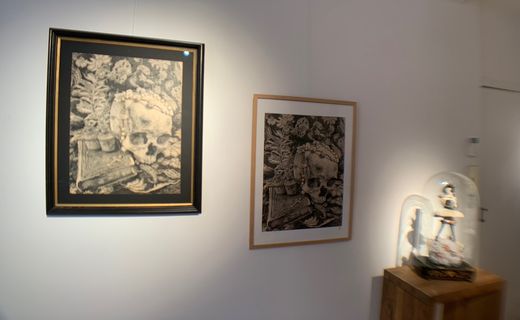
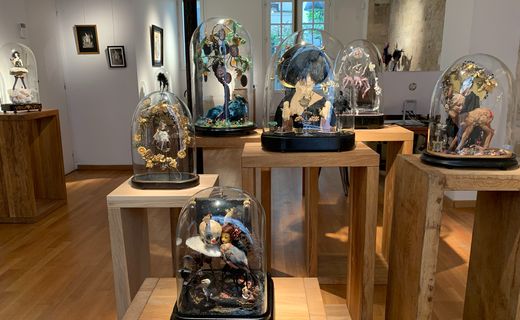
This exhibition brings together, for the first time, the stoneware sculptures of Maria Guilbert and the bronze works of Jacques Tenenhaus, in a dialogue as unexpected as it is harmonious. Two artistic languages that appear to be in contrast — the warmth of modeled clay versus the coolness of cast metal — yet share the same pursuit: that of inhabited forms, shaped by memory and the living world.
Maria Guilbert was born on June 11, 1973, in Gdansk, Poland, to a father who was a computer scientist and a mother who taught economics at the University of Gdansk. It was through her mother that she was introduced to drawing. Maria lived in Poland until the age of seven and grew up in a housing estate surrounded by forest in Sopot, a small seaside town near Gdansk on the shores of the Baltic Sea. The family moved to France in 1980.
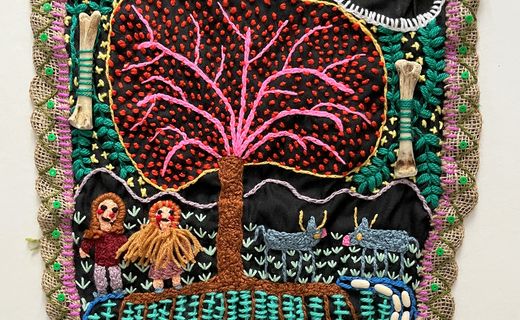
A painter, printmaker, and sculptor, the artist explores the relationship between humans, animals, and the natural environment. She draws inspiration from folktales and legends for their inexhaustible suggestive power and their resistance to fixed representation.
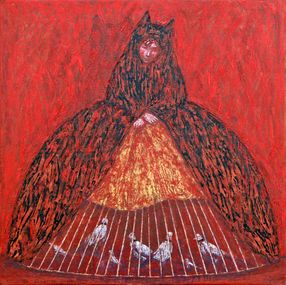
In her universe, the folk tale Donkeyskin (Peau d’Âne), retold by Charles Perrault in 1694, is particularly central. A reminiscence of her childhood spent wandering through forests in idle daydreams, Maria Guilbert’s art seems focused on a vision of the living world unified, working together in pursuit of peace and serenity.
Her painting technique originates from printmaking; it is achieved by transferring monotype-style images using a flexible plastic support pressed repeatedly and in layers onto the canvas. The result is a kind of negative impression with overlapping motifs that create a visual vibration, a shimmering effect.
Exhibiting since 1995, the artist, in search of new horizons, began working with clay in 2018 and has devoted herself almost exclusively to it since then. She works with faience and chamotte stoneware, chosen for their color and texture, with a marked preference for a reddish stoneware from Treigny in Puisaye, whose hue after firing closely resembles beechwood.
Graduated from Marc-Bloch University in Strasbourg in 1996, Maria Guilbert mainly exhibits in France and has received several awards. She lives and works in Robion, a village in the Luberon region of Provence, France.
Maria Guilbert has never forgotten the Polish forest of her childhood,
where she spent her energy, her mind filled with the fables of her homeland.
After arriving in France, these images—merged with other tales—helped build
the aesthetic strength of her creative universe.
Read more