










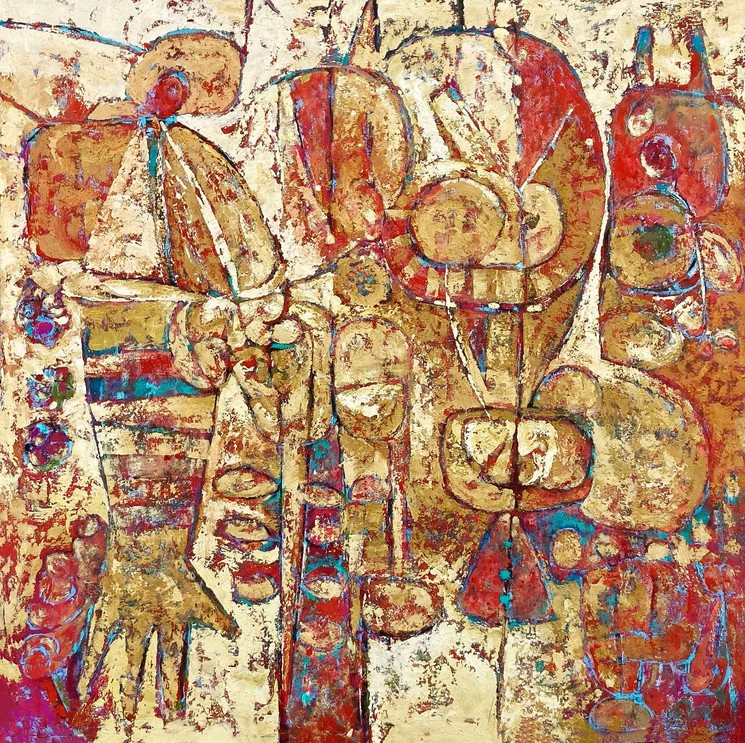

Canicula, 2024
Painting : mixed media · 140 x 140 x 1 cm 55.1 x 55.1 x 0.4 inch
$2,814
2 814 $US
Delivered in time for Christmas
Shipping & delivery
Shipped from: Mexico
Delivery to: United States , $ 189
Estimated delivery: Less than one week
Free returns within 14 days, full refund
Authenticity guaranteed
Sold with certificate of Authenticity from the artist
Invoice from the gallery Learn more
Secure payment • Card, Amex, PayPal...
We accept several payment methods:
Paypal
American Express
Visa
Mastercard
Apple Pay
Google Pay
- Credit cards (Visa, MasterCard)
- American Express
- PayPal
- Bank transfer
- Gift card
- Apple Pay / Google Pay
All payments are secured with 3D Secure validation to protect your confidential information.
Verified Reviews : 9.6/10
Similar works








About the artwork
Type
Painting : Unique artwork
Condition
Artwork sold in perfect condition, not framed
Unstretched (shipped rolled)
Authenticity
Sold with certificate of Authenticity from the artist
Invoice from the gallery
Signature
Hand-signed by artist
Technique & Support
Dimensions ( cm • inch )
140 x 140 x 1 cm 55.1 x 55.1 x 0.4 inch Height x Width x Depth
Sold by
Art gallery
Credentials
Vetted seller since 2023 • Top Seller
Description
“Canícula” – Juan Ibarra
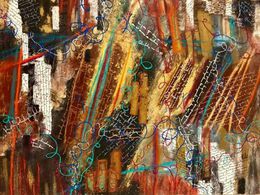
In , Juan Ibarra constructs a visual terrain that feels both ancient and immediate, rooted in the earth yet vibrating with emotion. Drawing on the legacy of Mexican muralism—and in particular, the enduring influence of Diego Rivera—Ibarra transforms the square canvas into a tactile, symbolic landscape where form, texture, and color converge to evoke the intensity of the sun’s zenith and the layered complexity of human experience.
At first glance, is a field of rocky textures and earthen tones. Shades of sand, ochre, and clay dominate the surface, evoking a parched landscape scorched by heat and time. Within this terrain, a multitude of abstract forms and fragmented figures begin to emerge—suggestions of bodies, faces, and gestures that resist precise definition. These presences feel embedded in the very matter of the work, as if excavated from beneath the surface of memory or history.
Throughout the composition, Ibarra introduces subtle yet striking accents of rose and blue—delicate counterpoints to the dominant palette. These small bursts of color create moments of contrast and visual relief, like mirages or fleeting sensations that punctuate the weight of the surrounding material. They offer glimpses of the emotional, the ephemeral, the poetic.
What truly defines , however, is its overwhelming sense of texture. The surface is worked with palpable intensity, layered with thick gestures, fissures, and rugged marks. Each section of the canvas reads like a topographic map of expression, inviting the viewer to engage not only visually, but almost physically, with the work. The canvas becomes a site of action and reflection—a contemporary mural that doesn’t illustrate, but rather evokes, narrates, and resists.
In this piece, Ibarra’s connection to muralism is not literal, but conceptual. Like Rivera, he seeks to give voice to what lies beneath the surface: to the layers of culture, labor, memory, and identity that shape our collective and personal geographies. is not a depiction of heat, but an embodiment of it. Not a portrait of people, but a record of presence. With this work, Juan Ibarra offers a profound meditation on endurance, transformation, and the raw material of existence itself.

Presentation
The burning sensation conveyed by Juan Ibarra's proposal is comparable to the feeling of seeing cuts and openings in flesh. It is no coincidence that the painter inherits techniques such as frottage and grattage, which give his canvases an aged appearance. In fact, his work is adjacent to the European tradition that encompasses informalism and abstract expressionism. In this way, the artist aims to highlight the worn-out character of painting, as well as the range of textures and reliefs that literally detach from the canvas.
Somehow, his pieces speak of the pictorial disintegration that not only exhausts itself but also gives rise to an exposed process of material healing. Therefore, his creations represent matter in a raw state of cauterization and transformation. This aesthetic of decay is crucial to him as it exacerbates the fragmented nature of the materials he uses to paint. This is because he deliberately resolves his compositions and, to a certain extent, anticipates the ravages of time in the realm of plastic arts.
Hence, his art decomposes color, forms, and spaces, along with their multiple interrelations. It is worth mentioning that the artist works in layers, much like sediments of rock formations, to then intercalate and blend the background with the surface and vice versa on a single plane. Furthermore, his works frequently feature geometric and expressionistic linear structures that enhance the visual effect of corrosion while carrying an immeasurable dramatic charge.
Discover similar artists



Reviews from our customers
All our reviews are extracted from Verified Reviews
You may also like
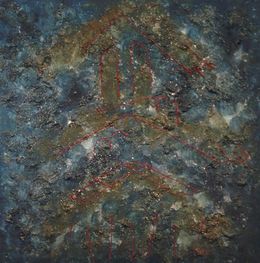
Pau Alemany
Painting . 120 x 120 x 2 cm Painting . 47.2 x 47.2 x 0.8 inch
$2,343
Recommended by Artsper

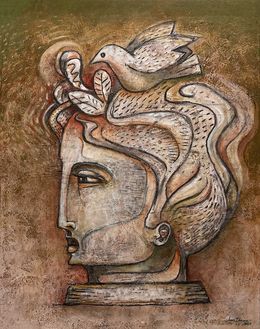


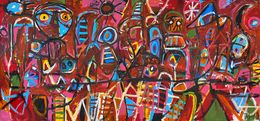
Enrique Pichardo
Painting . 220 x 440 x 1 cm Painting . 86.6 x 173.2 x 0.4 inch
$16,657

Pablo Ferrer Navarro
Painting . 120 x 180 x 3 cm Painting . 47.2 x 70.9 x 1.2 inch
$2,695


Richard Solstjärna
Painting . 36 x 48 x 1 cm Painting . 14.2 x 18.9 x 0.4 inch
$6,444




Juan Ibarra
Painting . 90 x 62 x 1 cm Painting . 35.4 x 24.4 x 0.4 inch
$547




Bernard-Marie Lauté
Painting . 24 x 16 cm Painting . 9.4 x 6.3 inch
$351
Karl-Karol Chrobok
Painting . 75 x 130 x 2.2 cm Painting . 29.5 x 51.2 x 0.9 inch
$3,983