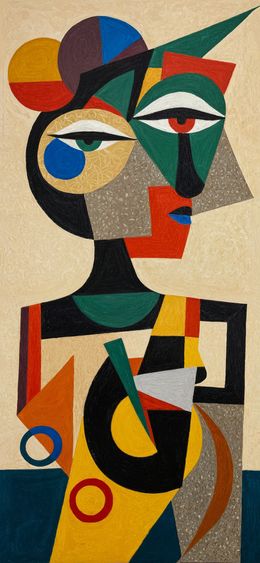
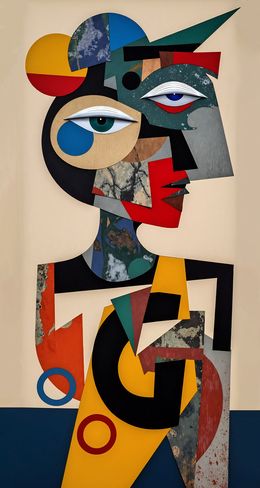
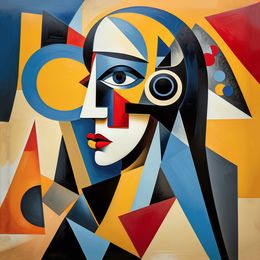
"The Labor Of Staying"' is a mixed-media geocubist surrealist work that explores the difficult, deliberate process of rebuilding a relationship after turmoil. Rather than presenting reconciliation as something effortless or romantic, the painting treats staying as a form of construction, patience, and ongoing labor.
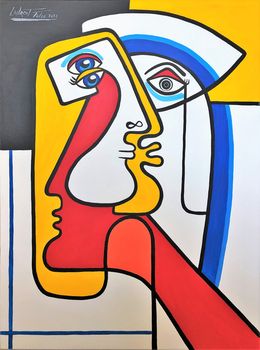
Two fragmented, abstracted figures occupy the centre of the composition, their forms overlapping and partially merging with one another. Their exaggerated eyes and ears transform perception into a central theme: to remain with someone requires not only seeing them again, but learning how to look and listen differently after what has happened. The large circular eye-like forms suggest vulnerability and heightened awareness, while the ears emphasize the necessity of hearing what was previously unheard.
The architectural geometry surrounding the figures evokes a structure under reconstruction. Sharp blue planes, white linear divisions, overlapping blocks and unfinished forms resemble fragments of a building being assembled piece by piece. This architecture becomes a metaphor for the relationship itself: something that has been damaged cannot simply return to its original state; it must be rebuilt into something new. The visible seams and irregular connections acknowledge that the reconstruction remains imperfect.
The recurring blue and yellow create an emotional tension between coolness and warmth. Blue dominates much of the work, suggesting distance, introspection and emotional restraint, while the intense yellow within the central circular form introduces warmth, life and the possibility of renewal. The contrast suggests that intimacy can coexist with uncertainty.
The small ants appearing within the architectural imagery reinforce the idea of labour. Their presence can be read as a surreal enlargement of the invisible work required to maintain a bond: small, repetitive actions that may appear insignificant individually but become meaningful through accumulation. They echo the human figures below, suggesting that rebuilding a relationship is itself a kind of collective construction.
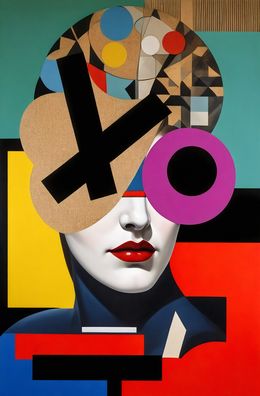
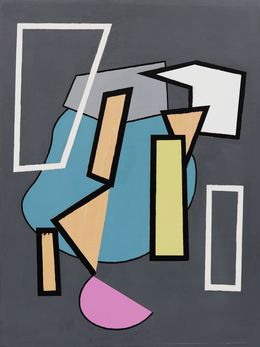
The long, thread-like forms descending from the ears and figures introduce another layer of meaning. They resemble nerves, roots, wires or threads connecting separate parts of a structure. Their winding paths imply that connection is rarely straight or simple; it bends, tangles, breaks and reconnects. At the bottom, the unfinished outlined form feels particularly significant: a structure that has not yet been filled in, suggesting that the future of the relationship remains something being actively made rather than something already resolved.
Through its combination of geometric architecture, fragmented anatomy, surreal symbolism and collage-like textures, turns an intimate emotional experience into a landscape of construction. The work proposes that love after turmoil is not defined by returning to what existed before, but by accepting the work of creating a different structure together.