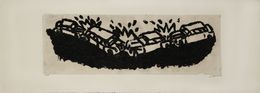






Canone Aureo Finale 4848, 2009
Painting : acrylic · 34 x 74.5 x 0.5 cm 13.4 x 29.3 x 0.2 inch
Sold
Authenticity guaranteed
Sold with certificate of Authenticity from the artist
Invoice from the gallery Learn more
Secure payment • Card, Amex, PayPal...
We accept several payment methods:
Paypal
American Express
Visa
Mastercard
Apple Pay
Google Pay
- Credit cards (Visa, MasterCard)
- American Express
- PayPal
- Bank transfer
- Gift card
- Apple Pay / Google Pay
All payments are secured with 3D Secure validation to protect your confidential information.
Verified Reviews : 9.6/10
Similar works


About the artwork
Type
Painting : Unique artwork
Condition
Artwork sold in perfect condition, not framed
Authenticity
Sold with certificate of Authenticity from the artist
Invoice from the gallery
Signature
Not Signed
Dimensions ( cm • inch )
34 x 74.5 x 0.5 cm 13.4 x 29.3 x 0.2 inch Height x Width x Depth
Sold by
Art gallery
Credentials
Vetted seller since 2019 • Top Seller
Description
Canone Aureo Finale 4848 (Golden Ratio - Final 4848) is an original painting by the Italian artist Giorgio Griffa (Turin, 1936).
An original acrylic painting on light canvas, from on of last Griffa's production of 2009. Unsigned and undated, this contemporary artwork comes with the certificate of authenticity by the artist.
With the usual folds of the canvas wanted by the artist. A unique piece by one of the most valued contemporary Italian artist, for your sophisticated home-collection!
Remembering the great lesson of the genius Leonardo da Vinci's Golden Ratio, Giorgio Griffa recreates in elementary signs and number the magician formula, revitalized by bright colors!
Giorgio Griffa was born in Turin in 1936; he started painting as a child under the guidance of traditional painters. In 1958, he graduated in law and started working as a lawyer. In 1960, felling the need for a new period of artistic training, he enrolled in the private school of Filippo Scroppo, an abstract artist from Turin who has been a member of the Movimento per l'Arte Concreta (MAC). For three years, he has attended the courses, even though the works he produced in that period were all characterized by a figurative style.
In the following years, he proceeded to progressively reduce the representative elements, without adopting a truly abstract style, until he produced non-representational works, the cycle entitled Quasi dipinto (Quasi Painting). In this cycle, he made the choice of unfinishedness that was to become a constant feature of his work.
He displayed these works in 1968 at the Galleria Martano in Turin. In 1969, he began exhibiting with the Galleria Sperone, also in Turin; in 1970, his works were featured at Ileana Sonnabend's galleries in New York and Paris. It was in that period that he was associated to the exponents of Arte Povera, whom he mentioned on the occasion of his exhibition in 2000 at the Galleria Salzano in Turin as follows: "The intelligence of the material was not used as a tool for new syntheses of form - which is, however, inevitable - but it became the protagonist of the work, with the artist's hand at its service. Similarly, since I am convinced of the intelligence of painting, I put my hand at the service of the colors that encounter the canvas, limiting my involvement to the simple gesture of placing the brush".
For about two years, from 1973 to 1975, he has painted almost exclusively horizontal lines: these consisted of a continuous line that was repeated - that is, by a series of brushstrokes placed one next to the other horizontally. In the following years, series of different signs started to coexist on the canvas. Griffa started the series called Connessioni o Contaminazioni (Connections or Contaminations), a modified version of the previous series entitled Segni primari (Primary Signs).
This was the period in which the artist's Minimalist reflections paved the way for new thoughts on painting's and sculpture's remarkable store of memory.
In reality, Griffa was not a Minimalist. Indeed, Paolo Fossati has clarified the difference between Griffa's work and Mimimalism. So in 1979 he painted a triptych, not by chance entitled Riflessione (Reflection), consisting of three large canvases dedicated to Matisse, Klee and Yves Klein respectively. This triptych, displayed in 1980 at the Galleria Martano in Turin (and then at Lorenzelli Arte in Milan), was the first step towards another series, which was eventually entitled (in 2000) Alter Ego. In this series, each work was dedicated to artists of different epochs. With long pauses, this series has continued for thirty years.
In the 1980s, there was a remarkable development of the cycle entitled Contaminazioni. The signs were often accompanied by areas of color of varying sizes. At the beginning of the 1990s, Griffa started the series Tre linee con arabesco (Three Lines with Arabesque), where each work, whether on canvas, a drawing, a watercolor, or an engraving, contains - among other signs - three lines and an arabesque. These works are numbered in the order in which they are created: the most recent is number 1,661. The numbering aims at establishing the position of the individual work within the series and, at the same time, to remind us of the fact that they belong to this series.
Later in the 1990s, Griffa started another series, where he used numbers. This was the series titled Numerazioni (Numbering). Here, in each picture, the numbers indicate the order in which various signs and colors were applied. The numbers refer to, on one hand, the order in which the pictorial event takes place and, on the other hand, the development of this event, with one sign after another in both time and space. It should, however, be noticed that there is no possibility of development or progress from one series to the other, but there is merely the presence of different aspects of coming into being. Thus, rather than following one another, the series overlap, intersect and coexist next to each other.
The series that Griffa produced in the 2000s confirm this aspect: their origins date back to twenty years ago, at the end of the 1970s. The series Alter Ego, with its reference to other artists, such as Piero della Francesca, Tintoretto, Josef Beuys or Mario Merz, originated from the triptych of 1979 titled Riflessione (Reflection), passed through various works of the 1980s and 1990s and clarified its identity with a group of works in the 2000s. In its turn, the cycle Sezione Aurea (Golden Section), which concerns this endless irrational number characterizing its mathematical aspect, avails of the transparencies of the canvas that were already a feature of Griffa's great work Dionisio (Dionysus) of 1980, which was exhibited at the Venice Biennal in the same year.
Between the 2009 and 2010 Griffa held solo shows at the Museum of Baotou (Baotou, Inner Mongolia), at the BaGuaShan Art Gallery (Taiwan) and at the Gehua Art Gallery (Pechino).
The Museum of Contemporary Art in Rome (MACRO) organized his personal exhibition (12.02.2011 - 13.03.2011) accompanied by a catalog: Giorgio Griffa: Golden Ratio, curated by Luca Massimo Barbero, MACRO, Marsilio Editori, 2011.
The works by Giorgio Griffa are in numerous museums and private collections.

Presentation
Born in Turin, Giorgio Griffa began painting at the age of 9 where he paints today.
Close to the artists of Arte Povera, the Minimalists, and the Conceptuals, of the 1970s.
Associated with movements such as Arte Povera, Conceptual Art, see Minimalism, Giorgio Griffa is a painter whose practice has little to do with any specific current. It is as a painter, with his consistent personal practice that he has been advancing since the 1960s, proposing his painting in a continuous future.
As early as the 1970s, his paintings can be appreciated on the international art scene (more than 150 exhibitions.)
21st century exhibition selection.
UN | Works 1968-1973 and two | Pink and purple 2001 at the GAM in Turin, 2001.///.
Giorgio Griffa Walter Storms Gallery, Munich, 2001.///.
Giorgio Griffa, Manifatture artistiche Palazzo Cavour, Turin, 2002.///.
collective 18 x 24 Gallery 41 contemporary art, Turin, 2003.///.
Giorgio Griffa - Opere recenti Studio Guastalla, Milan, 2003.///.
Anni 70 80 90 Lorenzelli Arte, Milan, 2003.///.
Red clouds Studio Guastalla, Milan, 2004.///.
AAVV - 30 Galleria Fumagalli Bergame, 2004.///.
Giorgio Griffa - Galleria dArte 2000 & NOVECENTO, Reggio Emilia, 2004.///.
Gli Anni 80 Lorenzelli Arte, Milan, 2004.///.
Enigma Galleria Biasutti Giampiero, Turin, 2005.///.
Arbeiten auf Papier recommended Walter Storms Galerie, Munich, 2005.///.
Between gesture and sign. Poetics of the informal Galleria Biasutti Giampiero, Turin, 2005.///.
Giorgio Griffa, Galerie Point to point Nîmes, 2007.///.
2003Canone Aureo | gold report at MACRO in Rome, 2010.///.
collective 18 x 24 Galleria 41 artecontemporanea, Turin -Fragments 1968-2012 at Casey Kaplan Gallery, New York, 2012-2013.///.
Alles auf eine Karte ... Walter Storms Galerie, Munich -Dance of neurons at Galleria Lorcan O'Neill, Roma, 2014.///.
Giorgio Griffa - Recent Works Studio Guastalla, Milan -Giorgio Griffa at the Douglas Hyde Gallery, Trinity College, Dublin, in 2014.///.
Anni 70 80 90 Lorenzelli Arte, Milan1968-2014 A retrospective organized by Andrea Bellini, Center for Contemporary Art, Geneva, 2015.///.
2004Painting in the fold by Andrea Bellini organized and Martin Clark, Kusthall Bergen, Bergen, 2015.///.
Red Cloud Studio Guastalla, Milan -The 1970s at the Casey Kaplan Gallery, New York, 2016.///.
AAVV - 30 Galleria Fumagalli Bergamo -Work on paper Andrea Bellini organized by Giuliani Foundation, Rome, 2016.///.
Giorgio Griffa - Galleria dArte 2000 & NOVECENTO, Reggio Emilia -Giorgio Griffa organized by Bice Curiger, Vincent Van Gogh Foundation Arles, Arles, 2016.///.
Gli Anni 80 Lorenzelli Arte, Milan Almost all organized by Suzanne Cotter and Andrea Bellini, Fundação de Serralves, Porto, 2016.///.
Discover similar artists


Reviews from our customers
All our reviews are extracted from Verified Reviews
You may also like

Achao
Painting . 200 x 100 x 2 cm Painting . 78.7 x 39.4 x 0.8 inch
€7,000


Pépé Vignes
Fine Art Drawings . 24 x 32 x 0.2 cm Fine Art Drawings . 9.4 x 12.6 x 0.1 inch
€850