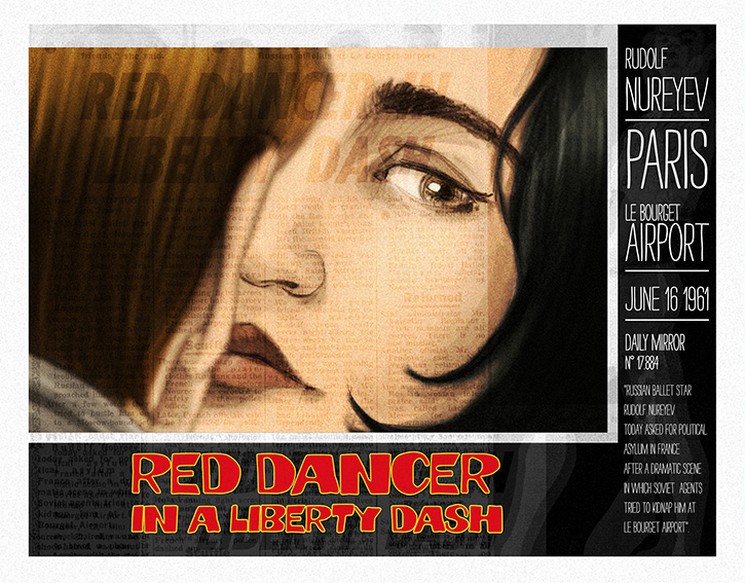

06 - 16 - 1961 - Lobby Cards Series - Red, 2013
Print : digital print · 39 x 50 cm 15.4 x 19.7 inch
€700
700 €
Shipping & delivery
Shipped from: France
Delivery to: Italy , € 48
Estimated delivery: Less than one week
Free returns within 14 days, full refund
Authenticity guaranteed
Sold with certificate of Authenticity from the gallery
Invoice from the gallery Learn more
Secure payment • Card, Amex, PayPal...
We accept several payment methods:
Paypal
American Express
Visa
Mastercard
Apple Pay
Google Pay
- Credit cards (Visa, MasterCard)
- American Express
- PayPal
- Bank transfer
- Gift card
- Apple Pay / Google Pay
All payments are secured with 3D Secure validation to protect your confidential information.
Verified Reviews : 9.6/10
Similar works







About the artwork
Type
Print : numbered and limited to 8 copies
6 copies available
Condition
Artwork sold in perfect condition, not framed
Authenticity
Sold with certificate of Authenticity from the gallery
Invoice from the gallery
Signature
Signed artwork
Technique & Support
Dimensions ( cm • inch )
39 x 50 cm 15.4 x 19.7 inch Height x Width x Depth
Sold by
Art gallery
Credentials
Vetted seller since 2015 • Top Seller
Description
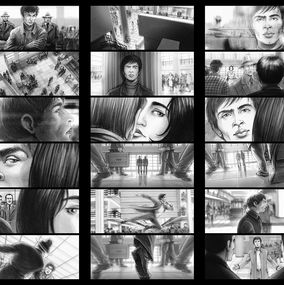
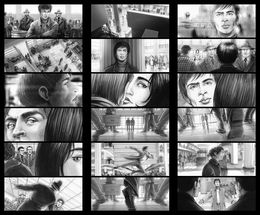
“06/16/1961” is a date, like the one on the front page of a newspaper showing the date it was released. It is a work that seeks to reflect on the reliability of information disseminated by the media in its form, as well as in its content; that moment when an event, while being spoken of, becomes a story, which soon becomes part of the story. This reflection is based on Rudolf Nureyev's defection from the Soviet Union, which took place in Paris on June 16, 1961, at Le Bourget airport. A characteristic of this event is the multiplicity of its versions, its narrative lines. After reading the newspapers of the time, different books and stories, it is finally impossible to know how it really happened. For some, he jumped majestically, for others he fell into the hysterical arms of the French police. Nureyev even gave, in an interview in the 90s, a totally different version of the biography which was published in 1962. According to the version of the 1990s, after hiding behind one of the poles in the hall of the airport , he would have waited patiently for the KGB men in charge of his surveillance to disappear as if by magic, and would have walked quietly towards the French police to seek asylum. Nevertheless, in order to be part of the story, the event must be told. It is this narrative line that gives an aesthetic form to a particular event and it turns into a story, which can then be incorporated into the story. Although the event was not a major Cold War event, it has all the flavor characteristic of a scene from a time movie. The suspense is "Hitchcockian" and so are the protagonists. The hero is overwhelmed and must make a decision, the situation impossible, and the young woman who would do anything to save him. The only thing we can be sure of, that Nureyev claimed for a freedom which will allow him to continue to practice his art as he wants. The project, which uses entertainment and information codes as the raw material, is divided into two parts: A short film, using a basic animation which is known as "animatic" in the advertising industry and cinema. An "animatic" is a preliminary form of a commercial activity or film sequence, consisting of a series of drawings of key moments in the action. In the same way as a storyboard, it is used to define a story, its issues, and to establish what will be drawn next. In our case, this animatic is presented as a preliminary draft of a trailer, a movie that has never been shot, that no one has ever seen. Each spectator is therefore able to imagine his own version. He is the legend of Nureyev's defection to the West that we will try to study with a film composed of a very large screen, divided into 3 screens showing 3 different versions of the event. The lobby-cards are the photos from the film displayed in the lobbies of cinemas. They are one of the marketing elements used to promote the film. Typically, a receipt card is made up of a photo of the movie surrounded by the movie title, credits, and sometimes logos or special designs that refer to the movie. In these series 3, inspired by the design of Alfred Hitchcock's pressure cards from the 60s, the texts are replaced by headlines and samples from the newspapers of that day. The articles are overprinted in order to offer a vibration, a noise, a buzz in which nothing can be clearly heard. Ultimately, the project aims to tell an event, not only as information, but as a story, and therefore as entertainment.
Presentation
Pierre-Emmanuel Chatiliez already has a brilliant career as an illustrator/storyboard artist
behind him. Since the beginning of the 1990s, he has been producing storyboards for some
of the greatest film directors in cinema: Alain Resnais for Les Herbes Folles, Mathieu
Kassovitz for Assassin(s), Shawn Levy for The Pink Panther, Brett Ratner for Rush Hour 3 to
name but a few. Working with these masters of the industry, he translates the script into a
series of technical drawings that portray their artistic interpretations with the greatest possible
exactitude. Pierre-Emmanuel Chatiliez would describe the storyboard as "somewhat
comparable to the preparatory sketches used in painting and sculpture”, it is also the sketch
for his concept of artistic creation.
Today guaranteed a steady stream of international orders, included in the Cinémathèque
française's drawing collection and exhibited as one of the great names in the genre in
France, he is using this confirmed experience to begin an entirely new journey, that of his
own artistic expression, in which he becomes a creator in the true sense of the word. The
artistic experiment involves presenting shots with the greatest possible exactitude, image
sequencing, in order to translate the movement which is unique to cinematographic
language.
He uses a computer, juxtaposing photographs taken beforehand in his studio. In the artist's
words, "the image is used like a tube of paint, adding touches, or translucent layers similarly
to glazing in oil painting or watercolour, in order to generate virtual images which, when
printed and remounted on a metal sheet become very solid and very real."
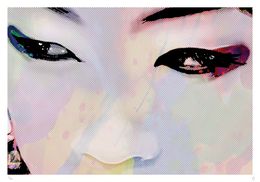
Composing his art in series, he begins his creative journey with "Paper Dolls". The idea for
the series was born during a trip to the USA when he noticed that the shape of the dollar bill
was exactly the same as that of the CinemaScope frame. He photographed, and then
computer-enhanced, the image of a head from a shop window dummy with the famous
banknote as the background. The woman's face looks like a model from the glossy pages of
a woman's magazine, from the world of fashion and of ephemeral concerns where money is
omnipresent and dominates absolutely. Thanks to a perfect command of computing tools and
their software, he was able to produce an image with a perfect face, "polished" as it would be
described in painting, and the background, the money, evanescent. The window dummy is
like a film star, made glamorous by her flawless skin, her false eyelashes and her painted
lips. She becomes part of the dollar, whose spirals extract a tear from her face in "Paper Doll
010" and whose complex anagrams, destined to protect the note from illegal forgery, adorn
her head giving her a sphinx-like look in "Paper Doll 003". But the feminine image can also
be a disconcerting one, trapped between the dollars or extricating herself in "Paper Doll 007",
perhaps illustrating the influence on the artist of the title sequences created by Maurice
Binder, a total of fourteen between 1962 and 1989, for the best known incarnation of these
three numbers, James Bond.
Chatiliez claims the ascendancy of these elders, just like he calls to mind American graphic
designer Pablo Ferro. He also claims the ascendancy of his extremely talented contemporary
Saul Bass with echoes of the burning car and the weightless characters from his title
sequence for Casino also appearing in the series.
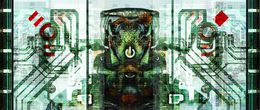
In a shift from representation to fantasy, he embarks on the "BUGs in the system" series,
translating the literal meaning of the word into insect images, which devour the infernal
machine, the computer, in a concept which is familiar to us all, the computer bug which can
attack with varying degrees of severity.
For this series, Chatiliez creates semi-realistic, semi-science fiction creatures, which leap out
from their background to threaten the observer.
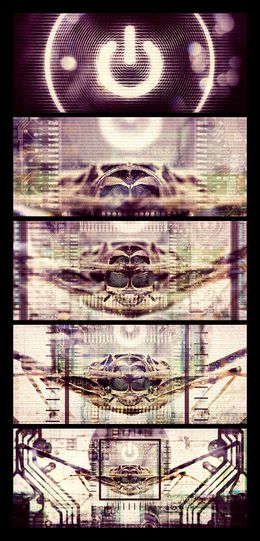
The creatures are placed on electrical components and in each image, one particular symbol
is recurrent: the button that powers up and shuts down the computer, a reference to the
gradual, relentless, shut down that will result from the destructive power of the insect.
"These warriors lurking in the shadows"4 with their metallic colours appear to present a far
greater threat to the observer than the electronic machine, particularly in "BUG 001".
The symbol of modern life appears to have become their nest, they have settled permanently
there, the shutdown is under way and the observer only is able to sense the danger of the
imminent disruption.
The terrifying thing about the images "BUG 005, 006 and 007" is their almost entire lack of
resemblance to an existing living being.
We see then that the insect that was going to devour the machine, the symptom of the most
alarming of modern afflictions, the annihilation of what has become man's closest friend, his
computer; this same insect eventually fuses with the computer to threaten the observer.
The BUG is deeply rooted within the machine, it has established its headquarters there, it
becomes the expression of the artist's concern with the great upheavals of our time.
It is also a metaphysical question, that of the fear of the unknown.
The series the artist is currently working on, "Money shot", continues this exploration into
movement, attempting to recreate its effect as closely as possible by sequencing the scene
within the same piece.
In this series, the movement is a stiletto heel that glides through the ice or cracks it. In the
series it is represented by a mirror, reminiscent of the artist's recent stay in Moscow, a city in
which the omnipresent glamour and wealth had a marked effect on him.
Starlets are reflected in the mirror; starlets whose high heels are their revered attribute. Such
is the ease with which they seem able to walk perched ten or fifteen centimetres above the
ice they appear to have been born wearing them.
The series' title, "Money shot", is the relationship between money and artistic production
which is rapidly becoming the disproportionate cost of this production.
It is also, in the pornography industry, the shot that earns the male actor a financial bonus.
It is the supreme domination of all that has monetary value and is superficial at a time where
many are manifesting the need to move away from such a system.
This series further explores the artist's preferred themes, his exploration of the concerns of
today.
Pierre-Emmanuel Chatiliez's choice to create his works in series clearly originates from his
work as a storyboard artist, but it also breaks free from these codes to become original art.
These references are undoubtedly the masters of graphic art and of film title sequencing as
described above, but they also include pop art and its offbeat vision as it tackles
contemporary issues and the use of advertising images in the first and third degrees.
It is also the memory of the great masters of photography, the icy, disconcerting universe of
Erwin Olaf, the extra-constructivist, futuristic inclinations of Rodchenko and so many others.
His method is not limited to an exploration of movement, but it is the evolution of a symbol, of
an idea which is the essence of his artistic direction.
Discover similar artists


Reviews from our customers
All our reviews are extracted from Verified Reviews
You may also like


Mateo Andrea
Painting . 114 x 146 cm Painting . 44.9 x 57.5 inch
€3,900
Recommended by Artsper

Christophe Boverli
Painting . 81 x 60 x 2 cm Painting . 31.9 x 23.6 x 0.8 inch
€1,500
Pierre-Emmanuel Chatiliez
Print . 21 x 50 x 2 cm Print . 8.3 x 19.7 x 0.8 inch
€1,250
Vincent Sabatier
Print . 50 x 70 x 0.1 cm Print . 19.7 x 27.6 x 0 inch
€180
Pierre-Emmanuel Chatiliez
Photography . 200 x 100 x 1 cm Photography . 78.7 x 39.4 x 0.4 inch
€3,500

Pierre-Emmanuel Chatiliez
Print . 200 x 220 x 1 cm Print . 78.7 x 86.6 x 0.4 inch
€3,000


Pierre-Emmanuel Chatiliez
Print . 64 x 150 x 1 cm Print . 25.2 x 59.1 x 0.4 inch
€3,500


Pierre-Emmanuel Chatiliez
Print . 166 x 80 x 1 cm Print . 65.4 x 31.5 x 0.4 inch
€2,900


Pierre-Emmanuel Chatiliez
Print . 166 x 80 cm Print . 65.4 x 31.5 inch
€4,500
Bazévian Delacapucinière
Painting . 81 x 63 x 2.2 cm Painting . 31.9 x 24.8 x 0.9 inch
€2,200

Gabriela Román Esnaurrizar
Painting . 90 x 60 x 1 cm Painting . 35.4 x 23.6 x 0.4 inch
€4,248


Pierre-Emmanuel Chatiliez
Print . 39 x 50 x 1 cm Print . 15.4 x 19.7 x 0.4 inch
€700