












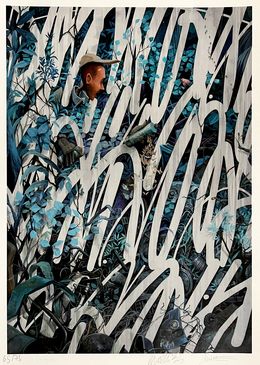
Swan Engraving Blue 1983 Signed Edition of 30 Color Relief Etching, 1983
Print : engraving · 97.5 x 77.5 x 1 cm 38.4 x 30.5 x 0.4 inch
Sold
Authenticity guaranteed
Sold with certificate of Authenticity from the gallery
Invoice from the gallery Learn more
Secure payment • Card, Amex, PayPal...
We accept several payment methods:
Paypal
American Express
Visa
Mastercard
Apple Pay
Google Pay
- Credit cards (Visa, MasterCard)
- American Express
- PayPal
- Bank transfer
- Gift card
- Apple Pay / Google Pay
All payments are secured with 3D Secure validation to protect your confidential information.
Verified Reviews : 9.6/10
Similar works







Sumit Mehndiratta
Fine Art Drawings . 76 x 56 x 0.1 cm Fine Art Drawings . 29.9 x 22 x 0 inch
€1,080


About the artwork
Type
Print : numbered and limited to 30 copies
Condition
Artwork sold in perfect condition, not framed
Authenticity
Sold with certificate of Authenticity from the gallery
Invoice from the gallery
Signature
Hand-signed by artist
Dimensions ( cm • inch )
97.5 x 77.5 x 1 cm 38.4 x 30.5 x 0.4 inch Height x Width x Depth
Sold by
Art gallery
Credentials
Vetted seller since 2026
Description
Medium: Color Relief Etching; Engraving
Edition: 29/30
Inscription: Signed, numbered, and dated in pencil on lower front right
Documentation: Includes Gallery Certificate of Authenticity
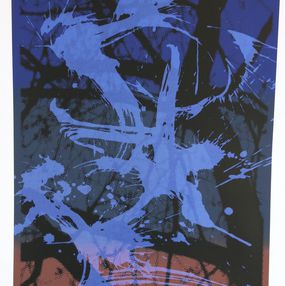
Frank Stella's "Swan Engraving Blue" (1983) exemplifies his sustained exploration of printmaking as a primary vehicle for formal invention during a pivotal period of his career. Created as part of the Swan Engravings series, the work demonstrates Stella's interest in dynamic geometric organization, the materiality of printed surface, and the interrelationship between line, plane, and spatial tension. The composition is structured through a series of intersecting forms in vibrant blue hues that push and pull across the flat picture plane, generating visual rhythm and a sense of movement intrinsic to Stella's mature abstract vocabulary.
Stella's print practice in the late 1970s and early 1980s was marked by experimentation with relief etching and engraving, techniques that allowed him to translate concerns from his larger painted and sculptural work into works on paper. In "Swan Engraving Blue", the etched linear elements and layered relief areas combine to produce depth and textural variation, reinforcing the optical complexity of the composition. The disciplined precision and rhythmic interplay typical of Stella's work are evident here, where the printed surface operates simultaneously as an object in its own right and as an articulation of abstract form.
Stella's contributions to printmaking are regarded as integral to his overall practice rather than ancillary; he treated prints as sites of investigation capable of extending his formal concerns across scale and medium. "Swan Engraving Blue" occupies this lineage, reflecting the artist's commitment to the structural logic of abstraction and the possibilities of contemporary print media.
Executed in 1983 as a color relief etching with engraving, "Swan Engraving Blue" is an editioned work, numbered 29/30. The sheet measures 39 × 31.5 inches. The work is signed, numbered, and dated in pencil on the lower right of the front, and it is accompanied by a gallery certificate of authenticity, documenting its provenance and authorship.

Presentation
Born in 1936 in Malden, Massachusetts, USA, Frank Stella is based in New York. A painter considered the precursor of minimalism, he is one of the main representatives of Op Art and the shaped canvas. After studying art at the Phillips Academy in Andover, Massachusetts, and then history at Princeton University, he was influenced by the abstract expressionism of Pollock and Kline. It was only later that he would renounce the expressive use of paint and reject the lyricism of this movement. He worked on the oppositions between shapes and colors and is the inventor of “cut-out canvases." This led him to break the boundaries of classical geometry, and his paintings would evolve into true sculptures from the 1980s onward.
His first solo exhibition took place in 1960. There he presented his “Black paintings", already exhibited previously at the Museum of Modern Art in New York City during the exhibition “Sixteen Americans". This work was the culmination of his reflections on object painting and marked his break with abstract expressionism. Frank Stella's compositions are defined by the representation of regular black bands separated by thin white lines: here again the artist studies the opposition between forms and (non) colors and uses painting as an end and not as a means of expression or representation. Indeed, as Carl Andre, minimalist painter and sculptor, put it, “For Frank Stella, it proved necessary to paint bands. There is nothing else in his painting. Frank Stella is not interested in expression or sensitivity. He is interested in the necessities of painting. Its stripes are the paths the brush takes on the canvas. These paths lead only to painting.
This exhibition marks the starting point of the minimalism movement.
Frank Stella developed the concept of "cut-out canvases," the outline merging with the geometric shapes represented. He plays with colors. White, black, multicolored, the artist uses different supports, from aluminum to copper, even steel. His compositions are generally series. From the mid-1970s, he took a turn in his artistic approach as he began to work in relief, and was influenced by the Baroque movement.
Since the 1980s, Stella has been interested in sculpture and creates it almost exclusively.
Numerous exhibitions have been dedicated to him; he is one of the few artists to have been able to attend his own retrospective during his lifetime. Indeed, in 1970 and ten years later, exhibitions were dedicated to him at the Musée d'Art Moderne de la Ville de Paris. His sculpture "The Prince of Hamburg" was installed at the National Gallery of Art in Washington in 2001. A retrospective at the Whitney Museum in New York, USA, was dedicated to him in 2015.
Discover similar artists





Reviews from our customers
All our reviews are extracted from Verified Reviews
You may also like

Frank Stella
Print . 190 x 132 cm Print . 74.8 x 52 inch
€5,000
Recommended by Artsper

Frank Stella
Print . 95.3 x 61 x 0.5 cm Print . 37.5 x 24 x 0.2 inch
€2,797

Frank Stella
Print . 55.625 x 43.125 x 1 cm Print . 21.9 x 17 x 0.4 inch
€7,925

Frank Stella
Print . 98.125 x 112.5 x 1 cm Print . 38.6 x 44.3 x 0.4 inch
€23,308

Frank Stella
Print . 132.1 x 132.1 x 0.3 cm Print . 52 x 52 x 0.1 inch
€22,842

Frank Stella
Print . 41 x 55.6 x 0.1 cm Print . 16.1 x 21.9 x 0 inch
€6,899

Frank Stella
Print . 186.69 x 134.62 x 15.24 cm Print . 73.5 x 53 x 6 inch
€97,893

Frank Stella
Print . 43.125 x 55.625 x 1 cm Print . 17 x 21.9 x 0.4 inch
€7,925

Salvador Dali
Print . 77 x 56 x 0.1 cm Print . 30.3 x 22 x 0 inch
€7,680


Elena Orlova
Fine Art Drawings . 86 x 61 x 0.1 cm Fine Art Drawings . 33.9 x 24 x 0 inch
€1,492

Roxane Mbanga
Painting . 70 x 50 x 1 cm Painting . 27.6 x 19.7 x 0.4 inch
€4,000

Baptiste Laurent
Painting . 62 x 52 x 2 cm Painting . 24.4 x 20.5 x 0.8 inch
€750
Jeanne
Painting . 92 x 65 x 2.5 cm Painting . 36.2 x 25.6 x 1 inch
€1,200



Karl-Karol Chrobok
Painting . 80 x 60 x 0.3 cm Painting . 31.5 x 23.6 x 0.1 inch
€800



Frank Stella
Print . 177.8 x 165.7 x 0.8 cm Print . 70 x 65.25 x 0.3 inch
Price upon request