



Romain Duris: a limited edition lithograph
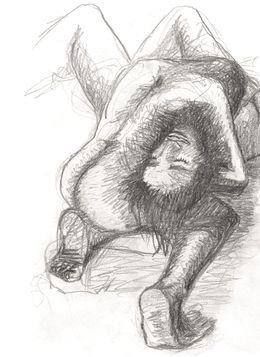
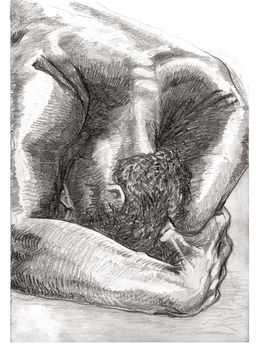
To coincide with his exhibition "Féroce" at the Galerie Cinéma-Anne-Dominique Toussaint in Paris, Romain Duris has partnered with Artsper to produce a limited-edition lithograph. Created at the Idem workshop, this work extends the artist's graphic style, characterized by a dense and expressive line that explores the fragility and power of the human body. We met with Romain Duris behind the scenes of this creation to discuss his relationship with drawing.


1. We'd love it if you could tell us a bit about your passion for drawing. What motivates you to draw?
Romain Duris: It's unoriginal, but 'life'. It's what I observe, feel and experience. It's hard to put my inspiration and passion into words, but, indeed, it has become a need. It was there very early on when I was a child, it decreased a little, then film came along and shook up the rhythm of my daily life. I discovered year after year that drawing was in fact like a refuge; it's a way to find myself. So drawing became a necessity. I cannot answer that it is anything other than 'life' that makes me draw. I think that I'm still looking for something, and that it isn't a problem to not find it. If I had to give a word for what I'm looking for, it's 'emotion'. I'm trying to convey emotions.

2. Is there a particular time or context in which you like to draw?
Romain Duris: It's very hard to orchestrate or aim for that magic moment when you think something will happen, because if you plan too much only a blank page will form. I know that it suddenly springs to mind, and it is very physical. You suddenly have this real and powerful urge to be facing a sheet of paper. But as to a method for how to trigger that or foresee it, I'm still not sure.
3. Do you listen to music? And are you in a workshop?
Romain Duris: It depends. I need to be in an isolated place, that's for sure. Alone, because I can't draw with anyone around me; yes, I can sketch, but this place on my own is important and special all the same. And after that, as for music or no music, it depends. Windows open or closed? There is still noise both indoors and out. Sometimes I don't need it; sometimes I do. Sometimes I need to listen to the radio or a particular album, it depends.
4. Your drawing exhibition is called Féroce (Fierce). What's fierce about your drawings?
Romain Duris: This is what I talk a little about in the introduction to the book. My drawings are like a cry - not of suffering; I wouldn't say that as I am not comfortable with the word and because it is far too strong. But they are like a cry, mixed with the the fear of opening up too much to the world, of revealing either too many feelings, or not enough, or the need to be alive. Drawing itself becomes something fierce, but to varying degrees. In any case, it's not so much the 'bestial' or 'cruel' senses of fierce that I want to highlight, but rather the fact that it could arise, yet is quickly stifled and held back; that's what I like.
And then there's also the sound of the word too. I enjoy the way the word 'féroce' goes through my mouth: 'Fé-roce', there's something about it that isn't light; I like it. I also find that it has so many definitions that it sounds different to everyone and evokes so many different things.
5. We followed you through the process of printing a lithograph. Is there anything that you've taken away from the experience? It wasn't your first; is there something that you particularly like, or liked this time round?
Romain Duris: I loved the atmosphere of these workshops, all underground; it's a rather mythical place. With all these incredibly old machines, there is something very sensual and moving to it all. I could draw on stone instead of paper to convey even more sensations, but it's a very sensual and moving thing to suddenly see the sheets and layers of ink pass through these machines that have been running for years. And I find the rendering quite magical; it is unlike any other process. Lithography produces something very distinctive. It is evidently not like the original, nor does it look like an ink print or a scan. A lithograph has a different sensation, a different feel to it.
Even the way that the paper is cut around it has something sensual to it. The rendering is not soft, because it could be, but when you see the final stage, with the very dense black print, 'soft' is not the word that comes to mind. I find that this printing process corresponds well with the drawing that we chose for it, because it's powerful yet sensory.


6. More generally, we'd love to talk to you about your inspirations. Are there any artists who have really influenced you or who still shape your work today?
Romain Duris: It's complicated because there are many of them. But yes, Rodin. He's ultimately the one artist who always has and always will inspire me. I'm still very moved whenever I see his work, and I find that very powerful.
7. You can feel that in your drawings…
Romain Duris: I don't know, perhaps. I love these shapes and forms that spring from blocks of marble or plaster. It's like a birth; the birth of a spectacular figure. And when you move closer and can see the strength of the hands and muscles, with veins running through them, and the sheer talent with which the artist reproduces them; that has a great effect on me.
"My drawings are like a cry mixed with the modesty of an alert."

Their favorite artworks


Romain Duris
Fine Art Drawings . 29.6 x 20.4 cm Fine Art Drawings . 11.7 x 8 inch
€2,000
Recommended by Artsper