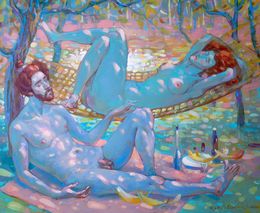
Venus, 2026
Painting : oil · 100 x 80 x 3 cm 39.4 x 31.5 x 1.2 inch · Ready to hang
€10,000
10 000 €
Shipping & delivery
Shipped from: France
Delivery to: Germany , € 119
Estimated delivery: One to two weeks
Free returns within 14 days, full refund
Authenticity guaranteed
Sold with certificate of Authenticity from the artist
Invoice from the gallery Learn more
Secure payment • Card, Amex, PayPal...
We accept several payment methods:
Paypal
American Express
Visa
Mastercard
Apple Pay
Google Pay
- Credit cards (Visa, MasterCard)
- American Express
- PayPal
- Bank transfer
- Gift card
- Apple Pay / Google Pay
All payments are secured with 3D Secure validation to protect your confidential information.
Verified Reviews : 9.6/10
Similar works




About the artwork
Type
Painting : Unique artwork
Condition
Artwork sold in perfect condition, framed, ready to hang
with stretcher frame
Authenticity
Sold with certificate of Authenticity from the artist
Invoice from the gallery
Signature
Hand-signed by artist
Dimensions ( cm • inch )
100 x 80 x 3 cm 39.4 x 31.5 x 1.2 inch Height x Width x Depth
Artwork dimensions including frame
110 x 90 x 6 cm 43.3 x 35.4 x 2.4 inch
Sold by
Art gallery
Professional art gallery • France
Credentials
Vetted seller since 2026
Description
In Venus, Sefa Çatuk returns the myth to its most ancient root: before Venus was desire, she was nature. The central figure—a whole body painted in an intense vegetal green, skin traversed by the same fine hatching as the grass, leaves, and moss around her—is not a woman in a landscape. She is the landscape.
Placed on a tree trunk as if on a sculpture's pedestal, she cradles the sleeping man's head in the hollow of her hand. He rests. She watches over him. And in this gap of consciousness between the two bodies, Çatuk lodges the entire question of the work: who contemplates whom? Who is the object, who is the gaze?
The tree trunk is not a detail. It is the theological heart of the painting.
In the Western tradition, the sculpture of Venus—from the earth to the stone—has always attempted to capture the divine in matter. To carve the stone was to approach the goddess. Çatuk reverses this gesture: he places the goddess herself on raw wood, on the felled trunk, on what remains of a living tree. The base is not polished marble—it is organic matter, imperfect, mortal.
In doing so, he suggests that the human desire to touch the divine in nature—by sculpting bodies, by painting goddesses—was perhaps unnecessary. Nature didn't need to be copied. It was already Venus.
The terracotta-skinned man sleeps, his eyelids closed, one hand resting on his own stomach in a gesture of complete surrender. The green figure holds him—not possessively, but with the grave attention of someone who knows that another's sleep is an act of trust.
Here, Çatuk constructs his favorite dyad: two beings in radically different states, one absent to himself, the other fully present. This is not equality in love—it is something older, more asymmetrical: the relationship between the mortal and that which transcends him, between the man who dreams and the force that watches over his dream.
The bird perched in the ginkgo above them — small, silent, bearing a red dot like a pupil — is the third gaze. The one that sees all and says nothing.
The green of Venus is not a chromatic fantasy. It is an ontological statement.
In the history of painting, Venus is flesh—pink, warm, luminous. Çatuk strips her of this superficial humanity to give her a deeper one: the color of sap, of seaweed, of copper oxidized by centuries, of the garden at dawn. Her body is made of the same substance as the stems that surround her, the ginkgo leaves above her, the dense grass that grows everywhere with an almost stubborn vitality.
Facing her, the man's terracotta skin—warm, ochre, fragile—evokes clay, pottery, the very material from which men are made in mythologies around the world, the earth. She is vegetal, he is mineral. Together, they form a complete world.

Presentation
Born in Istanbul in 1992, the artist completed his undergraduate studies at the Faculty of Fine Arts, Sakarya University, Department of Painting, in 2017. He continues to work and live in Istanbul. Sefa Çatuk creates narratives based on current political events, crafting his own mythology within his paintings. In these narratives, the artist incorporates themes such as social rituals, the moral structure of the public sphere, and cultural codes, creating a new history by reflecting the social and political impact of paintings that represent a turning point in the history of art in our time.
Discover similar artists



Reviews from our customers
All our reviews are extracted from Verified Reviews
You may also like


Hiromi Sengoku
Painting . 162 x 162 x 5 cm Painting . 63.8 x 63.8 x 2 inch
€13,900

Dasha Pogodina
Painting . 150 x 130 x 2.5 cm Painting . 59.1 x 51.2 x 1 inch
€3,600


Sefa Catuk
Painting . 150 x 150 x 3 cm Painting . 59.1 x 59.1 x 1.2 inch
€16,000
Recommended by Artsper

Dasha Pogodina
Painting . 80 x 80 x 2 cm Painting . 31.5 x 31.5 x 0.8 inch
€1,580


Kateryna Kolesnykova
Painting . 110 x 90 x 2 cm Painting . 43.3 x 35.4 x 0.8 inch
€1,489

Vakhtang Khelashvili
Fine Art Drawings . 49 x 69 x 0.1 cm Fine Art Drawings . 19.3 x 27.2 x 0 inch
€2,500


Martine Littot
Painting . 81 x 100 x 2 cm Painting . 31.9 x 39.4 x 0.8 inch
€3,200
Fannie Iribarnegaray
Painting . 100 x 100 x 2 cm Painting . 39.4 x 39.4 x 0.8 inch
€1,400

Aldona Jablonska Klimczak
Painting . 120 x 80 x 2 cm Painting . 47.2 x 31.5 x 0.8 inch
€6,500


Sefa Catuk
Painting . 120 x 80 x 3 cm Painting . 47.2 x 31.5 x 1.2 inch
€10,000