












Untitled, 2023
Painting : oil, charcoal, pastel, mixed media · 50 x 20 x 3 cm 19.7 x 7.9 x 1.2 inch · Ready to hang
$1,066
1 066 $US
Shipping & delivery
Shipped from: Spain
Delivery to: United States , $ 158
Estimated delivery: One to two weeks
Free returns within 14 days, full refund
Authenticity guaranteed
Sold with certificate of Authenticity from the gallery
Invoice from the gallery Learn more
Secure payment • Card, Amex, PayPal...
We accept several payment methods:
Paypal
American Express
Visa
Mastercard
Apple Pay
Google Pay
- Credit cards (Visa, MasterCard)
- American Express
- PayPal
- Bank transfer
- Gift card
- Apple Pay / Google Pay
All payments are secured with 3D Secure validation to protect your confidential information.
Verified Reviews : 9.6/10
Similar works


Emilie Serris
Painting . 60 x 60 x 2 cm Painting . 23.6 x 23.6 x 0.8 inch
$1,112
Recommended by Artsper


Le anh Tuan
Painting . 76 x 54 x 1 cm Painting . 29.9 x 21.3 x 0.4 inch
$3,858
Recommended by Artsper


About the artwork
Type
Painting : Unique artwork
Condition
Artwork sold in perfect condition, not framed, ready to hang
with stretcher frame
Authenticity
Sold with certificate of Authenticity from the gallery
Invoice from the gallery
Signature
Hand-signed by artist
Technique & Support
oil , charcoal , pastel , mixed media on canvas
Dimensions ( cm • inch )
50 x 20 x 3 cm 19.7 x 7.9 x 1.2 inch Height x Width x Depth
Sold by
Art gallery
Credentials
Vetted seller since 2022
Discount
This seller offers discount when you purchase multiple artworks.
Description
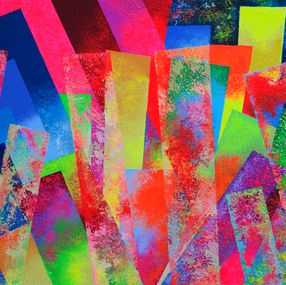
This work unfolds as a vertical sequence of intertwined bodies, suspended between emergence and dissolution. Figures appear not as fixed anatomies but as shifting presences—constructed through layered brushwork, translucent color fields, and rhythmic contour lines.
The palette—soft blues, ochres, and muted violets—creates a sense of atmospheric depth, as if the forms are held within a fluid, almost aqueous space. Limbs extend and fold into one another, producing a continuous circulation of movement rather than discrete gestures. The composition resists a single focal point; instead, the eye travels along the vertical axis, following a choreography of tension and release.
There is a clear dialogue with art historical figuration—echoes of Mannerist elongation and Renaissance bodily construction—yet these references are destabilized through fragmentation and painterly immediacy. The surface remains active and unresolved, allowing traces of process to remain visible.
The result is a work that operates between figuration and abstraction, where the human form becomes a site of transformation rather than representation.

Presentation
Human body is the main theme of Alisa Gorelova's art. Although it has been a subject of studies of anatomists and painters for the last five centuries, it looks unusual, fascinating, mysterious in her paintings. The image is living, breathing and collapsing, reaches the borders where it risks breaking into splashes of color or losing the understandable integrity, becoming something like a flower or a flame. You will not find two identical figures here: they intertwine in a single chain, fill narrow canvases to the brim and reach out for one another transmitting an impulse that has for the first time appeared in the touch of fingers of the God and Adam on the Sistine Chapel ceiling. Just as in the act of creation, bodies in Gorelova's works are free of any political views or taste preferences, all their distinctive features are in themselves. Each painting unfolds to the viewer as a dance of form and color; the painter owes a great deal to Matisse but her choreography is more modern and to a greater extent dedicated to physical opportunities of a human being. Outside of social, cultural or any other conventions, the "naked man on the naked ground" that philosophers have dreamed about doubly requires an attentive artistic view able to catch even the absolutely imperceptible beating under the skin surface that changes the relief and color. The endless plastic resource the human body represents cannot be replaced with any creations of the technological progress. Unlike in the Doctor Frankenstein's experiences, the Gorelova's works reveal the affectionate attention her brush and pencil confer to each model's bend. The painter gathers together anew the man taken to pieces by the modernist art and history of the 20th century or at least gives us hope that such recreation is possible.
The core of the exhibition constitutes four large three-part works created in 2022. All of them develop an intense life of form and color floating from figure to figure and giving its own emotional edge to each piece. Narrow vertical canvases have become a distinctive feature of the Gorelova's art much like long and dragging compositional diagonals not letting the viewer go, leading him imperiously, focusing on each triceps and muscle strain. Her talent exists in a broad and truly modern range, freely moving between antiquity, Mannerism and the 20th century. Today, Gorelova is increasingly resorting to wayward and self-assured 17th century Italians: the ceiling of the Michelangelo's Sistine Chapel and the gallery of the Rosso Fiorentino's Palace of Fontainebleau become the plastic resource.
Choosing the best from the Renaissance, cutting the body to pieces in Expressionism or deconstructing it in Surrealism, the painter is always seeking something new. Gorelova's art can be characterized by postmodern collectiveness of images: the paintings may show an absolutely natural arm or leg of a Renaissance character treated with acidity of Surrealism to achieve purity. Fluidity of graphic forms can be compared to the Leonora Carrington's vague enchanting characters as well as the Georgia O'Keeffe's feminine anatomy of colors. Feet and hands get thinner, longer, grow in number, start living on their own contrary to anything real. The movement is broken down into multiple stages but these naked figures are not descending the stairs, quite the opposite, they are agonistically climbing one atop the other. One cannot help but wonder where this all is taking place, maybe in the Dante's Inferno?
Fascinated by the structure of bodies and the movement of paint on canvas, the artist is unintentionally solving the complicated problem of expression that is mandatory in modern art especially for creators working in traditional and classic mediums. Figures in her paintings are so closely intertwined that they literally tug along the sociological concepts of mass and crowd. Corporality that has become one of the primary issues and themes of art in the latest decades reaches its utmost expression. Emotions are now unbearably strong and conveyed in their entirety not by individuality of faces rather by depersonalized bodies. Complicated plastic scrupulously developed by the artist is able to give birth to natural rhetorical formulas known from the Baroque. Gorelova extracts them from cultural memory layers found in dangerous proximity to the surface of man's existence and separating life from oblivion. These are not just subconscious depths that surrealists were so fond of, this is the thin line dividing a man from an internal beast. The painter has learned the lesson taught by the art of the entire 20th century together with expressionists, which is proven by the color harmony of her exceptionally bright-colored works.
A person standing in front of these paintings can be shocked or frightened, asking his body million instantaneous questions not reaching the consciousness: "Is this really me?" The images painted by the artist are juxtaposed and compared with reservoir of individuality a man has, muscular coating of unique consciousness, this is where the trick and paradox of verisimilitude lies. The human body remains a universal image able to explain everything, especially if it is portrayed with such inner thoroughness as in the Gorelova's art. The well-known problem of philosophy and psychology Self and the Other accepts a new shape.
The events of the last six months are probably the most profound revision of humanistic images and concepts of the 21st century. Rhetoric and plastic have gained newfound relevance. Figures with dog heads as if coming from another aesthetic universe catch up with the characters in one of the artist's works as a sign of dehumanization accompanying any war. "Can these be us as well?" that's what millions of honest people in Russia including Alisa Gorelova ask themselves.
Discover similar artists




Reviews from our customers
All our reviews are extracted from Verified Reviews
You may also like


Kajazun (Kajo) Avetisyan
Painting . 80 x 60 x 2 cm Painting . 31.5 x 23.6 x 0.8 inch
$2,225 $2,002
Recommended by Artsper

Alisa Gorelova
Painting . 30 x 30 x 3 cm Painting . 11.8 x 11.8 x 1.2 inch
$1,417

Liliane Cima
Painting . 80 x 65 x 2 cm Painting . 31.5 x 25.6 x 0.8 inch
$1,025


Âme Sauvage
Painting . 90 x 90 x 2 cm Painting . 35.4 x 35.4 x 0.8 inch
$1,054


Kajazun (Kajo) Avetisyan
Painting . 67 x 59 x 2 cm Painting . 26.4 x 23.2 x 0.8 inch
$1,054 $948

Yana Dmitrieva
Painting . 90 x 30 x 1.5 cm Painting . 35.4 x 11.8 x 0.6 inch
$1,000


Samantha Malone
Painting . 75.5 x 56 x 0.1 cm Painting . 29.7 x 22 x 0 inch
$937


Graça Tirelli
Painting . 40 x 50 x 2 cm Painting . 15.7 x 19.7 x 0.8 inch
$1,171


Yaki Li
Painting . 50 x 40 x 0.3 cm Painting . 19.7 x 15.7 x 0.1 inch
$703
Recommended by Artsper


Jean Christophe Stauder
Painting . 81 x 60 x 3 cm Painting . 31.9 x 23.6 x 1.2 inch
$2,693


Kateryna Malomuzh
Painting . 93 x 145 x 0.1 cm Painting . 36.6 x 57.1 x 0 inch
$950


Luo Yi
Painting . 80 x 90 x 4 cm Painting . 31.5 x 35.4 x 1.6 inch
$16,042

Peter Nottrott
Painting . 70 x 100 x 4 cm Painting . 27.6 x 39.4 x 1.6 inch
$1,054

