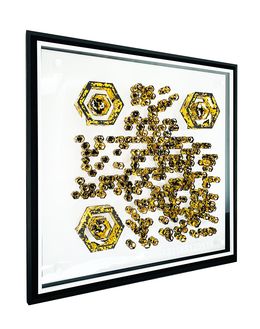
This relief work by Aurélien Guiho, freely inspired by Johannes Vermeer's , transposes one of the most famous faces in the history of art into the matrix of a QR code. The celebrated blue turban, the ochre drapery, the flesh tones of the face and the deep, almost black ground are no longer rendered by the brush but reconstituted module by module, as though Dutch chiaroscuro had been recompiled into readable data.
Where Vermeer worked light in glazes, I work it in volumes. Each square protrudes or recedes, and the relief casts its own shadows, turning the picture into a living surface that shifts with the hour and the lighting. The grainy texture of the coloured modules recalls the substance of pigment, while the strict geometry of the grid imposes the logic of the digital. Step back, and the gaze reassembles the face; step closer, and it sees nothing but code.
The pearl itself slips away. In Vermeer a minute detail, a point of light around which the entire canvas organises itself, it becomes here an absence to be sought within the matrix, a secret dissolved into information. Therein lies the paradox of the work: this face that has held us in its silent, intense gaze since the seventeenth century is now an image to be scanned. Contemplation comes before use, and then use opens another door.
This shift marks a major evolution of the portrait. The girl is no longer content merely to be looked at — she becomes an interface, a threshold between pictorial heritage and the flow of data that structures our era. By hybridising the legacy of the Old Masters with the most banal language of our connected daily lives, the work asks what remains of a face once it has been translated into signal, and what we still recognise in it.
Framed in a classical gilded moulding, the piece fully embraces this tension between the museum and the screen, between the aura of the unique work and the infinite reproducibility of code.