Oil painting and pastel on paper
Unique work
Signed at the bottom by the artist
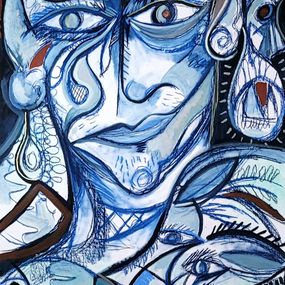
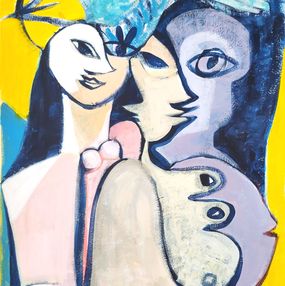
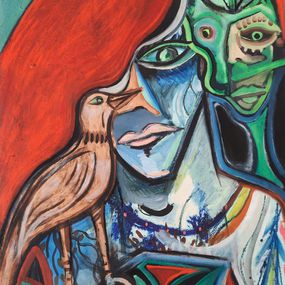
Returning to portraiture, the artist shifts the traditional stakes. The face is no longer the stable place of an identity, but that of its transformations. Human features mingle with those of the animal, the bird, the god, or creatures that escape any definitive designation. Ichor, that divine substance that circulates in the veins of Greek gods, becomes then a metaphor for the circulation between forms, an imaginary matter that crosses bodies and makes porous the boundaries between the human and the divine, the familiar and the strange.
Because Timothy Archer does not seek to illustrate myths, but to set them in motion. He transforms them into living matter, confronts them with the present, and brings them to the fore in new forms. The sacred coexists with the grotesque, the human with the bestial, without these tensions ever being definitively resolved.
Hybridity thus appears less as an anomaly than as a constitutive possibility of the living and the imaginary: that by which identities move, forms transform, and beings escape the categories that claim to define them.
Timothy Archer thus invites us to question what grounds our humanity, but also what, in it, remains unfinished, open to alteration and the birth of other possibilities.
What if we were never quite finished?
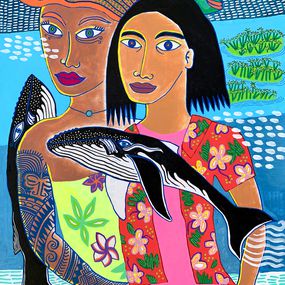
In Timothy Archer's work, the feminine is never reduced to a figure to be represented. It appears as a power of transformation, a principle of passage between the human, the animal, the plant, and the divine. Far from constituting an immutable identity, it becomes the place where forms move, contaminate, and reinvent themselves.
The figures that traverse his painting often borrow from mythology, but the artist does not seek to reproduce its stories.
They are neither muses destined to inspire a hero, nor presences subordinate to his fate, nor incarnations of an ideal to which they should conform. They occupy the foreground and fully participate in the making of the world. Protagonists or antagonists, guardians or forces of upheaval, they act according to their own necessity. They can carry the narrative as well as contradict the course, without their existence depending on that of a male rival. They do not have to conquer a place in a universe that would be foreign to them: they are already the sovereign actors.
This autonomy is accompanied by a deep ambivalence. The feminine can be protective or unsettling, maternal or warrior, erotic or wild. Athena can embody guardianship and strategy; the siren, attraction as well as peril; the figure of Morgan le Fay, the power of a transformation that escapes ordinary rules. Sweetness and beauty are just possibilities among others. These figures are never confined to a single function, no more than in a simplistic opposition between good and evil. Their power lies precisely in their capacity to exceed the roles assigned to them.
By detaching them from the fixity of their legends, Timothy Archer allows them to cross the boundaries between realms. The body can become mask, animal, vegetation, monster, or hybrid creature. None of these forms necessarily constitutes an end point: each carries within it the possibility of its own transformation. The feminine thus becomes less an identity than a passage, a territory where the human meets what overwhelms it and where established categories lose their evidentness.
Neither an ideal nor a simple counterpoint to the masculine, the feminine belongs to this mythological matter that the artist gathers and transforms. It is one of the privileged places of his research: the place where beings are not defined by the place they occupy in relation to another, where powers can be contradictory without annihilating each other, and where every form, even apparently finished, retains the possibility of becoming another.