Jonathan McFadden recieved his MFA in Printmaking from Edinburgh College of Art (U.K.) in 2009, and his BFA in Printmaking and BA in French in 2006 from Texas State University- San Marcos.
Jonathan Has exhibited in two doezen states throughout the U.S. and a dozen countries including at the National Gallery of Scotland, Royal Scottish Academy, University of Texas- San Antonio, University of Wisconsin- Madison, University of Minnesota, 621 Gallery, Highpoint Center For Printmaking, Wichita State University, Millsaps College, 55 Limited, and Inner Mongolia University to name a few.
His numerous residencies include Anchor Graphics at Columbia College, 55 Limited, a Jerome Residency at Highpoint Center For Printmaking, The Prairie Center of The Arts, John David Mooney Foundation, and Cove Park. He has tought at Houston Community College, Minnesota State University- Mankato and is currently an Assistant Professor of Print Media in the School of Art & Visual Studies at the University of Kentucky.
Artist Statement
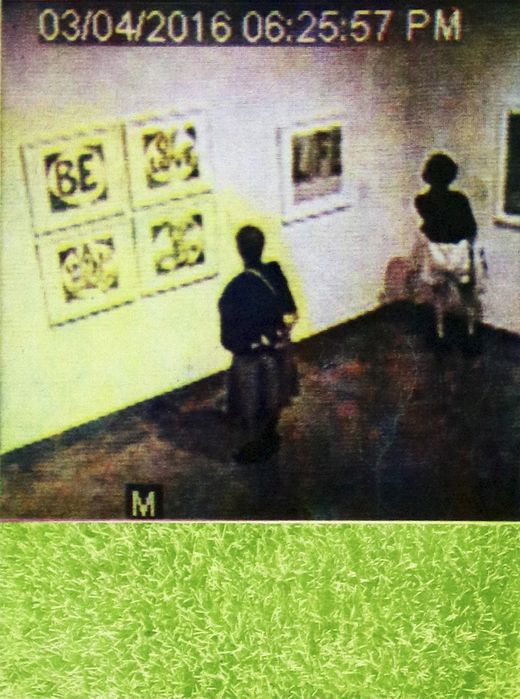
My work is centered on connections, be it between imagery, text, found and mass-produced objects I seek to create narrative contingencies by linking information. This information is largely taken from and influenced by social media posts, cell phone photography, online advertising, to name a few. From the sourced information look for connections between the objects and information seeking out what is real and a facsimile. This may include a cctv camera streaming an image of a fake houseplant on a mass-produced shelf that hold both an original print and a object that utilized the documentation of that print. I seek then to create a dialogue with the viewer about the value of objects and their hierarchy when placed together and in conjunction with the seemingly ephemeral nature of social media linguistics.
I am interested how we interact with, interpret and process fragments of personal narratives of people we have loose associations with yet have found ourselves a voyeur in the personal moments of their life. While this could be considered ephemeral imagery because it only is in our feeds temporarily these digital images have a permanence and history that exists beyond the few seconds we view them on our computers or phones. By utilizing this information for object creation the ephemeral take on a static permanence altering how the information is consumed and allows the viewer to engage in new dialogues with the work.