







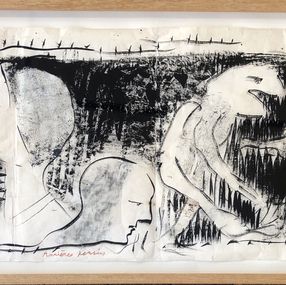
Deux femme dansantes en intérieur, Circa 1958
Fine Art Drawings : Watercolour, gouache · 33.5 x 47.5 x 0.3 cm 13.2 x 18.7 x 0.1 inch · Ready to hang
$1,843
1 843 $US
One of the last works available by this artist
Shipping & delivery
Shipped from: Switzerland
Delivery to: United States , $ 101
Estimated delivery: Less than one week
Free returns within 14 days, full refund
Authenticity guaranteed
Sold with certificate of Authenticity from the gallery
Invoice from the gallery Learn more
Secure payment • Card, Amex, PayPal...
We accept several payment methods:
Paypal
American Express
Visa
Mastercard
Apple Pay
Google Pay
- Credit cards (Visa, MasterCard)
- American Express
- PayPal
- Bank transfer
- Gift card
- Apple Pay / Google Pay
All payments are secured with 3D Secure validation to protect your confidential information.
Verified Reviews : 9.6/10
Similar works


Victor Prodanchuk
Painting . 55 x 42 x 1 cm Painting . 21.7 x 16.5 x 0.4 inch
$4,084
Recommended by Artsper


About the artwork
Type
Fine Art Drawings : Unique artwork
Condition
Artwork sold in perfect condition, framed, ready to hang
Authenticity
Sold with certificate of Authenticity from the gallery
Invoice from the gallery
Signature
Hand-signed by artist
Technique & Support
Watercolour , gouache on paper
Dimensions ( cm • inch )
33.5 x 47.5 x 0.3 cm 13.2 x 18.7 x 0.1 inch Height x Width x Depth
Artwork dimensions including frame
68.5 x 57.5 x 4 cm 27 x 22.6 x 1.6 inch
Sold by
Art gallery
Credentials
Vetted seller since 2019 • Top Seller
Description
Original frame.

Presentation
José Caballero studied at the school of the Padres Agustinos and passed his baccalaureate at the Institute of Huelva, where he showed a certain talent for drawing. In the 1920s, he met the poet Adriano del Valle. In 1924 his father died, leaving his family in a very difficult economic situation.
In 1930 he moved to Madrid to study industrial engineering, which he left two years later to join the Royal Academy of Fine Arts in San Fernando. He also took lessons in the studio of Daniel Vázquez Díaz, whom he met in Huelva, painting the walls of the Monastery of La Rábida. Thanks to his master, he came into contact with the most remarkable artists and intellectuals of the moment. Shortly after, he collaborated with artists such as Federico García Lorca in an exhibition at the Ateneo de Huelva, which was so controversial that it was closed at the very moment of its inauguration.
In 1933 he frequently visited the Uruguayan constructivist painter Joaquín Torres García, and a year later the sculptor Alberto Sánchez Pérez, from whom he learned a great deal. That same year Federico García Lorca incorporated him into the university theater La Barraca, where he provided several designs for the company's plays; he also designed the scenography for the play Historia de un soldado at the Student Residence in Madrid. It was there that he befriended Pablo Neruda, Rafael Alberti, Miguel Hernández, Maruja Mallo and Luis Buñuel.
The year 1935 represents for the artist a creative stage closely linked to Spanish surrealism. He thus produced three posters with Adriano del Valle in the Ateneo de Sevilla and illustrated poems by Federico García Lorca and Pablo Neruda. He also contributes to avant-garde magazines such as Cruz y raya, Noreste, Línea and Caballo Verde para la poesía or for the Primera Feria de dibujo de la Sociedad ibérica de artistas (“first drawing fair of the Iberian Society of Artists” ).
With the arrival of the Spanish Civil War, many of these artists went into exile or disappeared. This is not the case of José Caballero, whom the war will catch up with and enlist to draw maps. After the conflict, he carried out numerous works as a decorator for cinema, theater and dance (ballets by Pilar Lopez in Madrid, London and Paris). He collaborated with great directors of the Spanish scene and this work is immortalized by numerous shots by photographer Juan Gyenes in the 1940s and 50s.
In 1949, he produced his first painting for the Spanish Tourist Office and illustrated several books of poetry. His success was notable until in 1950 he was invited to the 25th edition of the Venice Biennale and then held his first major individual exhibition in Madrid, at the Clan gallery. It was then that he became interested in expressionism and in 1953 he exhibited in the Reina Sofía museum in Madrid. In 1957 he met Pablo Picasso in Paris. A change then gradually takes place in him and in his work, which is more abstract, in which he includes different elements such as mixed techniques or collages specific to the materialism of Antoni Tàpies, or which he brings back from his travels, such as the one in Turkey. , where he will try his hand at geometry.
Several exhibitions on his work will take place in the following years.
In 1972, he organized an anthological exhibition in Huelva, where he had previously produced several works for the Provincial Council. The following year, one of his exhibitions was censored by the Ministry of the Interior.
In 1984 he received the National Plastic Arts Prize.
He died in Madrid on May 26, 1991 and is buried in Alcalá de Henares.
Discover similar artists


Reviews from our customers
All our reviews are extracted from Verified Reviews
You may also like


Mari Ito
Fine Art Drawings . 59 x 42 x 3 cm Fine Art Drawings . 23.2 x 16.5 x 1.2 inch
$15,287

Florence Dussuyer
Painting . 146 x 97 x 4 cm Painting . 57.5 x 38.2 x 1.6 inch
$5,951


Masha Schmidt
Fine Art Drawings . 35 x 25 x 1 cm Fine Art Drawings . 13.8 x 9.8 x 0.4 inch
$688

Masha Schmidt
Fine Art Drawings . 35 x 25 x 1 cm Fine Art Drawings . 13.8 x 9.8 x 0.4 inch
$688


Hatem Akrout
Painting . 114 x 146 x 1 cm Painting . 44.9 x 57.5 x 0.4 inch
$6,068

Pere Bennàssar Obrador
Painting . 195 x 97 x 1.5 cm Painting . 76.8 x 38.2 x 0.6 inch
$9,919