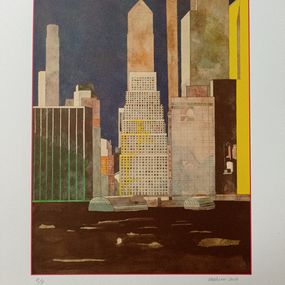
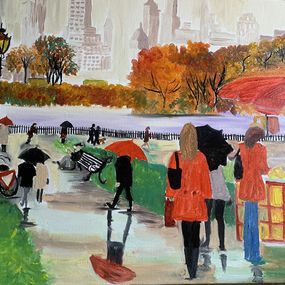
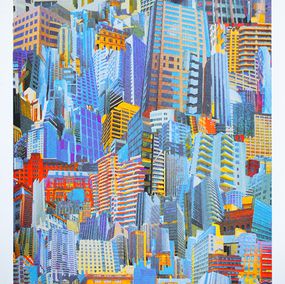
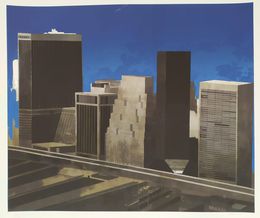
In 1975, Jacklin went to live and work in New York City, and his work has subsequently been correspondingly large and ambitious. His oeuvre since 1975 comprises a portrait of parts of New York and some of its more run-down areas and inhabitants: the meat market below his studio on 14th Street, 42nd Street, the dog show at Madison Square Garden, salesmen's cafés, Washington Square, the 35th Precinct police station, Grand Central Station, the Hudson River, Sheep Meadow, Tomkins Square (complete with full dress urban riot), and, most recently, a large series of paintings, drawings, prints and etchings of Coney Island, a rough, proletarian, seaside resort long past its prime.
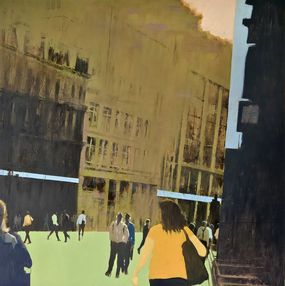
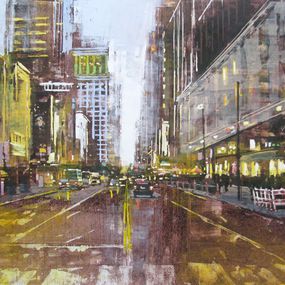
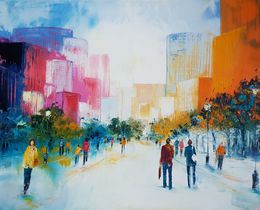
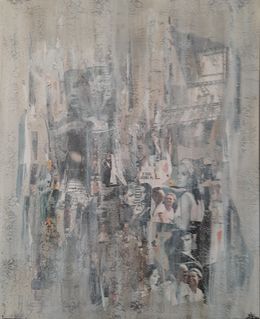
Jacklin's cityscapes are often an intriguing combination of hard and soft-focus passages, which create an impressionistic effect of figures moving or half-glimpsed. These effects are sometimes worked up from hard-edged preparatory sketches, but in the final versions even the apparently hard-focused figures are actually formed by roughly edged expanses of colour rather than by line. More intriguingly, there are passages in some of the paintings of marching crowds which, taken out of the whole painting, could stand as early abstract Jacklins. Sometimes, too, Jacklin paints or draws the same scene over and over again, as it appears at slightly different moments.
While Jacklin's methods in the New York paintings are not those of the Impressionists, the upshot is often rather similar, of figures half-seen and moving in and out of focus, of light and movements caught at one fraction of a moment.
Jacklin says that when he paints an object, place or person, his intention is not to possess, but to experience the relationship between himself and what he sees. This is correct, provided that it is understood that the relationship in question is one of seeing by the artist. Jacklin's figures are, on the whole, not engaging with the spectator, but absorbed in their own activities or worlds. Some, indeed, are involved in strange, even menacing incidents, not entirely clear to the viewer (Coney Island Incident). Jacklin says that 'the function of the artist is to act as a conduit through which the processes of seeing and responding may take place'.
This artwork beautifully captures the bustling dynamism of a cityscape with masterful brushwork and plays of light. The scene unfolds from an elevated perspective, revealing a procession of pedestrians, vibrant with the colors of flags, weaving between shadow-draped trees lining the street. The artist employs a soft focus technique, blurring details to convey movement and the hustle of urban life. Sunlight filters through the foliage, casting dappled golden highlights that contrast the imposing vertical stature of the surrounding skyscrapers. The composition’s depth is accentuated by the interplay of light and shadow, drawing the viewer's eye along the winding thoroughfare. This work is an evocative portrayal of a city’s pulse, combining realism with impressionistic elements, capturing both the grandeur and intimacy of urban spaces. The unique perspective and atmospheric quality make it a compelling study of rhythm and light.
BILL JACKLIN, R.A. (B. 1943)
Signed, inscribed and dated "The Parade /The March up'/6th Avenue /Jacklin 86." (on the reverse)