




Peru
•
1938
"In his monumental swirling universe, he managed to preserve his part of humanity in this delirious phantasmagoria," said Gaston Diehl, art critic and historian on Laos Braché.
Nationality
Categories
Biography
Carlos Laos Braché born on July 3, 1938, in Chincha Alta (Ica province) is a Peruvian painter, draftsman, and lithographer.
Associated with the post-surrealism movement, he has lived in Paris since 1972. He is also an illustrator of children's books and signs his works Braché.
Carlos Laos Braché is a Peruvian painter, draftsman, lithographer, and illustrator whose work develops a deeply personal universe located in the extension of surrealism.
He was born in Chincha Alta, in the Peruvian province of Ica. His date of birth is the subject of a divergence between sources: long given as 194, it is today documented by some sources as July 3, 1938, based on the municipal records of his hometown.
Braché studied painting at the National Higher School of Fine Arts of Lima. The Museo Ralli places this training between 1962 and 1968. After his studies, he taught at the Regional School of Fine Arts of Ica, where he later became director.
His path took a new direction when he settled in Paris in 1972. There he continued his training in the field of lithography at the National Higher School of Fine Arts. France thus became the main territory for the development of his artistic career.
Painting, drawing, and graphic work occupy a complementary place in his practice. Braché progressively develops an immediately identifiable language in which drawing retains a fundamental function. His characters are constructed by supple and nervous lines, then invested by a color often very intense.
However, his figurative universe escapes any realistic representation. Human figures transform into hybrid characters, sometimes grotesque, sometimes burlesque, surrounded by objects or signs whose meaning remains deliberately uncertain. Proportions are distorted, spaces become impossible, and situations seem to belong to a dream.
This dimension leads to associating his work with surrealism or post-surrealism. The Museo Ralli notably highlights the dreamlike dimension of his compositions and the role played by his imagination and personal experiences in the formation of this universe.
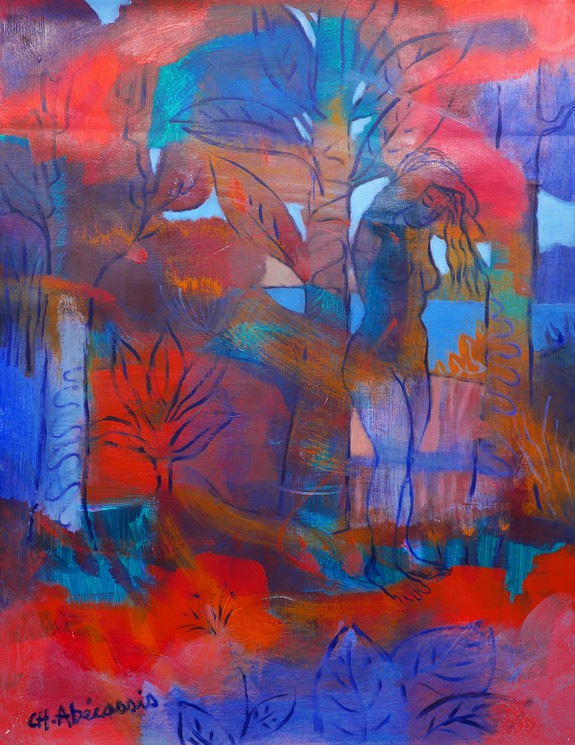
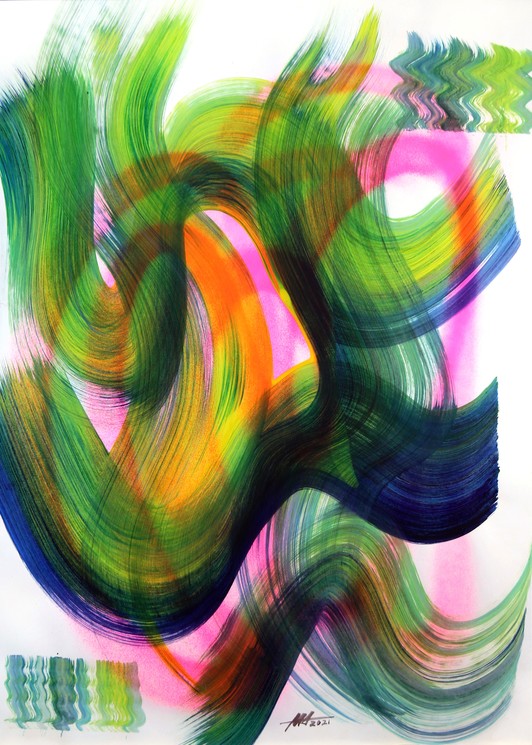
Color constitutes the other major element of his language. Deep blues, reds, oranges, greens, and pinks frequently confront each other in his compositions. Pigments can be used in flat areas, but also diffuse or overlap, creating a pictorial material that contrasts with the graphic precision of the drawing.
This freedom explains the diversity of techniques used by the artist: painting, drawing, pastel, mixed media, and lithography. Public sales catalogs document several works on paper executed in mixed media or with oil pastel.
Paralleling this, Braché develops an activity as an illustrator, particularly for youth literature. He illustrates among others Petit-Arbre cherche ses frères de Yak Rivais in 1989 and L'Arbre merveilleux by Jorge Nájar the same year.
His work receives different recognitions in France and Peru. He is notably distinguished by the Taylor Foundation, which awarded him the Roger-Marage prize in 202.
The work of Carlos Braché thus occupies a singular position between European surrealist heritage and Latin American imagination. His art does not seek to tell a precise story as much as to provoke an encounter with a parallel world: a space populated by strange figures, inexplicable situations, and particularly expressive colors.
Associated with the post-surrealism movement, he has lived in Paris since 1972. He is also an illustrator of children's books and signs his works Braché.
Carlos Laos Braché is a Peruvian painter, draftsman, lithographer, and illustrator whose work develops a deeply personal universe located in the extension of surrealism.
He was born in Chincha Alta, in the Peruvian province of Ica. His date of birth is the subject of a divergence between sources: long given as 194, it is today documented by some sources as July 3, 1938, based on the municipal records of his hometown.
Braché studied painting at the National Higher School of Fine Arts of Lima. The Museo Ralli places this training between 1962 and 1968. After his studies, he taught at the Regional School of Fine Arts of Ica, where he later became director.
His path took a new direction when he settled in Paris in 1972. There he continued his training in the field of lithography at the National Higher School of Fine Arts. France thus became the main territory for the development of his artistic career.
Painting, drawing, and graphic work occupy a complementary place in his practice. Braché progressively develops an immediately identifiable language in which drawing retains a fundamental function. His characters are constructed by supple and nervous lines, then invested by a color often very intense.
However, his figurative universe escapes any realistic representation. Human figures transform into hybrid characters, sometimes grotesque, sometimes burlesque, surrounded by objects or signs whose meaning remains deliberately uncertain. Proportions are distorted, spaces become impossible, and situations seem to belong to a dream.
This dimension leads to associating his work with surrealism or post-surrealism. The Museo Ralli notably highlights the dreamlike dimension of his compositions and the role played by his imagination and personal experiences in the formation of this universe.
Color constitutes the other major element of his language. Deep blues, reds, oranges, greens, and pinks frequently confront each other in his compositions. Pigments can be used in flat areas, but also diffuse or overlap, creating a pictorial material that contrasts with the graphic precision of the drawing.
This freedom explains the diversity of techniques used by the artist: painting, drawing, pastel, mixed media, and lithography. Public sales catalogs document several works on paper executed in mixed media or with oil pastel.
Paralleling this, Braché develops an activity as an illustrator, particularly for youth literature. He illustrates among others Petit-Arbre cherche ses frères de Yak Rivais in 1989 and L'Arbre merveilleux by Jorge Nájar the same year.
His work receives different recognitions in France and Peru. He is notably distinguished by the Taylor Foundation, which awarded him the Roger-Marage prize in 202.
The work of Carlos Braché thus occupies a singular position between European surrealist heritage and Latin American imagination. His art does not seek to tell a precise story as much as to provoke an encounter with a parallel world: a space populated by strange figures, inexplicable situations, and particularly expressive colors.
Explore all artworks (1)