










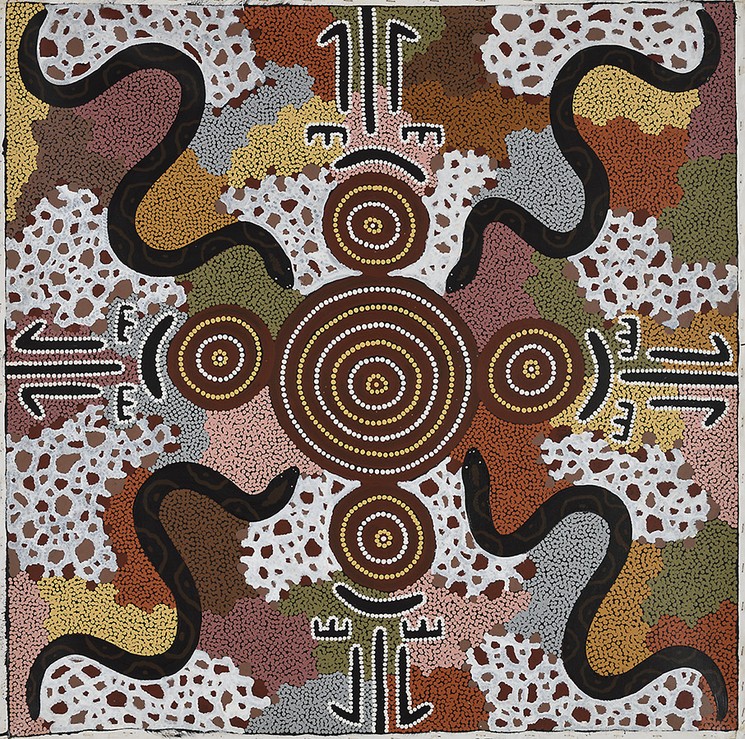

Rêve des Deux Hommes Kangourous, Circa 1990
Painting : acrylic · 100 x 100 x 2.5 cm 39.4 x 39.4 x 1 inch · Ready to hang
€6,200
6 200 €
One of the last works available by this artist
Shipping & delivery
Shipped from: France
Delivery to: Spain , € 125
Estimated delivery: One to two weeks
Free returns within 14 days, full refund
Authenticity guaranteed
Sold with certificate of Authenticity from the gallery
Invoice from the gallery Learn more
Secure payment • Card, Amex, PayPal...
We accept several payment methods:
Paypal
American Express
Visa
Mastercard
Apple Pay
Google Pay
- Credit cards (Visa, MasterCard)
- American Express
- PayPal
- Bank transfer
- Gift card
- Apple Pay / Google Pay
All payments are secured with 3D Secure validation to protect your confidential information.
Verified Reviews : 9.6/10
Similar works




About the artwork
Type
Painting : Unique artwork
Condition
Artwork sold in perfect condition, not framed, ready to hang
with stretcher frame
Authenticity
Sold with certificate of Authenticity from the gallery
Invoice from the gallery
Signature
Not Signed
Dimensions ( cm • inch )
100 x 100 x 2.5 cm 39.4 x 39.4 x 1 inch Height x Width x Depth
Sold by
Art gallery
Credentials
Vetted seller since 2016
Description
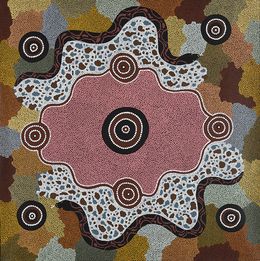
This fascinating artwork embodies the richness of Australian Aboriginal tradition through its intricate patterns and earthy color palette. In the center, concentric circles evoke sacred places or community meeting points, typical of Dreamtime stories. The sinuous, serpent-like lines symbolize paths or rivers, creating a fluid movement through the composition. Around it, dotted patterns, a signature of Aboriginal techniques, add a rich and vibrant texture, connecting each element visually and symbolically. The colors of brown, yellow, ochre, and black, in varying tones, accentuate the natural harmony of the work, symbolically rooting the viewer in the Australian landscape. This painting is not only visually appealing; it invites a meditation on the deep connections between the land, its inhabitants, and its spiritual heritage.

Presentation
Almost forty years ago, Kumantjayi (Michael Nelson) Jagamara (c. 1947-2020) first stepped onto the national stage as inaugural winner of the 1984 National Aboriginal Art Award. At that time, the long-dead Albert Namatjira was the only Aboriginal artist non-Indigenous Australians knew by name.
Papunya 'dot painters' were beginning to gain some recognition in the art world under the collective identity of Papunya Tula Artists, but few outside these circles were even aware of a new Indigenous art movement still largely localised to Papunya. Jagamara was a crucial figure in the revolution that unfolded over the ensuing decades to reposition Indigenous art and artists at the very centre of Australian cultural consciousness.
Jagamara led a second generation of artists following in the footsteps of the founders of contemporary desert art. He rapidly emerged as the Papunya painting movement's most articulate spokesperson, who could engage with journalists' questions, understand design briefs and present an uncompromising Indigenous perspective with eloquence and grace. A stellar artistic career rapidly unfolded.
The same year as his NATSIAA win, and less than a year after he had begun painting for Papunya Tula Artists in his own right, Jagamara was awarded the commission for the design of the Parliament House Forecourt Mosaic. His inclusion in the 1986 Biennale of Sydney made him the first Australian Indigenous artist to break through into contemporary international art circles and achieve individual recognition.
In 1987 an 18-metre painting by Jagamara was installed in the foyer of the Sydney Opera House.
His painting Five Stories featured on the cover of the catalogue of the landmark 1988-9 Dreamings: Art of Aboriginal Australia, the first major exhibition of Indigenous Australian art to tour the United States since the 1950s. Jagamara travelled to New York with Billy Stockman Tjapaltjarri to produce the first Central Australian ground paintings seen outside Australia in association with Dreamings. In 1989 he became one of the first Papunya Tula Artists to have a solo exhibition in a contemporary fine art gallery.
The same year Jagamara joined luminaries like Alexander Calder, Andy Warhol and Robert Rauschenberg in BMW's 'Art Car' project. His meticulously painted Dreaming designs transformed an M3 motor-race machine into the definitive 'Aboriginal Art car'.
As an artist, Jagamara was always willing to try his hand at new things that pushed against the boundaries confining Indigenous art and artists. His style evolved over four decades from the earlier 'each dot gently and carefully' works to the distilled and scaled up action painting style of his later works, often produced in association with the Campfire Group in Brisbane.
But his subject matter was always the Dreaming stories passed down to him by his Warlpiri ancestors and 'embedded in my heart'. One of the key influences on Jagamara's early life was his grandfather (and namesake) Minjana Jakamarra, a man universally respected for his vast ritual knowledge and personal charm. He taught his grandson his stories and designs and also passed on to him the formidable intelligence and energy needed to triumph over the obstacles facing his generation.
Seeing Jagamara operate with effortless command of the English language and Western cultural mores, few realised that his life journey had begun 'footwalking' across his ancestral lands with his extended family. He was a young boy when he saw his first white men and hid in the bushes, terrified by their murderous reputation. No one could have imagined this skinny child with the deep-set penetrating gaze would go on to achieve international acclaim as an artist.
But Jagamara's story, like so many others in Indigenous Australian art, is not a simple step from an idyllic life in the bush to art stardom. In between the road is strewn with experiences of dislocation and dispossession: of land, family and culture.
Central to Jagamara's legacy is the Parliament House mosaic. Now a national icon and featured on the $5 note, the mosaic is a Dreaming set in stone at the most conspicuous and politically charged location in the land. At the 1988 opening ceremony, Jagamara stood beside the Queen and Prime Minister Hawke explaining this gift from his people to all Australians, most especially his fellow Aboriginal Australians.
The following morning, this image was front page news when Ngunnawal activist Kevin Gilbert sensationally claimed that the mosaic secretly placed a curse on white Australia until justice was delivered to Aboriginal people. Overnight a distressed Jagamara became the highest profile Aboriginal artist in the country, appearing on national television to assure the nation that his mosaic 'blesses all'. At the same time, he endorsed Gilbert's view of it as a force for justice: 'My mosaic will draw them back into the past. They will think back and they will ask: What have we done for Aboriginal people?' Five years later the mosaic's power was demonstrated during the 1993 Mabo demonstrations. Jagamara, hammer and chisel in hand, tearfully threatened to remove the central stone of his life's greatest achievement. He did not actually deface the mosaic, but his actions galvanised deadlocked negotiators into compromise and within days the historic Native Title legislation was the law of the land.
His 1984 masterpiece Five Stories, signifying the moment when Indigenous representations of place overtook the European landscape tradition, was one of the most reproduced works of late 20th century Australian art. Its importance was belatedly recognised in 2016 when Sotheby's London sold the painting to an American collector for £401,000, setting a record for an 'Aboriginal work of art' by a living artist.
Few Australian artists have had greater impact on the history, culture and the very psyche of this nation than Kumantjayi (Michael Nelson) Jagamara. Through an incisive combination of art, words and action, he was instrumental in conveying the significance of Indigenous art and culture to a broad audience and pushing for acceptance of Indigenous land rights and self-determination. A master of both cultures, mastered by none, Jagamara's contribution to Australian art and culture was officially recognised when he was awarded the Order of Australia in 1993 and an Honorary Doctorate from the University of NSW in 2008.
Reviews from our customers
All our reviews are extracted from Verified Reviews
You may also like

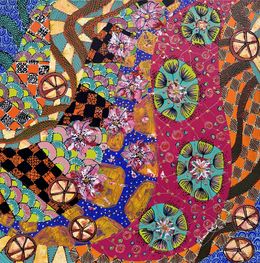
Aleksandra Pakhanian
Painting . 60 x 50 x 1.8 cm Painting . 23.6 x 19.7 x 0.7 inch
€837

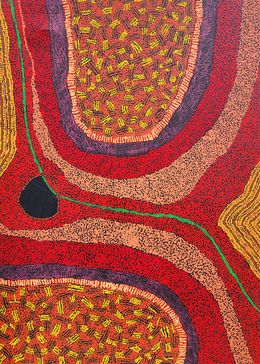
Gracie Ward Napaltjarri
Painting . 131 x 96 x 3 cm Painting . 51.6 x 37.8 x 1.2 inch
€4,250

Atipalku Intjalki
Painting . 120 x 150 cm Painting . 47.2 x 59.1 inch
€3,700
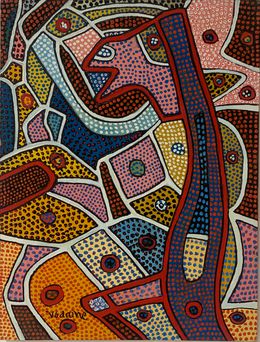
Jean Vodaine
Painting . 81 x 61 x 2 cm Painting . 31.9 x 24 x 0.8 inch
€6,000
Nazareth Collins Jangala
Painting . 40 x 40 cm Painting . 15.7 x 15.7 inch
€500
Recommended by Artsper

Atipalku Intjalki
Painting . 121 x 200 cm Painting . 47.6 x 78.7 inch
€4,600

Jennifer Napaljarri Lewis
Painting . 107 x 76 x 2.5 cm Painting . 42.1 x 29.9 x 1 inch
€1,195

Shanna Williams Napanangka
Painting . 107 x 61 cm Painting . 42.1 x 24 inch
€895

Bessie Nakamarra Sims
Painting . 122 x 122 x 2.5 cm Painting . 48 x 48 x 1 inch
€2,650

Michael Nelson Jagamara
Painting . 100 x 100 x 2.5 cm Painting . 39.4 x 39.4 x 1 inch
€6,200
Gwendolyn Martin Nangala
Painting . 40 x 40 cm Painting . 15.7 x 15.7 inch
€500

Rene Reza
Painting . 100 x 100 x 2 cm Painting . 39.4 x 39.4 x 0.8 inch
€16,087
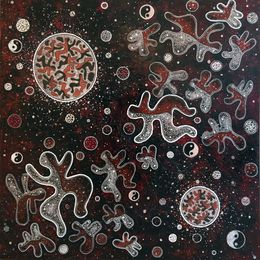

Marlette Ross Napurrurla
Painting . 46 x 46 cm Painting . 18.1 x 18.1 inch
€600
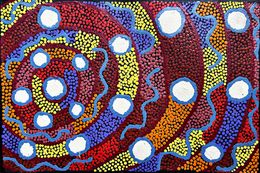
Juliette Nakamarra Morris
Painting . 30 x 46 x 3 cm Painting . 11.8 x 18.1 x 1.2 inch
€340