












L'Imperatrice (The Empress), Mourlot 396, 1964
Print : lithography · 89.5 x 61.6 x 0.3 cm 35.25 x 24.25 x 0.1 inch · Ready to hang
Sold
Authenticity guaranteed
Sold with certificate of Authenticity from the gallery
Invoice from the gallery Learn more
Secure payment • Card, Amex, PayPal...
We accept several payment methods:
Paypal
American Express
Visa
Mastercard
Apple Pay
Google Pay
- Credit cards (Visa, MasterCard)
- American Express
- PayPal
- Bank transfer
- Gift card
- Apple Pay / Google Pay
All payments are secured with 3D Secure validation to protect your confidential information.
Verified Reviews : 9.6/10
Similar works


Jean-Michel Atlan
Fine Art Drawings . 37 x 27 x 0.2 cm Fine Art Drawings . 14.6 x 10.6 x 0.1 inch
€15,000


About the artwork
Type
Print : numbered and limited to 75 copies
Condition
Artwork sold in perfect condition, framed, ready to hang
Authenticity
Sold with certificate of Authenticity from the gallery
Invoice from the gallery
Signature
Hand-signed by artist
Technique & Support
lithography on paper
Dimensions ( cm • inch )
89.5 x 61.6 x 0.3 cm 35.25 x 24.25 x 0.1 inch Height x Width x Depth
Artwork dimensions including frame
109.2 x 80.5 x 2.5 cm 43 x 31.68 x 1 inch
Sold by
Art gallery
Credentials
Vetted seller since 2024 • Top Seller
Description
Lithograph in colors on arches wove paper. Hand signed lower right by Joan Miro. Hand numbered 27/75 lower left. Mourlot 396. Published by Maeght Éditeur, Paris.
Additional images available upon request.
About the Artist: Joan Miró was a seminal figure in 20th-century avant-garde painting. The Spanish artist's innovative use of line, organic shapes, and color represented a major contribution to Surrealism. Representative of his ability to conjure evocative space, Miró's famed triptych Blue I,II,II (1961) portrays a floating world using only blue, orange, and black. “Little by little, I've reached the stage of using only a small number of forms and colors," the artist reflected. “It's not the first time that painting has been done with a very narrow range of colors. The frescoes of the tenth century are painted like this." Born on April 20, 1893 in Barcelona, Spain, the artist first studied commerce before defying his parents and enrolling in the art academy in his hometown. In 1919, Miró moved to Paris where he fell into the Surrealist milieu, befriending André Breton, Max Ernst, Jean Arp, and André Masson. Miró's work profoundly influenced several American painters, including Arshile Gorky and Mark Rothko. The artist died at age 90 on December 25, 1983 in Palma de Mallorca, Spain. Today, his works are held in the collections of the Art Institute of Chicago, The Museum of Modern Art in New York, the Tate Gallery in London, and the Fundació Joan Miró in Barcelona, a museum dedicated to the artist and his legacy.
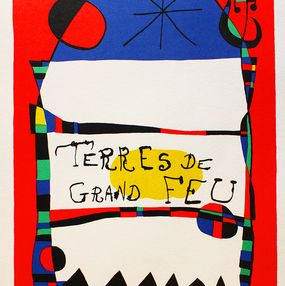
Presentation
Joan Miró (1893–1983) was a revolutionary Catalan painter, sculptor, and ceramicist whose bold, surreal, and symbolic style redefined 20th-century art. Born in Barcelona, he developed a unique artistic language that blended abstract forms, vibrant colors, and dreamlike imagery. His work, spanning painting, sculpture, engraving, and ceramics, continues to inspire contemporary artists and collectors worldwide.
From an early age, Miró was immersed in creativity. His father, a jeweler, and his mother, a cabinetmaker, introduced him to the world of craftsmanship. Initially pushed toward a business career, he studied commerce before abandoning it to pursue his true passion—art. By 1912, he was fully dedicated to painting, training at the Llotja Fine Arts School and later at the Galli Academy in Barcelona. Influenced by Fauvism, Cubism, and Expressionism, Miró's early works reflected these modern movements while maintaining a strong connection to his Catalan roots.
In 1919, Miró moved to Paris, where he became a key figure in the avant-garde scene. He connected with leading Surrealist artists and poets, including André Breton, Paul Éluard, and Tristan Tzara, and developed his distinctive style—rejecting conventional techniques in favor of spontaneity and abstraction. His breakthrough came in 1925 with the "Surrealist Painting" exhibition at Galerie Pierre, where he unveiled Carnaval d'Arlequin, a masterpiece of vibrant, surreal symbolism. That same year, he created The Birth of the World, a landmark work that merged his Catalan heritage with his Parisian influences.
Though deeply associated with Surrealism, Miró sought total artistic freedom. By the late 1920s, as political tensions grew within the movement, he distanced himself to explore new techniques. Throughout the 1930s and beyond, he experimented with collage, monumental sculpture, and ceramics, continuously pushing artistic boundaries. His large-scale murals, such as those created for UNESCO's headquarters in 1958, and his celebrated Blue I, II, III triptych (1961) cemented his status as a modern master.
Today, Joan Miró's legacy endures through his influence on abstract expressionism and contemporary art. His works are housed in major institutions worldwide, including the Fundació Joan Miró in Barcelona, MoMA in New York, and the Tate Modern in London. Collectors and art lovers continue to admire his pioneering vision, making him one of the most celebrated and influential artists of the 20th century.
Discover similar artists


Reviews from our customers
All our reviews are extracted from Verified Reviews
You may also like


Joan Miró
Print . 40.6 x 32.4 x 0.3 cm Print . 16 x 12.75 x 0.1 inch
€5,579

Joan Miró
Print . 56 x 77 cm Print . 22 x 30.3 inch
€7,800


Joan Miró
Fine Art Drawings . 31 x 44 x 0.5 cm Fine Art Drawings . 12.2 x 17.3 x 0.2 inch
€54,000


Joan Miró
Print . 31.1 x 23.2 x 0.1 cm Print . 12.2 x 9.1 x 0 inch
€6,000


Joan Miró
Print . 110.5 x 73 x 1 cm Print . 43.5 x 28.7 x 0.4 inch
€26,501


Joan Miró
Print . 90 x 66 x 0.2 cm Print . 35.4 x 26 x 0.1 inch
€19,000
Recommended by Artsper


Joan Miró
Print . 75.2 x 57.8 x 0.3 cm Print . 29.62 x 22.75 x 0.1 inch
€7,067


Virginie Benoit-Dignac
Painting . 44 x 60 x 0.1 cm Painting . 17.3 x 23.6 x 0 inch
€1,000


Said Ouarzaz
Painting . 120 x 120 x 3 cm Painting . 47.2 x 47.2 x 1.2 inch
€4,370

Said Ouarzaz
Painting . 120 x 120 x 3 cm Painting . 47.2 x 47.2 x 1.2 inch
€4,370