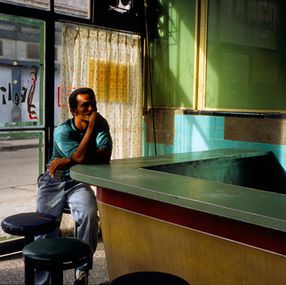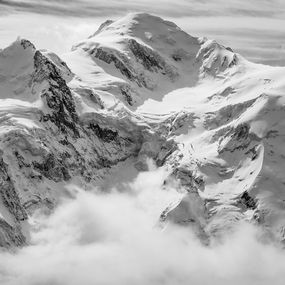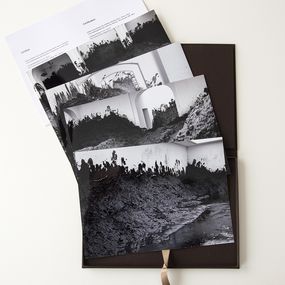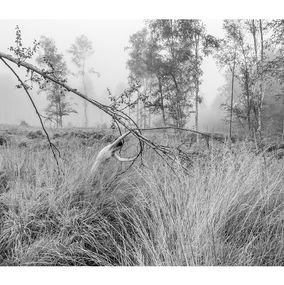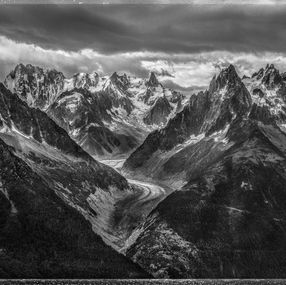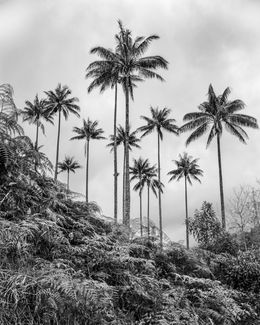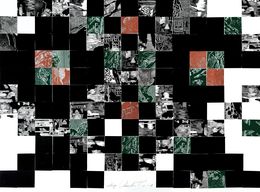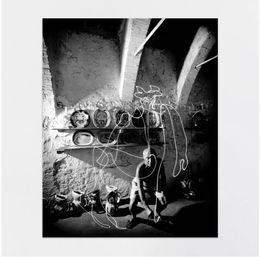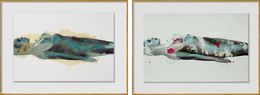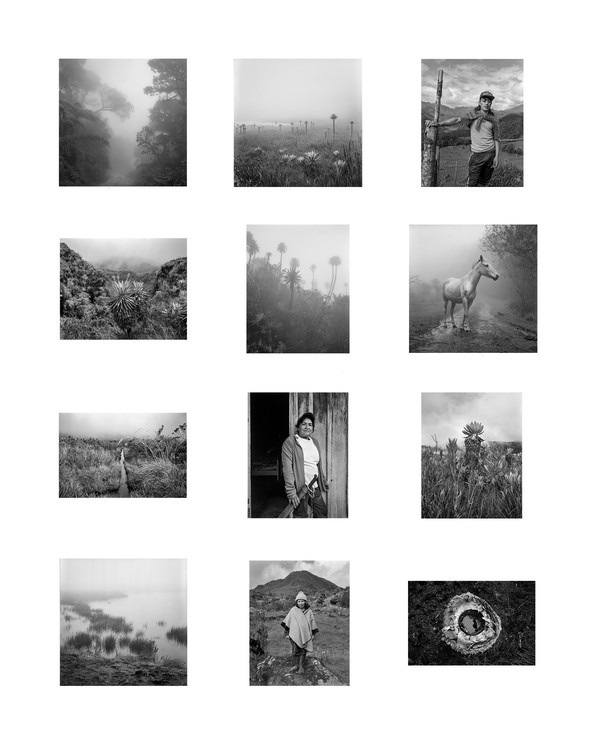
Portfolio, 2021 by Miguel Winograd 12. Selenium- Toned Gelatin Silver Prints (B&W). Sheet Size: 10 in H x 8 in W Acid-free box. Edition 1/3 + 1AP 1. Road to El Palmar, Chingaza 2. Lagunas Buitrago, Chingaza 3. Martín, Macizo colombiano 4. Frailejones, El Verjón 5. Frailejones en la niebla 6. Caballo el Palmar 7. Canal Páramo de la papas 8. Doña María Elena, Macizo colombiano 9. Frailejón, Páramo de las papas 10. Laguna, El Verjón 11. Doña Anatilde Molina, Sumapaz 12. Ojo/Origen Black and white Edition
. Things keep their secrets. - Heraclitus Light, shining in a perpetual mist, is like a dream. Suddenly, a window opens onto the sky and the rays of the sun, pure and intense, outline the details and textures of the landscape with a delirious sharpness. Afterwards, a gray curtain falls again and fogs the shapes in a dense mist. A friend tells me that to him, the foggy landscape of the páramo is the most transparent region. It is a paradoxical landscape in any case. Nineteenth-century travelers, and the colonial chroniclers which baptized it with that somewhat sinister name, tend to describe it as a desolate terrain. In pre-Columbian mythology, on the other hand, it is the origin of life and man. It is not surprising that such a strange landscape has been the source of so many myths and superstitions. In the space of several years of photographing in these tropical Andes, I started to sense, no doubt in a very subjective and personal way, a language in the images I captured. They were signs that whispered of the intricate cycles of time and pointed to a series of unresolved polarities: light/darkness, life/death, aridity/exuberance, lucidity/dreams, creation/destruction, beginning/ending. What began as a pretext to exercise my gaze and capacity to abstract, gradually became a meditation on different, interwoven temporalities. The superposition of very ancient times with dynamic and fleeting cycles: from the geological time of the formation of those mountains, passing through the recurrent periods of flowering and decomposition of the plant life, to the immediate oscillation of a climate that swings between extremes. All the seasons in one day, sometimes in one hour or less. And at the same time, traces of many pasts persisting in a spectral present. Ghosts. Melancholic friars wandering in the mist. Land of deities and demons. The mountains of the god of the night, as some have interpreted the meaning of Chingaza’s name. Photography since its origins has been used to document things destined to disappear: therein its intimate association with death. The impulse to photograph these places and their populations could be included in that documentary tradition. It is probable that I am driven by a consciousness of the fragility of these place which, in spite of their apparent unmovable nature, are objectively threatened. I also sense a complex network of interconnections within and among the ecosystems of the different altitudes: the high Andean forest, the windswept mountain peaks, the cycles of water (the páramo as a sponge for the clouds that carry the water evaporated from the jungle and as the source of the river that irrigate it). And, of course, human activity, inevitably destructive as it is. That is why the pictures play with different scales. On another level, this project could be interpreted in a much more personal and even romantic line: the landscape as a mirror and projection of the emotions. And, on a more symbolic plane, organizing these images was a way for me to think about time (time is also one of the technical variables of these, and all, photographs). Even though sometimes that thinking results in a blind stumbling. I hope that some of this is apparent in these images, though it is not my intention to articulate arguments. As William Eggleston says, pictures are what they are. There’s not much sense in speaking of them.