Bronze Sculpture for Sale

Upload an image to find similar artworks
Abstract painting stands in contrast to representational art, where capturing a subject's likeness is the main objective. Instead, abstraction moves away from figurative representation, prioritizing emotion, color, shape, and composition. Even without a clear subject, abstract art can evoke deep feelings and interpretations, allowing viewers to experience the artwork on a personal level.
The origins of abstract painting are often linked to Vassily Kandinsky, one of the pioneers of 20th-century abstraction. His revolutionary approach, alongside Kazimir Malevich, Piet Mondrian, and František Kupka, redefined modern art. Kandinsky not only painted abstract works but also theorized them in his influential 1910 book, Concerning the Spiritual in Art. He argued that every element in a painting holds symbolic significance, giving each artwork a spiritual dimension. That same year, he unveiled Abstract Watercolor, considered one of the first purely abstract paintings. This marked a turning point where artists moved away from realism and representation, instead focusing on intangible concepts and emotions.
Kazimir Malevich further expanded abstraction with Suprematism, a movement centered on pure geometric shapes and dynamic forces within a composition. His famous paintings Black Square (1915) and White on White (1918) emphasized simplicity, balance, and harmony. Meanwhile, lyrical abstraction flourished, often inspired by music and emotions. Kandinsky's Picture with the Black Arch (1912) embodies this approach, using vibrant colors and dynamic forms to evoke musical compositions. His synesthesia—a condition that allowed him to "hear" colors and "see" sounds—played a key role in shaping his unique artistic language.
Geometric abstraction emerged as a distinct branch, focusing on precise lines, bold shapes, and structured compositions. Artists like Mondrian and Kupka sought purity in art through mathematical precision. Mondrian developed a signature style of grids, right angles, and primary colors, defining geometric abstraction as a pursuit of visual balance and order. Despite his contributions, Kupka resisted the term "abstract," believing art should be tangible and concrete rather than intangible.
Robert and Sonia Delaunay also played a major role in abstraction's development. Their vibrant use of color and circular forms caught the attention of poet and critic Guillaume Apollinaire, who named their style Orphism. This movement blended dynamic color harmonies with abstract compositions, bridging the gap between lyrical and geometric abstraction.
Abstract art didn't emerge in isolation; it evolved from earlier artistic movements. Fauvism explored bold, expressive color, while Cubism deconstructed shapes into geometric forms. German Expressionism, founded in 1905, emphasized emotion over realism, paving the way for abstraction's focus on inner experience rather than external representation. By breaking from tradition, abstract art enabled modern artists to push creative boundaries, free from the constraints of recognizable reality.
Today, abstract art remains a universal language, continuously influencing contemporary artistic expression. Its evolution has shaped the way artists and audiences engage with modern and contemporary art. Explore abstract masterpieces by influential artists such as Henri Matisse, Jackson Pollock, and Mark Rothko, and discover how abstraction continues to redefine the art world.

Sculpture . 50 x 48 x 11 cm Sculpture . 19.7 x 18.9 x 4.3 inch
$1,000

Painting . 80 x 80 x 2.4 cm Painting . 31.5 x 31.5 x 0.9 inch
$3,231

Painting . 80 x 80 x 2 cm Painting . 31.5 x 31.5 x 0.8 inch
$1,795

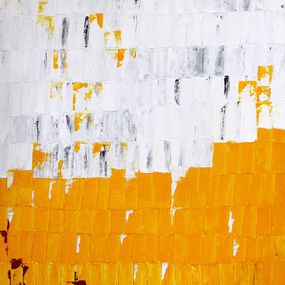
Painting . 121.9 x 91.4 x 5.1 cm Painting . 48 x 36 x 2 inch
$1,100

Sculpture . 162 x 82 x 4 cm Sculpture . 63.8 x 32.3 x 1.6 inch
$3,350

Sculpture . 12.5 x 12.5 x 12.5 cm Sculpture . 4.9 x 4.9 x 4.9 inch
$5,500

Painting . 40 x 40 x 2 cm Painting . 15.7 x 15.7 x 0.8 inch
$1,346


Painting . 122 x 152 x 4 cm Painting . 48 x 59.8 x 1.6 inch
$2,720
Choose your preferences
The best
of art, online
SIGN IN - REGISTER
Forgot your password?
No worries, enter you email address and we'll send you a link to reset your password.
ReturnUpload an image and discover similar artworks available on Artsper